AFRL brings Stream Engine deepfake analyzer to test-ready status
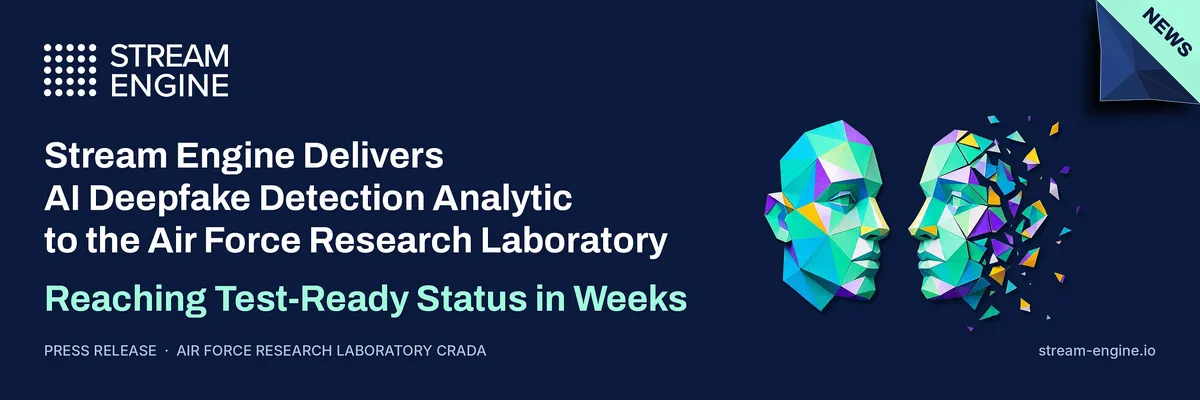
Stream Engine has delivered its semantic-based deepfake detection analyzer to the US Air Force Research Laboratory. By June 2026, the system had entered the Air Force Research Laboratory's new operational test and evaluation environment, where formal assessment can begin.
- Stream Engine delivered a semantic-based deepfake detection analyzer to AFRL.
- The system was ready for formal testing in June 2026.
- The analyzer examines grammatical, syntactic and semantic signals.
- The agreement lasted 12 months and involved no transfer of federal funds.
- AFRL recommended continuing the collaboration.
A test-ready system from a one-year collaboration
The development took place under a Cooperative Research and Development Agreement, or CRADA, between the Air Force Research Laboratory Information Directorate and Stream Engine. The agreement was signed on June 6, 2025, for a 12-month term. Its primary technical objective was to integrate and evaluate semantic-based deepfake detection technologies.
The joint work plan was revised at the start of the project. Stream Engine was tasked with building a deepfake detection analyzer from the ground up, while AFRL used the integration to conduct load testing on its newly created test and evaluation environment.
According to AFRL's annual CRADA report, the analyzer was integrated into the new test environment, which became fully operational. The system was ready for formal testing in June 2026, and AFRL recommended continuing the collaboration.
Calculating probabilities from linguistic signals
Stream Engine built the two-stage detection process on its experience with large language models, or LLMs, in text analysis. First, a model that extracts semantic features examines the text. It focuses on two areas: grammatical and syntactic irregularities, and semantic contradictions within the text.
A neural network classifier then combines these features and calculates probability scores. The aim is to distinguish between text generated by a machine and simply poorly written human text. According to the announcement, surface-level fluency alone does not provide a reliable basis for making this distinction.
The analyzer was packaged in a container based on a Docker template developed by AFRL, enabling secure deployment in the test environment. AFRL provided synthetic and manipulated datasets for training, along with a custom software environment for integration and testing.
Formal evaluation comes next
According to the announcement, the project reached test-ready status despite several obstacles. The team had to contend with a facility power outage, a six-week federal government shutdown and the access authorizations required for the test environment. AFRL's report said configuration of the T&E environment was successfully completed in June 2026, leaving the test environment ready for this and future programs.
AFRL's report identifies an “enhanced technology or software” as the technological benefit delivered to the Air Force. No federal funds changed hands under the agreement. The parties estimated Stream Engine's contribution over the 12-month period at more than $1 million, including personnel effort, intellectual property, inventory and equipment.
“We were asked to direct our language intelligence at one of the most difficult problems in national security: determining whether content was written by a human or produced by a machine,” said Brian Kim, Stream Engine's co-founder and chief executive. The next phase will be formal testing and evaluation of the system.
According to AFRL's announcement, reference to the laboratory does not constitute an endorsement of Stream Engine or its products. The views expressed in the report are those of Stream Engine and do not necessarily represent the official position of the US Air Force, the Department of Defense or the US government.