AI Agents Now Help Steer Telescopes in the Search for Alien Signals
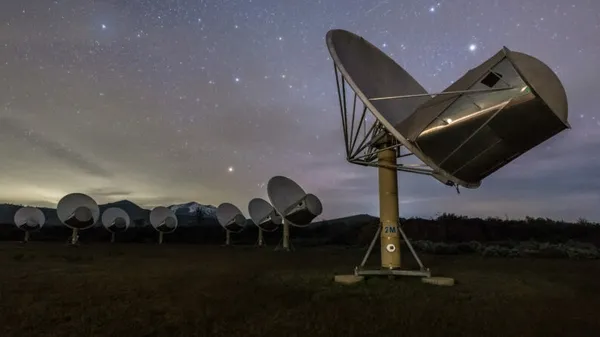
Breakthrough Listen and the SETI Institute are bringing agentic AI into the daily search for extraterrestrial intelligence at the Allen Telescope Array in Northern California. According to NVIDIA, agents can steer the telescope, correct incoming data and apply AI models to the live stream from a single natural language request.
- Breakthrough Listen and the SETI Institute use agentic AI at the Allen Telescope Array in Northern California.
- Agents can steer the telescope, correct data and apply AI models from one natural language request.
- According to NVIDIA, the system handles 2.4 terabits per second on NVIDIA RTX PRO 6000 Blackwell GPUs, with on-premises inference.
- The pipeline achieved the first real-time AI detection of a pulsar in the Crab Nebula.
- The team is evaluating open models including NVIDIA Nemotron for future use.
Agents take control of the observatory
At the Allen Telescope Array, agents can now steer the instrument, enhance and correct incoming data, and apply AI models to the incoming stream. Researchers trigger all of this with one request in natural language, NVIDIA says. The NVIDIA Holoscan platform processes the massive streams of sensor data and gives the agents live data to act on.
The company describes the outcome as a faster and more adaptable search for potential signals from extraterrestrial life and technologies. In practice, an agent can steer a telescope's antennae, calibrate and focus the instrument for a clean signal, catch and fix data errors and plot the result. According to NVIDIA, agents compress what would take humans weeks or years into hours.
Andrew Siemion, Bernard M. Oliver chair for SETI at the SETI Institute and principal investigator of Breakthrough Listen, put the shift in broader terms. "As our new agentic observatories reach out into the universe, what they find may have much more in common with themselves than with the humans who created them," he said. He added: "But this isn't something to fear. Rather, it's a breakthrough in translation."
Terabits a second, processed in flight
Radio telescopes produce enormous volumes of data, and scientists need to spot interesting signals while observations are still under way. NVIDIA describes a stack of tools built for that problem:
- DAQIRI, a Holoscan platform library, lets the telescope pull terabits per second of sensor data straight into GPU memory. Observations are processed in flight rather than filling hard drives.
- CyberEther, a signal-processing framework developed at the SETI Institute, does the math using NVIDIA CUDA-X libraries including cuFFT and cuBLAS.
- Nexus, a web-based observatory orchestrator, acts as the agent harness. It gives agents a single source of truth for instrument state, compute resources and pipelines.
Through Nexus, researchers can monitor packet loss, read live spectrograms and rewrite signal-processing blocks, all by prompting in natural language. The system can handle 2.4 terabits per second on NVIDIA RTX PRO 6000 Blackwell GPUs, with inference running on premises, next to the instrument.
A first detection and plans for open models
NVIDIA says the pipeline has already proven itself. It achieved the first real-time AI detection of a pulsar in the Crab Nebula. A pulsar is a rapidly spinning stellar remnant that pulses like a cosmic lighthouse.
The team is now evaluating open models, including NVIDIA Nemotron. These are aimed at cases where data locality and turnaround matter most, and at observatories that may someday run offline on the far side of the moon.
The framing behind the project is that some scientists have suggested extraterrestrial civilizations, if they exist, could be billions of years older than humanity and might have developed forms of AI. NVIDIA's article therefore notes that the search increasingly focuses on AI agents built by humans listening for AI agents built by aliens.
What it means for the search
For researchers, the main change is speed and flexibility. Processing data in flight, next to the instrument, means signals can be examined as observations unfold instead of after the fact. Natural language control also lowers the effort needed to reconfigure pipelines or inspect live data.
The Crab Nebula pulsar detection is the concrete result reported so far. The move toward open models such as Nemotron points to where the team wants to go next, including remote or offline observatories.