Claims Panel: AI Can Clear the Noise, but Not Replace Adjusters
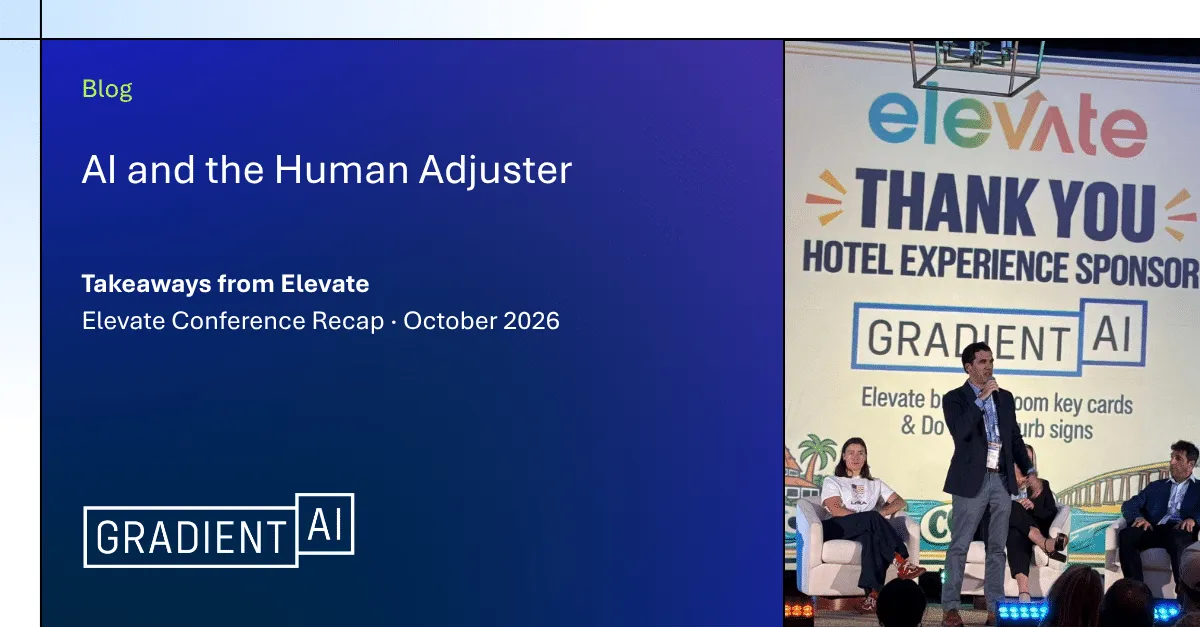
A panel at this year's Elevate workers' compensation conference concluded that AI is useful for administrative and analytical work in claims, but cannot supply the judgment and empathy of a human adjuster. Gradient AI, whose executive sat on the panel, published a recap of the discussion on October 13, 2026.
- An Elevate 2026 panel said AI suits administrative and analytical claims work but cannot replace adjuster judgment and empathy.
- Panelists said the claims desk has not changed in twenty years despite rising medical severity, mental health claims and litigation.
- Gradient AI's Brook Rosenbaum called for synthesized recommendations instead of more risk scores on adjuster dashboards.
- Chris Schaffer urged cross-training adjusters across claim types to counter narrow specialization.
- Advice for leaders: involve adjusters in technology planning, start small and begin with real pain points.
A claims desk that has not kept pace
The panel featured Dave Chmiel of HUB International, Gia Sawko of Signal Mutual, Chris Schaffer of Charles Taylor, and Brook Rosenbaum, General Manager, P&C at Gradient AI. Yvonne Guibert moderated. According to Gradient AI's recap, the panelists agreed that the claims desk has not kept up with the claim itself.
The recap lists several pressures: medical severity is rising, mental health claims are more frequent and harder to resolve, litigation is up, and the industry is losing experienced adjusters faster than it can replace them. Meanwhile, caseloads, mentorship structures and workload expectations have barely moved in twenty years, the panel said.
Rosenbaum said adjusters now carry more than before. "Carriers have added more tools to measure performance, and they're focused on speed and efficiency, which is great but what's missing is the human connection," he said. Schaffer argued that tasks such as compliance, Medicare reporting and internal checklists have crowded out the real goal of workers' comp, "which is getting injured people back to health and back to work."
Where AI helps and where it stops
Every panelist drew a similar line: AI is strong on the administrative and analytical layer, and weak on the parts of the job that require empathy.
- Chmiel pointed to analytics that let brokers benchmark a client's claims performance against peers from five or ten years ago in seconds.
- Schaffer said AI is already improving how adjusters write reports and sort mail, freeing them to focus on the claim itself.
- Sawko gave a cautionary example: an algorithm fed only comorbidities would have recommended spinal surgery for a patient, who declined it in favor of rehab and medication. The data was not wrong, she said, but a human was needed to interpret what it meant for the patient's situation and life choices.
Rosenbaum described two competing narratives about AI: one selling it as the solution to everything, the other warning it is coming for everyone's job. "The truth is hopefully somewhere in the middle," he said. He said he fears people treat technology as a "panacea", and that problems will persist if the underlying pain points at the adjuster level are not addressed.
On dashboards, Rosenbaum said he would prefer meaningful, synthesized recommendations over "another risk score with no context attached." Adjusters, he suggested, need to know the typical options for an injured worker, not another score. Schaffer summed up the limit: "You're just not gonna get compassion from a chatbot."
Redesigning the desk: less specialization
Asked what they would change first, the panel focused on specialization. Schaffer said decades of narrowing adjusters into silos such as medical-only, lost-time, subrogation and SIU has made the job less satisfying and the talent pipeline harder to fill. He proposed cross-training adjusters across claim types.
Sawko said most good adjusters are not promoted. Their reward for being good, she said, is more claims, because carriers are reluctant to lose strong people from the desk. She said she personally promotes her best people but that this is not the norm. Chmiel added that lower caseloads and more in-person client contact build trust.
Rosenbaum tied caseloads to recruiting, saying the industry should identify mundane tasks "crying out for automation" and shrink them so adjusters can spend more time on each case. Schaffer said what blocks such changes is "dogma and conventional wisdom."
Advice for adjusters and leaders
The panel's closing advice split by audience. Adjusters should seek exposure to more claim types and ask for a seat at the table when new technology is deployed. Leaders should reduce administrative burden, use technology to support compliance and decision-making rather than to mandate communication with injured workers, and avoid letting adjusters burn out clearing the noise.
Rosenbaum advised enlisting adjusters' perspectives when planning technology rollouts, beginning with their actual pain points and starting small instead of overhauling the whole organization at once. Schaffer closed with: "The human element is heart and pulse to being a good adjuster."
Elevate is an annual workers' compensation and leadership conference. This year it was held September 21 to 23 at the Hotel del Coronado in San Diego.
Gradient AI: AI and the Human Adjuster