AI Litigation Shifts From Training Data to How Systems Behave, J.S. Held Says
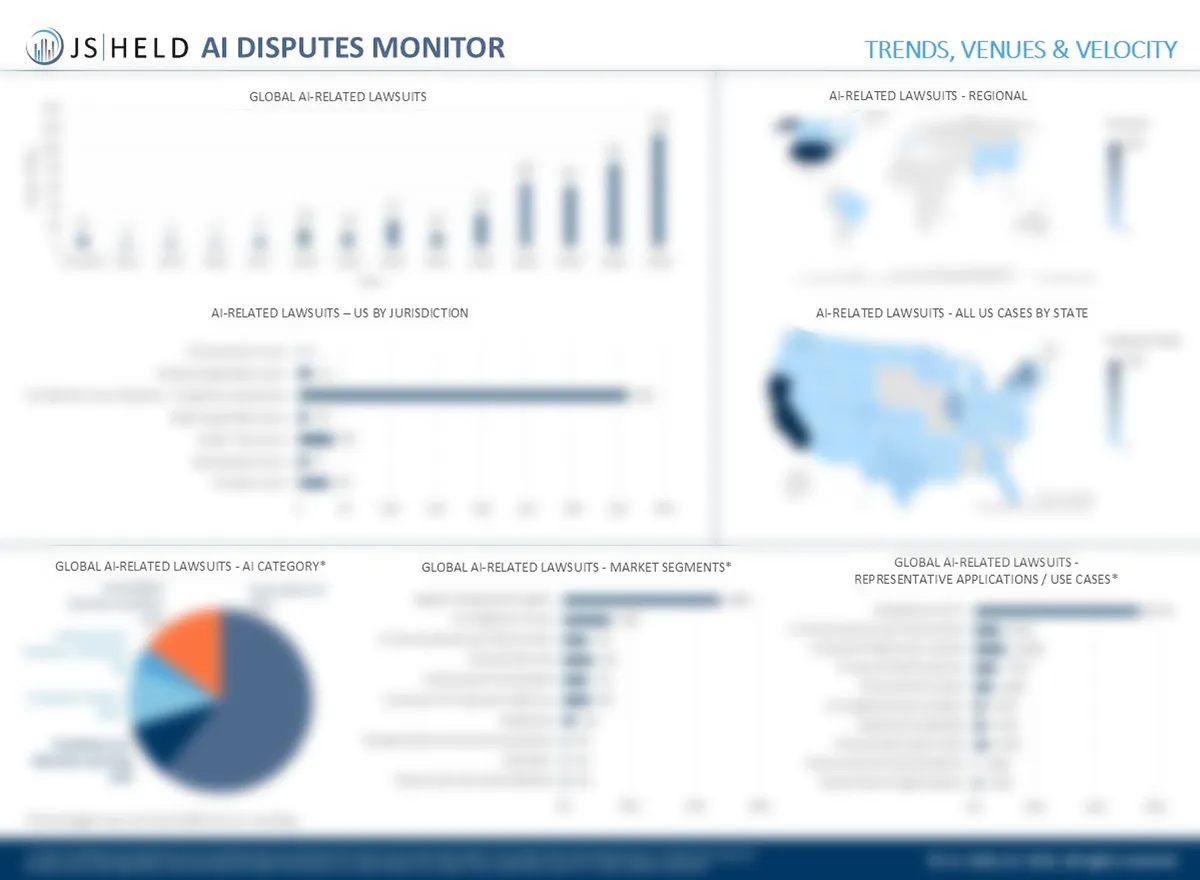
AI lawsuits are increasingly about what systems do after deployment, not only how they were trained, according to the Q3 2026 update of the J.S. Held AI Disputes Monitor. The consulting firm added 42 matters in the quarter, bringing the tracked dataset to 468 cases.
- J.S. Held added 42 matters in Q3 2026, bringing its AI Disputes Monitor to 468 cases.
- 115 of the tracked actions were filed in 2026 through September 30.
- Copyright and training-data disputes remain central, but new cases focus on outputs, safeguards, automated decisions, disclosures and board oversight.
- The firm describes two disclosure risks: overstating AI capabilities ("AI washing") and understating AI's effect on the existing business.
- Evidence in such disputes may include model versions, prompts, system logs, testing records and proof of human oversight.
What the Q3 update shows
J.S. Held, a global consulting firm, released the Q3 2026 update to its AI Disputes Monitor on Oct. 14. The Office of the Chief Intellectual Property Officer reports that the dataset now includes 468 cases, of which 115 are actions filed in 2026 through September 30.
According to the firm, copyright and training-data disputes remain central, and legal and intellectual property disputes are still the largest individual market segment in the update. The new matters, however, reflect a broader landscape. Courts are increasingly being asked to examine AI outputs, product safeguards, automated decisions, corporate disclosures and board oversight.
J.S. Held says the Q3 data reinforce a shift already visible in the first half of 2026. Early AI litigation focused heavily on the materials used to train models and whether developers were authorized to obtain, copy or use protected content. The new cases increasingly concern what happens after an AI system enters the market or is built into business, consumer and government decision-making.
Exposure spreads across the AI value chain
The firm says litigation exposure now reaches model developers, technology platforms, companies deploying AI in their operations, public institutions, corporate officers and directors, and users alleged to have circumvented safety controls.
"The litigation is expanding from the inputs used to build AI systems to the consequences of putting those systems into operation," said James E. Malackowski, Chief Intellectual Property Officer at J.S. Held and Co-founder of Ocean Tomo, a part of J.S. Held.
This changes the evidence involved. According to J.S. Held, a dispute may require examination of:
- model versions, prompts and outputs
- system logs and integration records
- testing evidence and data provenance
- human-review procedures and governance documentation
- market impact and economic loss
The firm argues that technical causation and economic harm often rest on the same factual record, which makes coordination among technical, financial and governance experts more important.
J. Scott Womack, Senior Director in the Office of the Chief Intellectual Property Officer and head of the AI Disputes Monitor data analysis team, said a recurring question across product safety, privacy, automated decisions, securities and governance is whether an organization can reconstruct how the system operated and show that appropriate controls were functioning. In his words, "Policies alone will not answer that question."
Two forms of AI disclosure risk
The Q3 additions also point to two distinct kinds of disclosure risk, according to J.S. Held. The first involves statements about whether promoted AI capabilities, integrations, partnerships or commercial benefits were substantiated. These allegations are commonly associated with "AI washing," where claims about AI sophistication or value allegedly exceed the supporting evidence.
The second concerns whether a company adequately disclosed how AI was disrupting its existing products, pricing models, customer behavior or growth prospects. In these matters, the firm says, the allegation is not necessarily that the company's AI capabilities were fictitious. Plaintiffs instead contend that the organization underrepresented AI's competitive effect on its established business.
J.S. Held notes that the distinction matters for directors, officers, investors, insurers and counsel, since AI disclosure risk may arise both from overstating what AI can do and from understating what it may do to the business.
What it means for organizations
As cases broaden, J.S. Held says the expert inquiry increasingly starts with reconstruction. Key questions include which version of the system was operating, what inputs, prompts, external sources and integrations shaped the result, what testing, guardrails and monitoring were in place, and what the company knew or represented about the system.
The Monitor tracks AI-related disputes across technology categories, market segments, jurisdictions and use cases, drawing on public sources and expert analysis. The firm says it is designed to help law firms, corporate legal departments, insurers and risk professionals identify emerging litigation patterns and assess developing areas of exposure. The report is available for download through Ocean Tomo.
The takeaway from the firm's findings is that organizations deploying AI may need records, such as testing evidence, system logs, escalation procedures and proof of human oversight, that show how a system behaved. J.S. Held notes it is not a law firm and does not provide legal advice.