Alibaba releases Qwen4-Max with a one-million-token context window
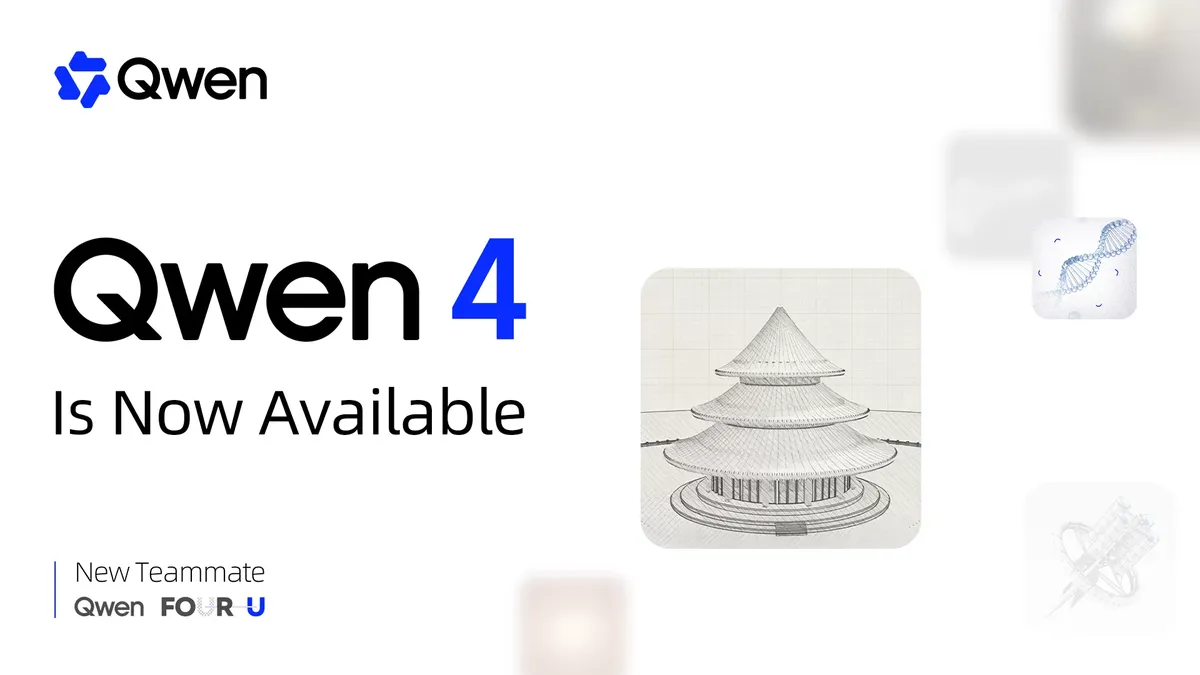
Alibaba has released Qwen4-Max, describing it as the most capable model in the Qwen family to date. The model combines 2.4 trillion total parameters, native vision capabilities and a one-million-token context window for work, creative production and research tasks.
- Qwen4-Max has 2.4 trillion total parameters and a one-million-token context window.
- It is available now on QwenCloud, QwenWork and QwenStudio.
- Alibaba says it reduced average Work360 task costs by around 60%.
- The model completed a continuous 48-hour scientific agent run.
- Smaller open-weight Qwen4 models will soon be released worldwide.
A larger model with lower activation costs
Alibaba says Qwen4-Max achieves strong results in coding, agentic tasks and visual reasoning. It ranked 6th on Code Arena, a real-world coding leaderboard, and posted scores across Agents' Last Exam, Vals Index, JobBench and Chartography.
On Alibaba's Work360 benchmark, which evaluates challenging industry tasks across 721 specialized fields, Qwen4-Max outperformed Qwen3.8-Max overall. Alibaba says it used 35% fewer tokens in High effort reasoning mode and reduced the average cost per task by around 60%.
The model uses a sparse Mixture-of-Experts architecture with 2.4 trillion total parameters, while activating 71 billion parameters per token. According to Alibaba, that is 25% fewer activated parameters than Qwen3.8-Max at the same 2.4T scale. The company attributes the gains to upgrades across attention, residual connections and embeddings.
Available through Alibaba's AI platforms
Qwen4-Max is available now on QwenCloud through the Token Plan and API. Users can also access it through Alibaba platforms including QwenWork and QwenStudio. Input with an Implicit Cache Hit is priced at $0.075 per 1M tokens.
Alibaba says the model is designed for professional workflows and creative production, including 3D modeling, game development and agentic video creation. Its Cloud Resource Scheduling capabilities operate in a closed loop, autonomously optimizing scheduling workflows. In benchmark testing, Alibaba says this reduced data-annotation model call costs by an average of 9% and increased offline CPU rescheduling speeds by more than 14 times.
In an automotive manufacturing showcase, Qwen4-Max reduced manual workpiece programming time from roughly 475 minutes to 24 minutes. Alibaba says the model used feedback-driven iteration to identify overcuts and insufficient material removal before machining began.
Long-running agents and safety controls
Alibaba is also positioning Qwen4-Max for sustained scientific work. The company says Qwen4 completed a continuous 48-hour agent run through four iterations combining molecular design, synthesis and testing, and active learning, resulting in an experimentally validated coolant molecule for chip cooling research.
In an Alzheimer’s research experiment, Qwen4-Max autonomously executed 454 tool calls and 3,239 metric evaluations to design and optimize 24 candidate molecules across target research, molecular design and computational evaluation.
Alibaba says governance is embedded across the model's lifecycle. Software engineering training included code security checks, while cybersecurity training data retained defensive material and removed offensive attack content. The company also used dedicated safety datasets and post-training enhancements to strengthen protections against chemical, biological, radiological and nuclear risks.
Open-weight, smaller-scale models from the Qwen4 series will soon be released to developers worldwide, according to Alibaba.
Alibaba Cloud: Alibaba Unveils Qwen4-Max: New AI Teammate for Work, Creativity, and Discovery