Amazon’s Mitra-v2 scales synthetic training for tabular data
Amazon has introduced Mitra-v2, a tabular foundation model designed to predict missing values in unfamiliar tables for classification and regression tasks. The company says the model leads the single-model field on the TabArena benchmark after expanding the scale and diversity of its synthetic pretraining data.
- Mitra-v2 supports classification and regression on previously unseen tables.
- It uses synthetic pretraining tables with 10 times as many rows and roughly three times as many columns as Mitra-v1.
- Amazon says it leads the single-model field on TabArena’s 51 datasets.
- Fine-tuned Mitra-v2 ranks first on the ScoringBench regression leaderboard.
- The models and code are available under the Apache-2.0 license on Hugging Face.
A foundation model for business tables
Business data often lives in tables whose rows represent customers, transactions or interactions, while columns contain their attributes. Common tasks include predicting customer retention or estimating future demand. Traditional tools such as gradient-boosted decision trees typically require a model and processing pipeline tailored to each table.
Mitra-v2 is intended to reduce that work. It reads labeled rows from a previously unseen table and predicts the unlabeled rows through in-context learning. Amazon says the model supports both classification and regression, and is being adopted by Amazon Connect Customer for prediction on structured business and customer-experience data.
Amazon says Mitra-v2 is pretrained entirely on synthetic tables. The training process uses no real data, including no customer data, and is designed to teach the model general relationships between columns rather than information from a particular dataset.
Larger tables and more varied synthetic data
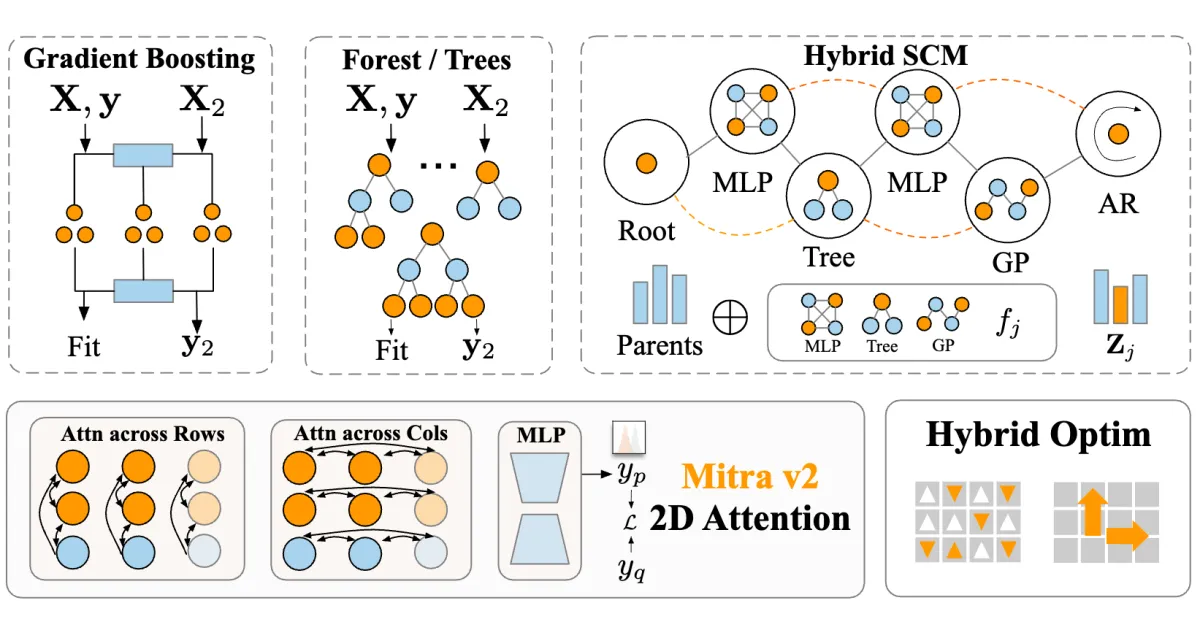
The model retains Mitra-v1’s Transformer architecture, which attends across both the rows and columns of a table. The main change is the scale of its training examples. Mitra-v2 was pretrained on tables with 10 times as many rows and roughly three times as many columns as those used for Mitra-v1.
Amazon also added a hybrid structural causal model. Within one synthetic causal graph, relationships between columns can be represented by a small neural network, a decision tree, a smooth function drawn from a Gaussian process, or a time-dependent autoregressive process. A hybrid optimizer was added to keep training stable across these mechanisms.
Two lightweight wrappers help the model handle tasks beyond its pretraining limits. Singular-value decomposition is used for very wide tables, while a hierarchical tree refines predictions for classification problems with more than 10 classes. By default, the model is briefly fine-tuned on each new table and averages predictions from eight copies, a process Amazon calls bagging. The company says this adds computational overhead but can improve accuracy and give customers more options.
Benchmark results and availability
On TabArena, a public benchmark containing 51 real-world datasets, Amazon says Mitra-v2 leads the single-model field. It produced a better result than Mitra-v1 on 32 of the 33 datasets where both models ran natively, and completed all 51 datasets within the benchmark’s one-hour budget. Amazon says Mitra-v1 failed to complete more than a third of them.
On the independent TALENT benchmark of roughly 300 datasets, Mitra-v2 ranks among the leading methods and is strongest on classification tasks with more than 10 classes. For regression, the model predicts a range of likely values as well as a point estimate. Fine-tuned Mitra-v2 ranks first on ScoringBench, which evaluates the accuracy and calibration of prediction intervals.
Amazon has released fine-tuned classification and regression versions, along with inference and fine-tuning code, under the Apache-2.0 license on Hugging Face. The release gives researchers and practitioners access to the model for testing on their own tables, while Amazon’s results support its claim that broader synthetic pretraining can improve tabular foundation models without making the network deeper.
Amazon Science: Mitra-v2: Scaling synthetic pretraining for tabular foundation models