Amazon's Trainium chip powers the AI behind Prime 360 NBA highlights

Amazon says its custom Trainium AI chip helps run the diffusion models behind Prime 360, a technology that creates cinematic highlights from real game footage during select NBA on Prime broadcasts. According to Amazon, the chip makes the process fast enough for live television.
- Amazon's custom Trainium chip helps power the AI behind Prime 360 highlights in select NBA on Prime broadcasts.
- Prime 360 uses diffusion models, which Amazon calls exceptionally compute-intensive, to build highlights frame by frame from court-side camera footage.
- Each frame is split into dozens of overlapping tiles, which suits Trainium's “tile in, tile out” design.
- Amazon says the result is diffusion-model inference that reduces latency by more than 40%.
What Prime 360 does
Prime 360 is a proprietary, AI-powered technology built through a collaboration between Prime Video producers, engineers, and AI scientists, according to Amazon. During select NBA on Prime broadcasts this season, it will deliver cinematic highlights of actual game footage, presenting on-court action to fans at home in a new way.
The system uses an array of high-resolution cameras positioned around the court. That footage is then processed through AI models that construct the immersive highlights frame by frame. Amazon says the hard part is not capturing the footage, but delivering broadcast-quality highlights quickly enough to be used within live game coverage.
Why the computing demand is so high
The visual quality of Prime 360 comes from a diffusion model, the same foundational technology behind popular image-generation tools. Such a model iteratively refines its output, turning noise into a polished frame. Amazon describes diffusion models as powerful but exceptionally compute-intensive.
Every frame must pass through the model before it is ready for air. According to Amazon, each iteration involves billions of mathematical operations, including matrix multiplications, attention computations, and iterative denoising steps. All of them must finish fast enough to keep pace with a live broadcast, which makes the diffusion process a critical step in the Prime 360 pipeline. Amazon says solving this requires both software optimization and innovation at the chip level.
How Trainium fits in
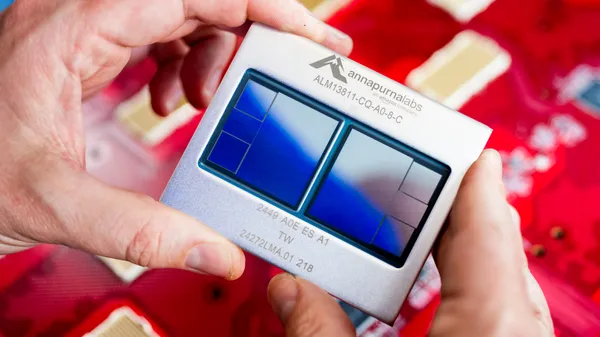
Trainium is Amazon's custom-designed AI chip, built for workloads that process large blocks of data at high speed. Amazon says it was designed for this kind of workload, even though such an application was only a moonshot idea a few years ago.
Amazon's Trainium engineers describe its architecture as a “tile in, tile out” design, optimized for workflows whose inputs and outputs are large tensors. Prime 360's diffusion model divides each frame into dozens of overlapping tiles, and each tile passes through the model independently. The inputs and outputs at every step are large tensors, which Amazon describes as massive grids of numbers that AI models use to represent images, motion, and depth.
According to Amazon, the result is diffusion-model inference that reduces latency by more than 40%. That makes it fast enough to generate the highlights for in-game use and lets producers enhance storytelling and the viewing experience.
What it means for Amazon's chip strategy
Amazon says it has been building custom chips for years, but most of that work has powered cloud infrastructure behind the scenes, making computing faster and more efficient for businesses and developers who build on AWS. Prime 360 puts that investment in front of viewers, since the company says millions of fans will see the results on screen.
For Amazon, the example shows a direct line from chip design to what appears on a TV. The company presents it as one illustration of what its growing custom chip portfolio makes possible. The source does not give details on pricing, wider availability of Prime 360, or which games will carry the highlights beyond the description of select NBA on Prime broadcasts.