Apple's New MacBook Pro Adds Tandem OLED PROLED XDR Display and Touch
Apple has introduced a new MacBook Pro with a tandem OLED display called PROLED XDR and, for the first time on a Mac, Touch. The 14- and 16-inch models are powered by M5 Pro and M5 Max chips and, according to Apple, offer up to 24 hours of battery life.
- Apple introduced 14- and 16-inch MacBook Pro models with the PROLED XDR tandem OLED display.
- According to Apple, the display offers up to 2000 nits peak HDR and SDR brightness and a 10,000,000:1 contrast ratio.
- Touch comes to the Mac for the first time, with the sensor built into the display panel.
- The laptop runs on M5 Pro and M5 Max, with up to 128GB of unified memory, up to 16TB of storage and up to 24 hours of battery life.
- Pre-orders opened October 28, with availability from Friday, November 6.
PROLED XDR: the display at the center of the update
Apple says the new PROLED XDR display builds on tandem OLED technology with changes in every layer of the panel, advanced algorithms in the display engine and a factory calibration process. The panel uses two self-illuminating pixel layers, which Apple says deliver deep blacks and bright highlights without blooming or halos.
According to Apple, the display reaches up to 2000 nits peak HDR and SDR brightness and a 10,000,000:1 contrast ratio. It supports a 120Hz variable refresh rate through ProMotion, with adaptive rates from as low as 10Hz for better power efficiency. Apple describes it as "the world's best laptop display", a claim the company makes in its own release.
The display engine controls the color and luminance of every pixel at the sub-millisecond level, Apple says, compensating for content, pixel use, temperature and environment. It also monitors and adapts each pixel's usage over time to preserve image quality.
For color-critical work, the display covers both P3 and, new to this model, Adobe RGB, which Apple calls critical for photography and design. Apple also cites more than 80 percent Rec. 2020 coverage for HDR video editing and color grading. Both color spaces are available within a single default preset. A state-of-the-art antireflective coating is standard, and a nano-texture option is now etched into the cover glass to cut reflections and glare further.
Touch comes to the Mac
The new MacBook Pro is the first Mac with Touch. Apple says the touch sensor is built directly into the display panel rather than layered on top of it, which reduces latency so users feel as if they are touching the content itself.
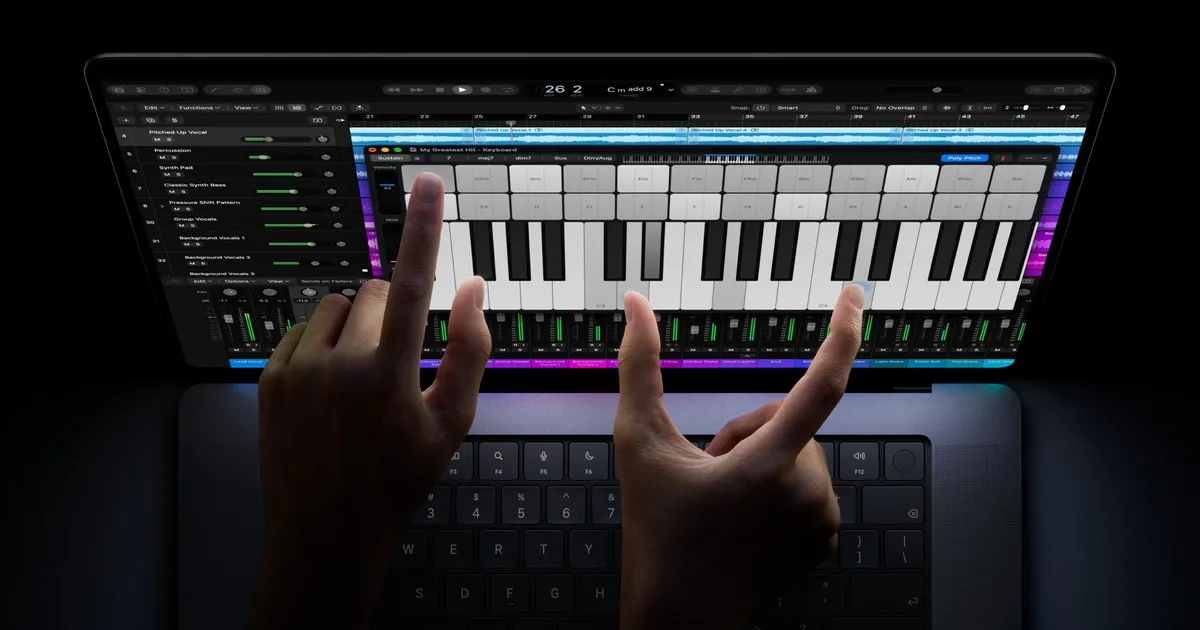
Everyday gestures include swiping to scroll a webpage, pinching to zoom on a photo, dragging and dropping slides between presentations, double-tapping a window to fill the screen and flicking to tile it into place. Apple also points to pro uses: graphic designers can use the entire display as a canvas instead of the trackpad area, musicians can play software instruments onscreen, and app developers can test how Touch behaves in their iOS and iPadOS apps directly on the MacBook Pro.
The Dynamic Island also arrives on the Mac. Apple says it serves as the home for Spotlight, Live Activities and Siri AI.
Chips, memory, battery and design
The laptop uses M5 Pro and M5 Max, which Apple calls its most powerful chips ever built for a pro laptop. Configurations go up to 128GB of unified memory and up to 16TB of storage. Apple says the design is thinner and much lighter, at 3 and 4 pounds, while battery life reaches up to 24 hours.
Other changes include an enhanced six-speaker sound system that Apple says provides 50 percent deeper bass, Thunderbolt 5, a 12MP Center Stage camera and studio-quality mics. The machine runs macOS 27 with Apple Intelligence and Siri AI.
"The new MacBook Pro with PROLED XDR Display is a monumental step forward for the Mac," said Johny Srouji, Apple's chief hardware officer, in the release.
Availability and what it means for pros
Pre-orders started on October 28, with availability beginning Friday, November 6. The source text does not include pricing.
For photographers, colorists, designers and video editors, Apple is positioning the display as a portable reference screen, with Adobe RGB support and factory calibration aimed at consistent results from panel to panel. For creative and development workflows, Touch adds a new input method to a platform that until now relied on the trackpad, keyboard and mouse.