Biel Crystal Named to Forbes China’s 2025 Intelligent Economy Selection
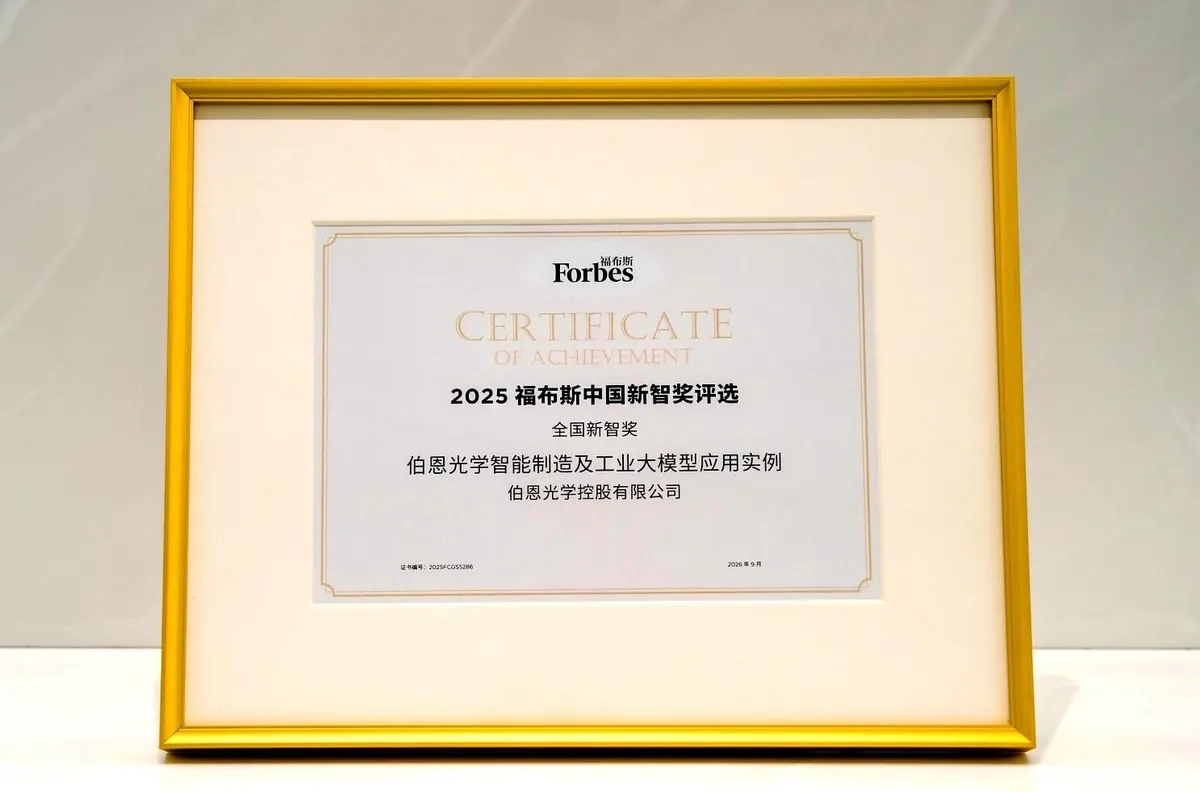
Forbes has named Biel Crystal to its “2025 Forbes China Novel Intelligent Economy Selection,” citing the company’s implementation of smart manufacturing and industrial large models. The company says its industrial AI systems are being used across production, research and development, and quality inspection.
- Forbes named Biel Crystal to its 2025 China Novel Intelligent Economy Selection.
- Biel Crystal operates nine smart manufacturing bases and has more than 100,000 employees.
- The company says its production applications improve overall efficiency by at least 10%.
- Its R&D systems identify and resolve more than 80% of potential problems during development.
- Its automated inspection technology lowers the missed-detection rate to 0.05%, according to the company.
Industrial AI across manufacturing
Biel Crystal is a global provider of exterior structural components and module solutions for smart devices. According to the company, it operates nine smart manufacturing bases worldwide, has more than 100,000 employees and annual capacity of more than 2.5 billion units.
The company says it has fully deployed industrial AI large models using an architecture designed specifically for industrial scenarios. The systems span research and development, product design, manufacturing, finished-product inspection, operations management and maintenance services.
Forbes cited Biel Crystal’s “deep implementation and innovation breakthroughs in smart manufacturing and industrial large models” when naming it to the selection.
Production and product development applications
In production, Biel Crystal says it has integrated machine learning with industrial simulation. This combination is used to automatically optimize coating machine parameters dynamically and provide automatic tool compensation for CNC machine tools. The company says these applications have improved overall efficiency by at least 10%.
In research and development, the company coordinates structural, fluid and thermal, motion, and electromagnetic simulations. Biel Crystal says this approach enables product designs to identify and resolve more than 80% of potential problems during the R&D stage. It also says the approach cuts R&D cycles by 30% to 50% and reduces physical prototypes by more than 60%.
Automated inspection and purpose-built models
Biel Crystal’s quality inspection systems use self-developed automated optical inspection technology. The company says the technology combines multimodal inspection, few-shot learning and millisecond-level real-time feedback.
According to Biel Crystal, the system lowers the missed-detection rate to 0.05% and reduces the workload associated with manual re-inspection by 50%. These figures are company claims presented in the announcement.
Biel Crystal says it did not rely on general-purpose large models. Instead, it adopted an architecture built for industrial scenarios, incorporating requirements for real-time performance, determinism and reliability into the model design. The company describes the resulting systems as “usable, stable and precise” on production lines and says they are helping move manufacturing from “single-point automation” toward “plant-wide intelligence.”
What the selection means for industrial AI
The announcement places Biel Crystal’s recognition in the context of applying AI across several connected manufacturing functions rather than limiting it to one automated task. Its examples cover equipment optimization, digital product development and inspection, with the company linking these applications to efficiency, development time, prototype use and inspection workloads.
For users of industrial AI, the announcement highlights Biel Crystal’s focus on models designed around factory requirements. The company’s claims suggest that its approach is intended to support production-line reliability and broader deployment across its manufacturing operations.
PR Newswire: Biel Crystal Named to 2025 Forbes China Novel Intelligent Economy Selection