Boston Dynamics puts wheels on Atlas to test its limits
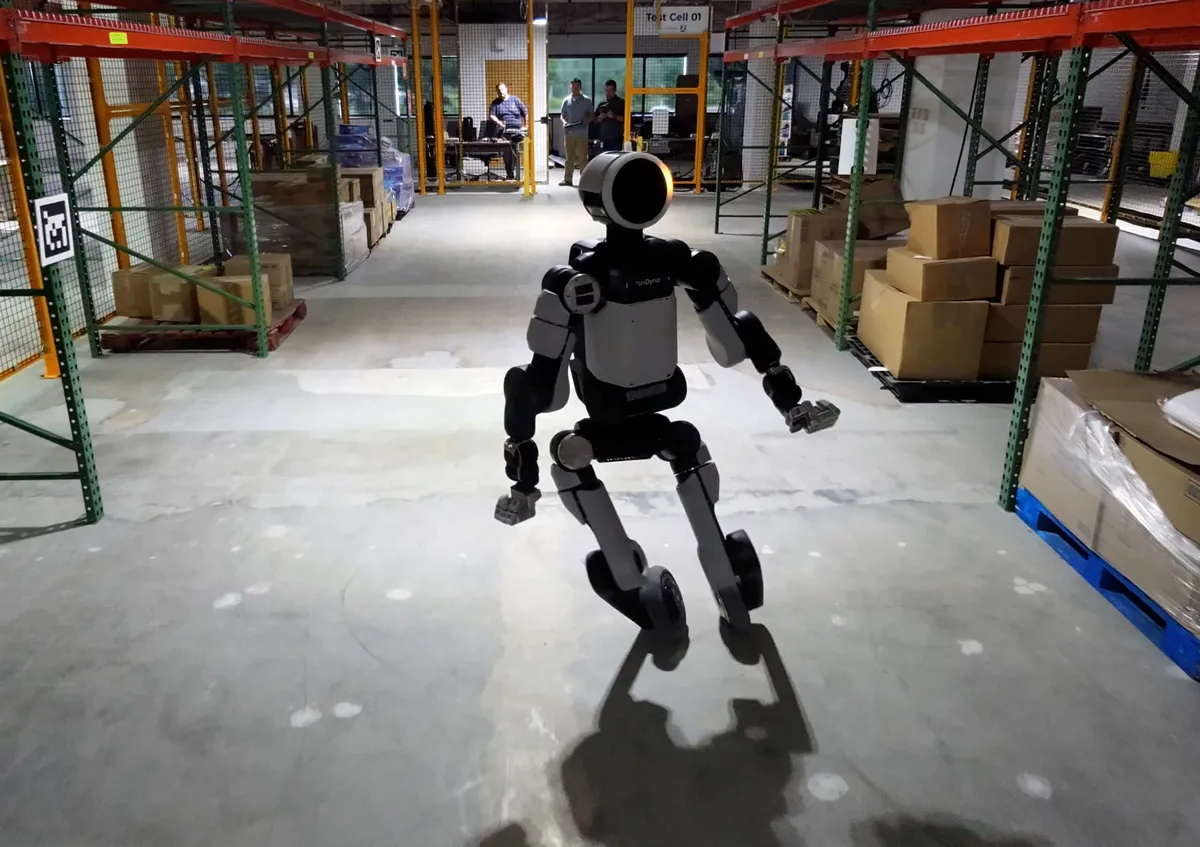
Boston Dynamics has fitted its Atlas humanoid robot with wheels to test how classical motor controls and whole-body reinforcement learning work together under demanding conditions. The company says the wheeled Atlas is a research testbed, rather than a product.
- Boston Dynamics replaced Atlas’ feet with wheels for actuator testing.
- The wheeled Atlas is a research testbed, not a product.
- The project connected motor controls with whole-body reinforcement learning.
- Atlas learned rolling side dashes and performed a 360-degree jump.
- The findings are being adapted to Atlas’ standard configuration.
A wheeled testbed for Atlas actuators
The project replaced Atlas’ feet with wheels so the robot’s motors had to deliver high torque and high speed continuously while carrying a real load. According to Boston Dynamics, every launch, turn and stop pushed the actuators across their full torque-speed range.
The physical conversion required a single custom adapter to mount an off-the-shelf scooter rim onto an existing ankle actuator. The company said the retrofit was about as involved as swapping a wheel on a bicycle. In software, each wheel was modeled as an ankle that could spin continuously, allowing the team to modify the baseline robot model rather than build a separate system.
Controls Engineer Xiaoyu (Andy) Wu said the wheels were a means of pushing the actuation hardware and its models to their limits. The experiments also produced behaviors such as side dashes, in which Atlas rolled while moving sideways and jumping.
Connecting motor controls and reinforcement learning
The work focused on the boundary between actuator design, low-level motor control and whole-body reinforcement learning. Boston Dynamics said an overly idealized motor model in simulation can teach a policy behaviors that real hardware cannot perform. A model that matches the physical motor more closely can instead help the policy learn movements that transfer to the robot.
Reinforcement learning runs millions of simulations before a policy is used on hardware. For this project, the team checked low-level control parameters across software setups, ran characterization experiments and tuned the simulated motor model against measurements from Atlas. It also assessed which approximations were safe and which ones a policy might exploit.
The team adapted existing policy frameworks, making targeted changes to reward composition, command ranges and posture control. Boston Dynamics said smooth rolling emerged while Atlas remained stable and easy to drive. The robot also transferred its simulation behavior to the physical hardware, which the company described as working “basically perfectly.”
Motion capture and the next research focus
Some of Atlas’ movements came from a library of human motion capture data. The team selected clips involving substantial foot sliding, including side dashes. A 360-degree jump used a recorded human jump trajectory and worked on the first try, according to Boston Dynamics. Despite its energetic appearance, the company described the move as relatively low risk.
The project’s findings are being adapted to Atlas’ standard configuration. Wu’s next area of work is improving policy responses to failed actuators, including whether reinforcement learning can produce emergent behaviors for handling those failures.
Boston Dynamics says the research can help it understand how robots respond to extreme circumstances that are difficult to recreate in a lab. By integrating accurate actuator dynamics with whole-body reinforcement learning, the company aims to improve policy robustness and expand Atlas’ capability envelope, while keeping the wheeled version as a research platform rather than a product.
Boston Dynamics: Atlas On a Roll | Boston Dynamics