Cezar Yazbeck Joins Scale to Move Healthcare AI Into Production
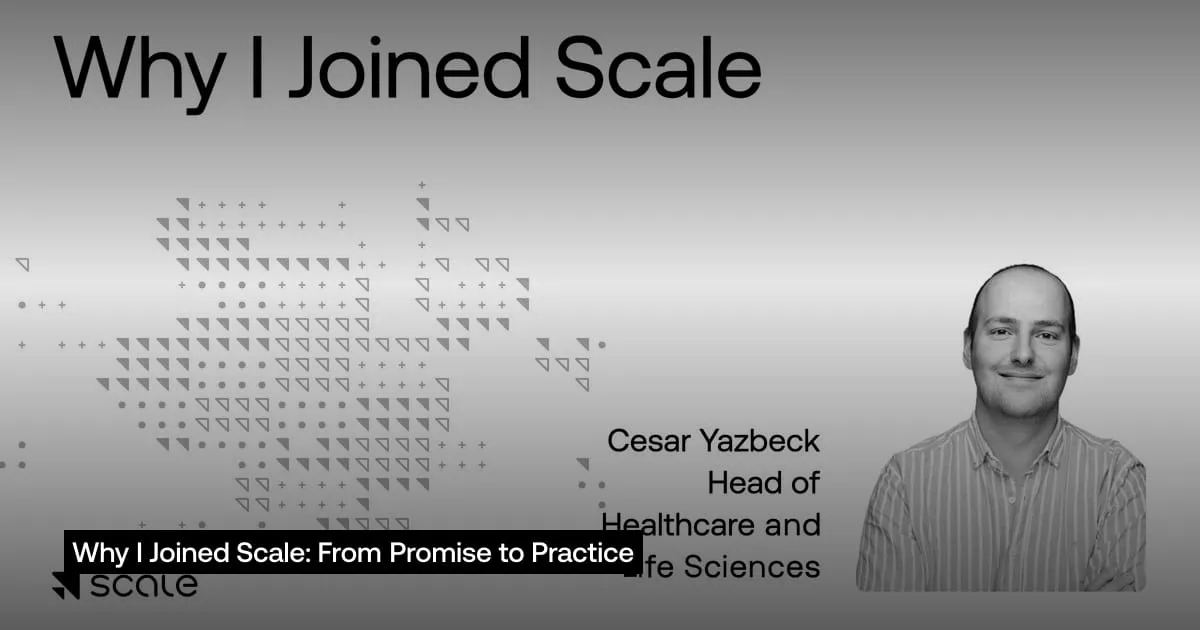
Cezar Yazbeck has joined Scale to help bring AI systems into routine healthcare and life sciences work, arguing that the sector needs reliable tools beyond promising demonstrations. Yazbeck, a medical doctor who has spent the past decade working with healthcare and life sciences organizations, said he joined because the shift from pilots to production is beginning.
- Cezar Yazbeck has joined Scale after a decade working with healthcare and life sciences organizations.
- He says AI pilots often fail to reach daily use.
- Scale focuses on evaluation, expert involvement and production deployment.
- The company plans to work with providers, payers, administrators, biopharma and life sciences companies.
Why Yazbeck says healthcare AI is changing
In a blog post published November 13, 2026, Yazbeck described a persistent gap between the potential of AI in healthcare and its use in everyday operations. He wrote that he had mostly seen pilots that performed well in demonstrations but never reached daily use.
Yazbeck said AI technology is now capable enough to handle real clinical and operational work, while the people closest to that work remain under pressure. He identified capacity as a central constraint and pointed to patient access as one area where applications could help.
The process between a patient requesting care and receiving a visit can involve scheduling, outreach and follow-up, all of which contain manual work. Yazbeck also pointed to life sciences research, where lengthy manual steps can separate a promising molecule from patient outcomes.
The barriers between a pilot and production
According to Yazbeck, healthcare and life sciences professionals have many possible uses for AI but need systems that perform reliably in real working conditions. He contrasted an AI tool that works on a busy Monday morning in a clinic with one that performs well only on a benchmark in a sandbox.
He listed data spread across dozens of systems, electronic health record integration, privacy and compliance requirements, and teams without spare hours to supervise a new tool as challenges that must be addressed. The consequences of failure are also more serious in healthcare, he wrote, because an error could leave a patient without an appointment or a condition without an approved treatment.
Yazbeck stressed that the aim is not to replace healthcare and life sciences professionals. Instead, AI should give them more time for the work that only they can do.
Scale's approach to healthcare and life sciences
Yazbeck said Scale works with leading health systems on clinical operations and builds evaluation into its process from the start. The company uses experts in the loop and continues testing after launch, reflecting its view that AI depends on both the data beneath it and the testing around it.
Scale also builds alongside partners inside their environments and through production, shaping solutions around how people work. Yazbeck said this approach is intended to support adoption rather than produce a pilot that only impresses in a demonstration.
He said Scale plans to work with providers, payers, administrators, biopharma companies and other life sciences organizations, taking on one focused problem at a time. The announcement positions Yazbeck's arrival around a practical challenge: helping organizations address their capacity and data constraints while moving AI into the systems used to deliver care and advance research.
Scale AI: Why I Joined Scale: From Promise to Practice