CoreWeave launches ARIA, an agent that runs experiments inside Weights & Biases
CoreWeave has introduced ARIA, a coding agent built directly into Weights & Biases that reads experiments, builds live visualizations and launches the next experiment through W&B Launch. According to CoreWeave, the tool is available now in public preview.
- CoreWeave ARIA is a coding agent built into Weights & Biases and is available now in public preview.
- ARIA forms hypotheses, writes configs, launches experiments through W&B Launch, evaluates results and drafts W&B Reports.
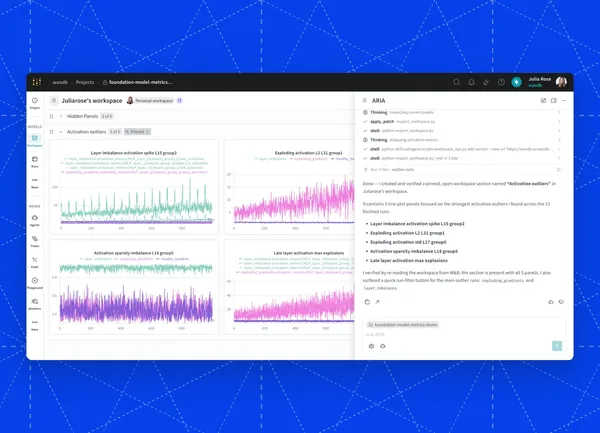
- It builds live, shareable dashboards and starts each conversation with the user's project and run context.
- CoreWeave says ARIA is trained by the W&B team on platform specifics and works for projects from 20 to 20,000 runs.
- Roadmap items include shared team conversations, persistent memory, custom MCP servers, bring-your-own API keys and enterprise admin controls.
A research loop that runs end to end
CoreWeave describes ARIA as the engine of an "autoresearch loop": analyzing results, forming hypotheses, launching the next experiment and evaluating what comes back. The company says ARIA runs the full research cycle rather than only analyzing it.
A user describes what they want to learn, for example whether adding dropout after the attention layers helps with overfitting. According to CoreWeave, ARIA then forms a hypothesis, writes the config and launches the experiment through W&B Launch on the team's compute. When the run finishes, it evaluates the results against the baseline, updates the workspace with comparison panels and drafts a W&B Report with its findings.
If the result is inconclusive, ARIA proposes a follow-up, such as a different dropout rate, a longer schedule or a sweep across values. CoreWeave says every run is tracked and every decision is visible in the conversation, and that the gap between a finished run and the next configured one shrinks from hours to minutes.
Live dashboards and built-in project context
Instead of replying with long text or lists of numbers, ARIA creates shareable W&B workspaces, panels and reports to support its findings, the company says. It picks the panel type to fit the question: a heat map for two-dimensional parameter sweeps, a parallel coordinates plot for hyperparameter interactions, or a bar chart for comparing discrete configs. Because these are live dashboards, they update as new runs arrive and are visible to the whole team.
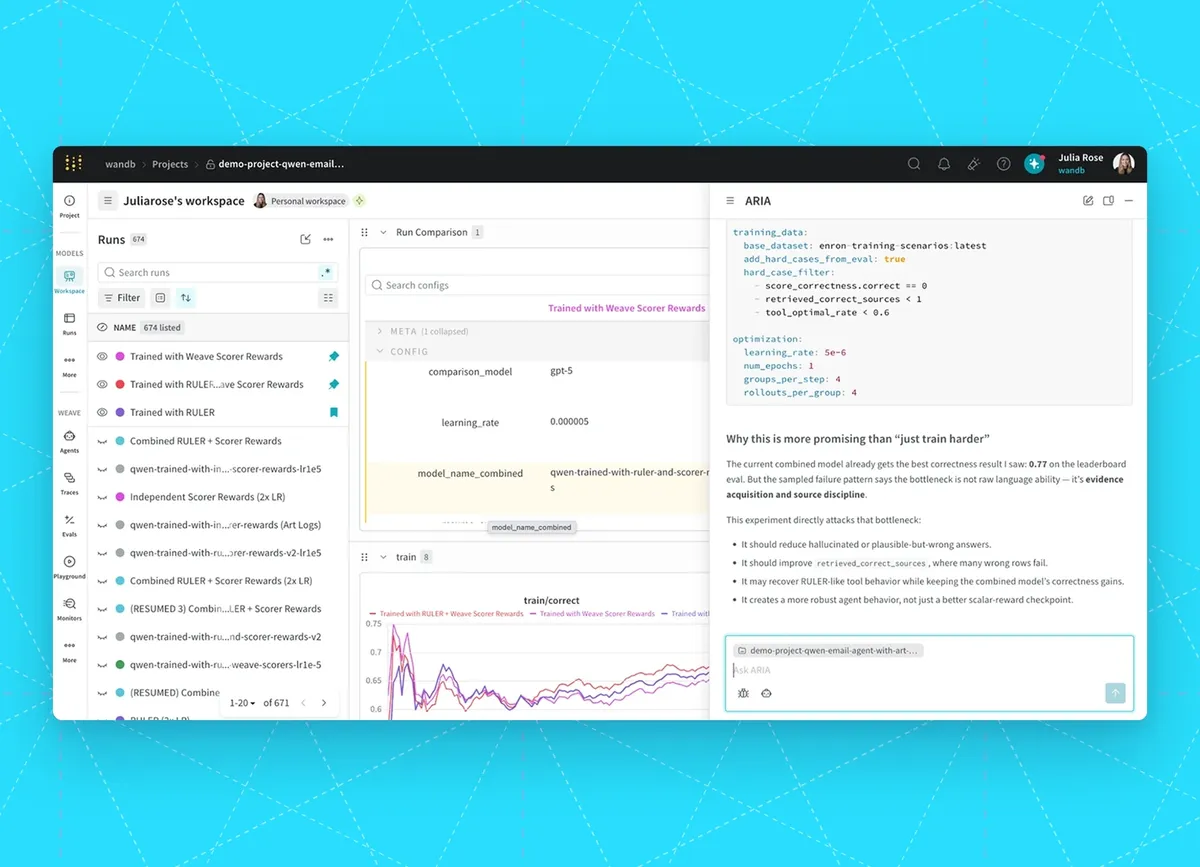
When ARIA is opened from a workspace page, it already knows the project, the visible runs and the active filters, so users do not need to paste screenshots or explain where they are working. CoreWeave says ARIA can access training code logged to W&B, experiment logs, loss curves, metrics, artifacts and checkpoints. It can also work across projects and into teammates' experiments.
The company gives several examples. Asked why validation loss plateaued at epoch 12 while downstream eval scores keep climbing, ARIA pulls training logs, checks the learning rate schedule, compares against similar runs in other projects and cross-references techniques from recent papers on arXiv. From a failed run's log page, it can spot a CUDA OOM error and begin investigating without being told which run is meant.
Why CoreWeave built a platform-specific agent
CoreWeave argues that a general-purpose coding agent can query W&B through APIs but was not built for it. According to the company, such an agent may not know the difference between a run's display name and its ID, how to query the run history API efficiently, or which visualizations a sweep generates automatically. It may scan entire projects when only a few runs matter or make redundant calls that leave users waiting.
ARIA, by contrast, is continuously trained by the W&B team on the platform's nuances, CoreWeave says. The company claims this yields fast, reliable answers whether a project has 20 runs or 20,000. ARIA is also available in the Weights & Biases mobile app, so researchers can monitor runs and interact with the agent on the go.
Listed use cases include analyzing patterns in results, building views that highlight outliers, debugging OOM errors from logs and system metrics, suggesting the next hyperparameter set and launching the job, finding a teammate's best run in another project and importing it for comparison, and answering product questions.
Roadmap and how to start
CoreWeave calls the public preview "just the beginning". Planned features include shared agent conversations for whole teams, a shared board where people and ARIA contribute research ideas, and a mode in which ARIA picks up the highest-priority hypothesis, designs and launches the experiment, monitors it and reports back. The company also plans a persistent memory of the project, team workflows and research goals.
For enterprise use, the roadmap lists custom instructions and skills, custom MCP servers to connect internal tools, databases or documentation, and the option to bring your own API keys for a preferred LLM provider. ARIA is also planned to connect to CoreWeave Mission Control through MCP so compute and experiments can be analyzed in one conversation. Enterprise admin controls are on the roadmap as well.
To try it, users open any project in W&B, click the agent icon in the sidebar and ask a question about their experiments. For teams already tracking large numbers of runs in Weights & Biases, the pitch is to shorten the time between one experiment and the next, though the features beyond the current preview remain plans rather than released functionality.
CoreWeave: Introducing CoreWeave ARIA: AI Research and Iteration Agent