CoreWeave adds Telemetry Relay and GPU Straggler Detection to Mission Control
CoreWeave has expanded its Mission Control operating standard with Telemetry Relay, now in general availability, and previews of GPU Straggler Detection and a conversational Mission Control Agent. According to the company, the additions aim to give AI teams more transparency and faster answers when large training and inference jobs slow down or fail.
- CoreWeave's Telemetry Relay is entering general availability as a new Mission Control capability.
- GPU Straggler Detection and the Mission Control Agent are launching in preview.
- Straggler Detection uses NCCL signals to pinpoint the rank, GPU and node slowing a job.
- CoreWeave claims up to 96% goodput and 20% higher model utilization (MFU) with Mission Control.
- Telemetry Relay forwards audit and observability data, including Kubernetes audit logs, into SIEM tools.
What CoreWeave announced
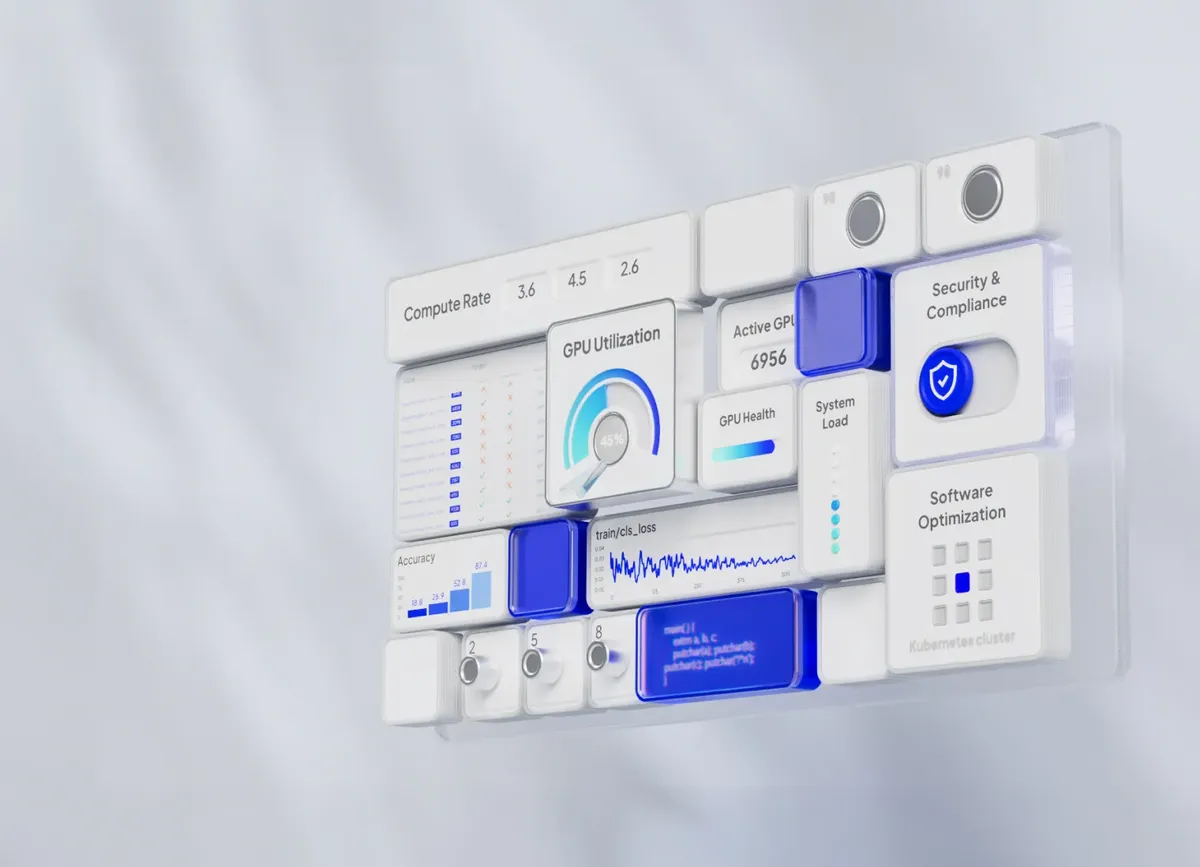
CoreWeave describes Mission Control as the industry's first operating standard for AI at scale, designed to let AI workloads run reliably on CoreWeave Cloud. The company says it runs through the whole stack, from foundational infrastructure through observability, security and agent workflows.
The latest update has three parts:
- Telemetry Relay, now entering general availability, forwards audit and observability signals into a customer's SIEM or monitoring tools.
- GPU Straggler Detection, in preview, looks for bottlenecks inside large distributed jobs.
- CoreWeave Mission Control Agent, also in preview, surfaces telemetry and remediation guidance through conversational workflows.
CoreWeave ties the platform to its orchestration systems, such as SUNK (Slurm on Kubernetes), which it says helped it earn SemiAnalysis' Platinum ClusterMAX rating for the second consecutive evaluation. The company says it remains the only AI cloud provider to receive that rating.
Reliability and transparency
CoreWeave argues that dashboards and scripts stop working once teams train large models or serve production traffic across thousands of GPUs. Small problems in the networking fabric, noisy nodes or gaps in audit visibility, it says, lead to wasted compute and hours of troubleshooting.
According to the company, Mission Control continuously evaluates health across GPUs, fabric and nodes. It watches for signals such as rising correctable ECC rates, recurring Xid errors or sudden changes in collective execution time. When a value crosses a threshold, the system takes nodes out of rotation, steers workloads and triggers automated recovery. If automation is not enough, incidents are routed to CoreWeave experts.
CoreWeave cites one customer, a large AI lab training frontier-scale models, where automated recoveries and continuous node and fabric monitoring resolved issues roughly five to six times per day for every thousand nodes. The company also claims Mission Control enables up to 96% goodput, which it defines as the share of GPU time actually spent on useful training work, along with 20% higher model utilization (MFU).
On transparency, Telemetry Relay forwards Kubernetes audit logs, API and console activity, and hardware and fabric metrics with what CoreWeave calls reliable, predictable delivery. The company says this removes the need to build and maintain a custom export pipeline. Mission Control also provides Grafana dashboards for GPUs, clusters, network and storage without extra setup. Through an integration with Weights & Biases, CoreWeave says its cloud can stream more than one million data points per second into training and experiment tracking.
Finding slow GPUs with Straggler Detection
CoreWeave highlights what it calls gray failures: cases where a single slow or unhealthy rank in a collective drags down throughput for an entire run. These are hard to detect, since from the outside the job simply seems to move more slowly than it should.
GPU Straggler Detection uses signals from NCCL to identify the specific rank, GPU and node that are out of line with the rest of the job. The outlier stands out in Grafana, and alert patterns point to the hardware to investigate. Teams can then correlate the findings with their training runs in Weights & Biases.
A demo video described in the announcement shows a user asking the Mission Control Agent in Slack why a job is running slowly. According to CoreWeave, the agent traces the straggler through the observability stack, highlights the bottleneck GPU and node, and replies in the thread with a short explanation and the relevant Grafana view.
What it means for AI teams
For teams running large training jobs, the pitch is less manual detective work. CoreWeave says Mission Control shortens detection and repair cycles and keeps training and inference running consistently, from small-batch jobs to frontier-scale research. Because Telemetry Relay feeds existing SIEM and monitoring tools, security and SRE teams can keep using the systems they already know.
The performance figures, including the goodput and utilization claims, come from CoreWeave itself. The straggler detection and agent features are still in preview, while Telemetry Relay is the part moving to general availability.
CoreWeave: Why Leading AI Teams Rely on CoreWeave Mission Control™