CoreWeave Shares 5 Network Lessons From Building Fabric for Agentic AI
CoreWeave has published five lessons from building a multi-plane network fabric meant to carry training, inference and agentic AI traffic on the same fleet. According to the company, agent chains stress the east-west network in ways that training never did.
- CoreWeave says agent chains make fabric latency the sum of every hop, unlike rhythmic training traffic.
- The company uses a 1:1, non-oversubscribed design on every fabric it has built.
- According to CoreWeave, multi-plane topology lets a flat two-tier design reach 128,000 GPUs, 64 times a single-plane fabric.
- ConnectX-9 SuperNICs run up to 1,600 Gb/s per GPU on its Vera Rubin NVL72 deployment, with hardware load balancing.
- Resilience is built across topology, silicon, software, operations and geography.
Why agentic traffic differs from training
CoreWeave describes training a foundation model as a well-behaved problem for the network: thousands of GPUs run the same collective at roughly the same time for weeks. It is hard on bandwidth, but rhythmic, so a network can be designed around it.
Agents behave differently. An agent splits a task into steps, calls a retriever, a tool, another model and sometimes another agent, and waits on each hop before it knows the next one. Latency of that chain is the sum of every hop rather than the worst one. Thousands of such chains running next to training jobs and standard inference make the traffic latency-sensitive and many-hop, according to the company.
CoreWeave says it rebuilt its backend network from the topology up so one fleet can carry sustained training collectives, steady inference and bursty agent traffic without any of the three degrading the others. The network uses the NVIDIA Spectrum-X Ethernet platform, BlueField-3 DPUs and ConnectX-9 SuperNICs, combined with CoreWeave Kubernetes Service (CKS), SUNK and CoreWeave Mission Control. The company says the fabric now connects fleets across more than 50 data centers.
Non-blocking design and multi-plane scaling
The first lesson is not to oversubscribe. CoreWeave argues that a fabric can pass point-to-point bandwidth tests and still stall agent chains when leaf switches have less uplink capacity than the nodes below them can generate. Its rule is a 1:1 ratio, so every leaf can sustain full line rate from every connected node, at every layer. The company says this is why it operates some of the largest NVIDIA Quantum InfiniBand and RoCE fabrics running today.
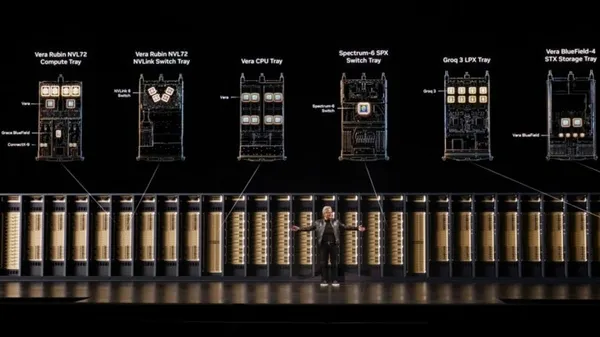
On Spectrum-X, adaptive routing and telemetry-based congestion control are meant to keep one tenant's synchronized training burst from hurting another tenant's agent chain. CoreWeave also says it was one of the first cloud providers to deploy the NVIDIA Spectrum-X SN6600-LD, described as the industry's first fully liquid-cooled 102.4 Tb/s Ethernet switch, as the switching fabric for NVIDIA Vera Rubin NVL72.
The second lesson concerns growth. A flat two-tier leaf-spine design eventually runs out of radix, and the usual fix, a third tier, adds hops and jitter. Multi-plane topology instead splits each GPU's SuperNIC connectivity across two or more independent planes. CoreWeave says this lets a flat, two-tier design reach 128,000 GPUs, 64 times the reach of a single-plane fabric. Multi-rail works at node level: each GPU connects through more than one SuperNIC, and in a rail-optimized design every node's Nth SuperNIC connects to the same leaf switch, keeping GPU-to-GPU paths short and predictable.
Hardware load balancing and layered resilience
The third lesson is that bandwidth only helps if traffic uses it. Static hashing can pile large flows onto one path while others sit idle. Load balancing has traditionally run in software, with NCCL spreading a collective's traffic, which competes for host CPU cycles and reacts to congestion after the fact.
CoreWeave says ConnectX-9 SuperNICs move that work into hardware, reacting to live congestion telemetry at line rate. The company pairs them, at up to 1,600 Gb/s per GPU on its NVIDIA Vera Rubin NVL72 deployment, with adaptive routing on the Spectrum-X switch fabric. It also stresses tuning: priority flow control and explicit congestion notification should be set against real traffic, and congestion thresholds need separate tuning for NCCL patterns, rather than relying on textbook defaults.
The fourth lesson is that an agent chain has no clean restart boundary. A stalled training job can restart from a checkpoint, but an agent halfway through a 10-step chain cannot. CoreWeave therefore builds resilience across five layers:
- Topology: multi-plane and multi-rail shift traffic off a degraded plane or rail.
- Silicon: BlueField-3 DPUs run networking, isolation and policy enforcement on dedicated hardware instead of host CPUs.
- Software: CKS removes the hypervisor entirely.
- Operational: Mission Control replaces degraded nodes automatically once they cross a health threshold, backed by a FleetOps team watching around the clock.
- Geographic: the network backbone, though the source text is cut off before describing it.
What it means for AI infrastructure customers
The post is a statement of CoreWeave's own design choices rather than independent benchmarks, and it gives no performance comparisons. Its message to customers running mixed workloads is that agent traffic should be treated as a first-class network design requirement, not an afterthought to training. The company says the Vera Rubin NVL72 deployment gives customers access to higher-capacity networking as new AI systems come online.
CoreWeave: 5 Lessons from Building a Multi-plane Network Fabric for Agentic AI