CTM and Huawei Outline Built-In Network Security for Macao in the AI Era
Macao operator CTM wants security to be a built-in capability of its network rather than a firewall at the edge. At Network X 2026 in Vienna, the company presented a plan, developed with Huawei, that combines AI-driven traffic control, on-demand security services and quantum-safe technology.
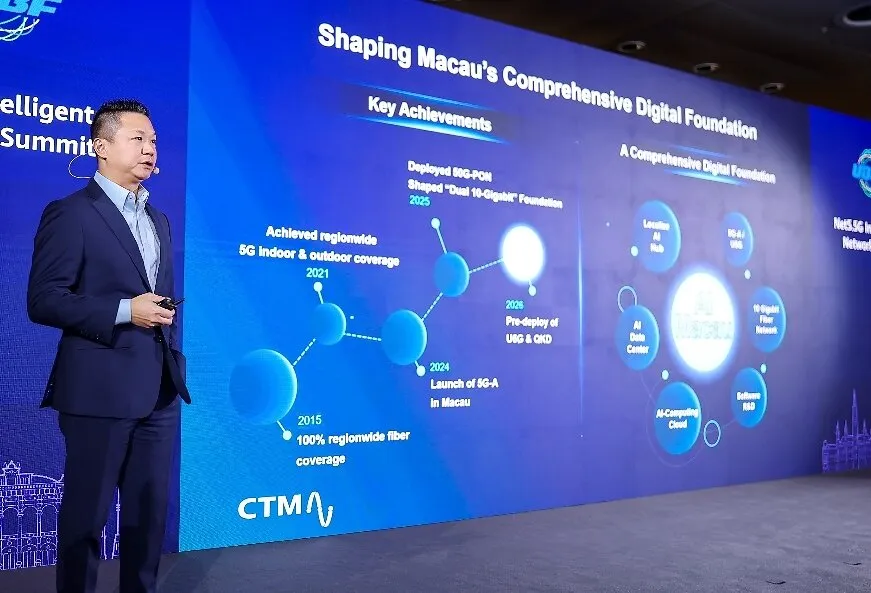
- CTM presented its secure target network in a keynote at Network X 2026 in Vienna.
- AGW and AI BNG capabilities steer traffic to optimal paths; AGW 2.0 will add telemetry and AI analytics for auto-optimization.
- CTM wants security built into the network, with behavior-based detection on devices.
- Carriers can pool DDoS defense, IPS and anti-phishing and provision them within days, according to CTM.
- CTM and Huawei developed a target IP architecture with QKD-communication integration for quantum-safe planning.
From connectivity pipes to intelligent infrastructure
Hudson Lou, Head of Network Services and Development at CTM, delivered the keynote at Network X 2026. According to the announcement, which was distributed by Huawei through PR Newswire, CTM is accelerating efforts to evolve its networks from traditional connectivity pipes into intelligent, deterministic and secure infrastructure. The stated aim is to speed up the digital and intelligent transformation of enterprises in Macao.
CTM says the push is driven by the high-reliability and low-latency requirements of AI. The company has envisioned an "intelligent, deterministic, and secure" network infrastructure. To get there, it is introducing AGW and AI broadband network gateway (BNG) capabilities. These give the network intelligent service awareness and dynamic scheduling, and they steer traffic to optimal paths. According to CTM, this should improve user experience and reduce international bandwidth costs.
The next step is AGW 2.0. CTM plans to integrate telemetry with AI-powered analytics, moving from manual optimization to AI-driven auto-optimization. The company says this will deliver a deterministic, differentiated experience for high-value scenarios and support revenue growth in government and enterprise businesses.
Three areas for network security modernization
CTM argues that future security planning must go beyond setting up a firewall at the network edge. Security should instead be a built-in capability of the network itself. The company named three areas where the industry can explore network modernization.
- Built-in device security. Devices use built-in security capabilities and AI-powered behavior analytics to identify abnormal behaviors in real time. This marks a shift from traditional signature- and rule-based defense to behavior-based detection.
- Security capabilities as a service. By pooling capabilities such as DDoS defense, IPS and anti-phishing, carriers can provision network security services within days. According to CTM, this removes the need for manual on-site deployments and lets government and enterprise customers subscribe to security services on demand. The company also points to rapid monetization of these capabilities.
- Future-proofing for the quantum computing era. Quantum computing poses emerging risks to traditional cryptographic frameworks. CTM and Huawei say they have pioneered a joint innovation: a target IP architecture featuring QKD-communication integration.
Quantum-safe planning and what it means
The QKD-communication integration is meant to let carriers proactively advance quantum-safe technology validation and network planning. According to the announcement, it will deliver next-generation security capabilities for data transmission in critical industries. An innovative built-in QKD solution, the companies say, significantly reduces O&M costs.
For Macao, the roadmap is presented as a way to strengthen the competitiveness of the local network. The announcement also claims the technology evolution roadmaps offer global carriers a new blueprint for moving to intelligent, secure networks in the AI era. The source gives no deployment dates, pricing or performance figures, so the practical impact for customers will depend on how and when CTM puts these capabilities into service.
For government and enterprise customers, the central proposal is that security becomes a subscription service delivered by the network operator, provisioned within days and without on-site work.