Databricks connects customer value signals to advertising platforms
Databricks has introduced CustomerLake Conversions, a capability that connects first-party customer data and machine learning models with advertising activation and measurement. The company says it will help brands send more meaningful conversion signals to ad platforms while keeping control of the data they share.
- CustomerLake Conversions connects first-party data and ML models to advertising activation.
- Marketers can define value-based conversion signals, including predicted lifetime value.
- Campaign insights return to Databricks through OpenSharing and Lakeflow Connect.
- Unity Catalog permissions and an audit trail govern what data is shared.
- The capability will be available to customers using Campaign Agents in CustomerLake.
From conversion counts to customer value
Advertising reports can treat two purchases as identical conversions even when their long-term value differs. CustomerLake Conversions is designed to let marketers use business context such as purchase history, margin, loyalty, engagement and predicted lifetime value when defining campaign signals.
For example, a retailer could identify first purchases from customers predicted to become repeat buyers, rather than sending every purchase event with the same weight. A B2B company could use qualified leads or closed won revenue to represent progress beyond a submitted form.
According to Databricks, marketers still define what success means. CustomerLake translates those priorities into audiences and conversion signals that advertising platforms can use, with the aim of helping brands pursue more valuable conversions and improve return on ad spend.
A workflow linking activation and measurement
CustomerLake Conversions extends Campaign Agents, part of Databricks’ Agentic CDP, across three steps. Teams can use first-party data and ML models to create audiences and identify conversion signals, then deliver them to advertising platforms through Conversions API integrations and native Reverse ETL connectors.
Campaign performance insights return to Databricks through OpenSharing integrations and Lakeflow Connect. This allows brands and agencies to evaluate advertising performance alongside customer and business context instead of relying on separate extracts, uploads and reporting workflows.
A dedicated Conversions tab within CustomerLake Campaign Agents lets marketers select conversion data, configure destinations and manage delivery. Databricks says the approach can help teams refine audiences, signals and media strategy using the same context used during activation.
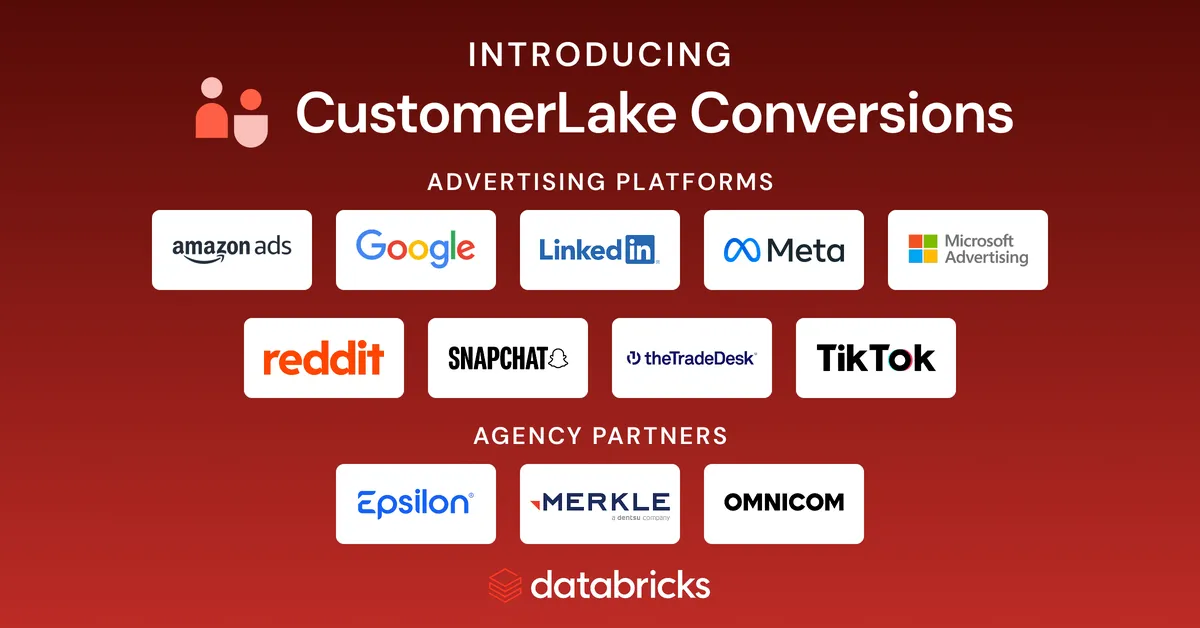
Launch partners include Amazon Ads, Google, LinkedIn, Meta, Microsoft Ads, Reddit, Snapchat, The Trade Desk, Tiktok, Epsilon, Merkle and Omnicom.
Governance for brands and agencies
CustomerLake Conversions is built on Unity Catalog, where Databricks says customer profiles and business context remain governed. Brands decide which audiences and conversion events go to which destinations, while an audit trail records what was sent and where.
Agencies can receive delegated access without copying or duplicating customer data. They can configure destinations and conversion definitions, and combine identity data and predictive models with a brand’s first-party information. Databricks gives Epsilon’s identity graph as an example of how identity data could connect conversion events to customer identities when an original event contains limited identifying information.
When available, CustomerLake Conversions will be accessible to all customers using Campaign Agents in CustomerLake. Databricks also says people remain responsible for strategy, goals and guardrails, while agents help scale execution.