Databricks Lakeflow Connect adds managed connectors for Jira, SharePoint, OpenAI and more
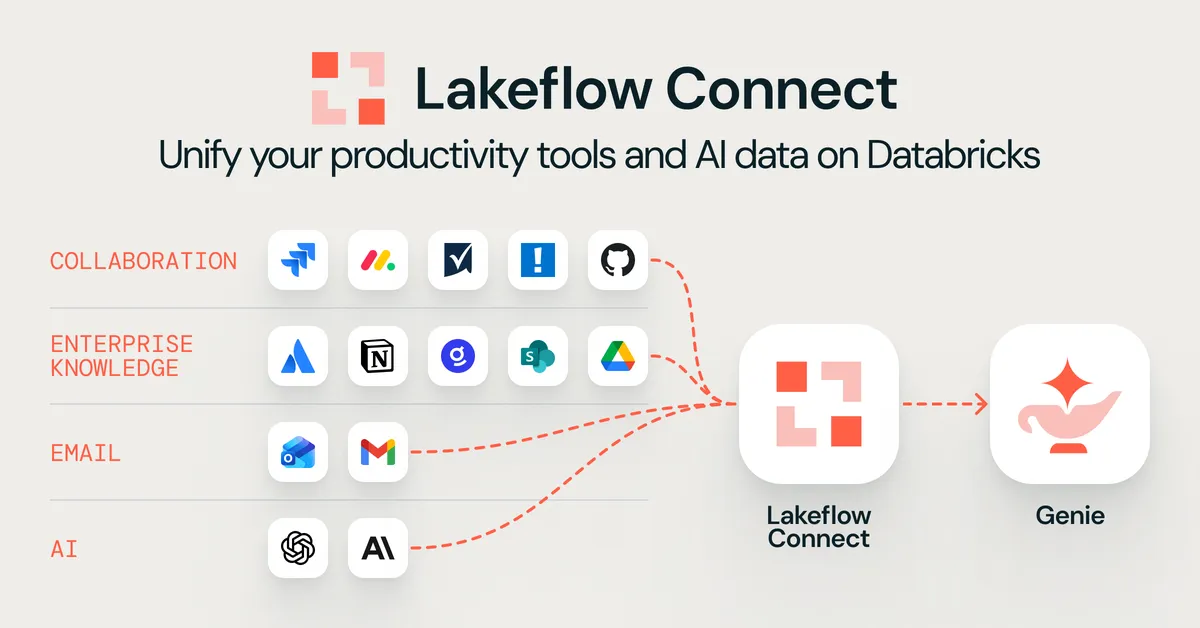
Databricks says its Lakeflow Connect service offers fully managed connectors for productivity tools such as Jira, Confluence, SharePoint, Google Drive, Outlook, Gmail and GitHub, as well as for AI providers OpenAI and Anthropic. According to the company, the data lands in Unity Catalog as governed tables, so teams can feed AI agents and dashboards without building custom pipelines.
- Lakeflow Connect offers managed connectors for Jira, Confluence, SharePoint, Google Drive, Outlook, Gmail, GitHub, OpenAI and Anthropic.
- Data lands in Unity Catalog as governed tables, set up via a point-and-click UI or an API.
- Raw document files are converted to text with ai_parse_document before indexing for retrieval.
- The OpenAI and Anthropic connectors bring in usage, audit and user data to govern AI spend and adoption.
- Toyota Finance Australia, VaxCare and M3 Accounting are named as customers.
One ingestion layer for the productivity stack
In a blog post, Databricks describes enterprise knowledge as scattered across project trackers, wikis, document stores, inboxes and AI tools, each holding only a slice of how work gets done. Getting that data out has historically required custom pipelines that are slow to build and painful to maintain, according to the company.
Lakeflow Connect is meant to remove that bottleneck. Each connector can be set up through a point-and-click UI or a simple API, and data is ingested incrementally as managed tables in Unity Catalog, with no infrastructure to provision or scale. The post is the second in a series on bringing managed ingestion to every line of business, following one on marketing data.
Databricks groups the productivity connectors into four areas:
- Collaboration: Jira, Monday.com, Smartsheet, Aha! and GitHub
- Enterprise knowledge: Confluence, Notion, Glean, SharePoint and Google Drive
- Email: Outlook and Gmail
- AI: OpenAI and Anthropic
Unstructured content prepared for AI agents
Databricks argues that an AI agent is only as good as the data behind it, and that most of this data is unstructured. The connectors land files, pages and messages as governed tables, and the format depends on the source.
- SharePoint and Google Drive: each unstructured file, such as PDFs, Word documents, slide decks and images, lands as one row with its raw bytes in a content column. Structured files such as Excel files, CSVs or Google Sheets can be landed directly as Delta tables.
- Confluence: the content of every page and blog post arrives as STRUCT type in a body field of the pages and blogposts tables.
- Outlook: the email body is stored in a full_body_content column and attachments in an attachments column as BINARY type, both in the email_messages table.
- Gmail: the full message body is held as a text string in the messages table, along with a reference to each attachment as an attachmentId.
- GitHub: repository text files, including source code, Markdown and config, are stored in the content column of the repo_contents table.
Text content such as Confluence pages, email bodies and source files is ready to chunk and embed after light cleanup, according to Databricks. Document files that arrive as raw bytes are first converted to text with ai_parse_document, which the company calls its built-in document intelligence. The result is text that can be indexed for retrieval and placed behind an agent.
Tracking AI spend and Atlassian data
The post also covers governance of AI usage. The OpenAI connector brings in usage, costs, API keys, projects, users and audit logs, so spend can be attributed by team and adoption tracked. The Anthropic connector brings in audit logs, the organization's users and roles, and the content of claude.ai chats and messages, so companies can govern how the tool is used. Databricks says this gives a single view of AI usage trends and helps teams report the ROI of AI investments to stakeholders.
For Atlassian, the Jira connector brings in issues, comments, sprints, boards and custom fields, so teams can track delivery and build dashboards across projects. The Confluence connector also covers pages and blog posts, as described above.
Customer examples and what it means
Databricks cites several customers. Toyota Finance Australia uses the Jira connector as a fully managed, zero-maintenance pipeline. Charbel Khoury, Head of Data Office at the company, said it delivers "governed, analytics-ready Delta tables in the Databricks Lakehouse with minimal effort and maximum reliability."
VaxCare, which the post describes as running the largest primary-care vaccination network in the U.S., uses the Confluence connector to ground a chatbot in its internal knowledge base. M3 Accounting uses the GitHub and SharePoint connectors. Ross Serven, its VP of Data & AI, said: "No custom crawlers, no file sync scripts, just a connector and a pipeline." He said the company had its internal knowledge assistant pulling from live content within a week.
For data teams on Databricks, the pitch is less custom integration work for knowledge bases, agents and developer productivity dashboards. These results are customer statements published by Databricks, and the post does not provide independent benchmarks.
Databricks: Unify your productivity and AI data with Lakeflow Connect