Datadog launches Scout 1.0, a cheaper AI model for incident investigation
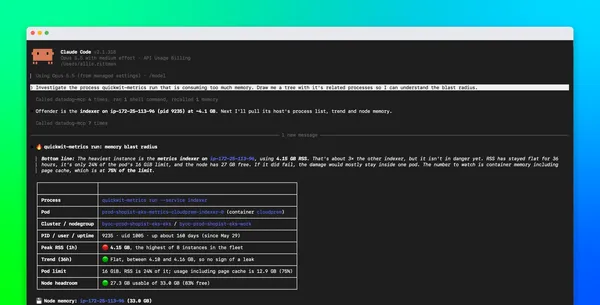
Datadog has introduced Scout 1.0, its first AI model built specifically for investigating production issues. According to the company, Scout matches or approaches leading general-purpose models on its investigation benchmark at a much lower estimated inference cost.
- Datadog introduced Scout 1.0, its first model specialized for investigating production issues, powering Bits Investigation.
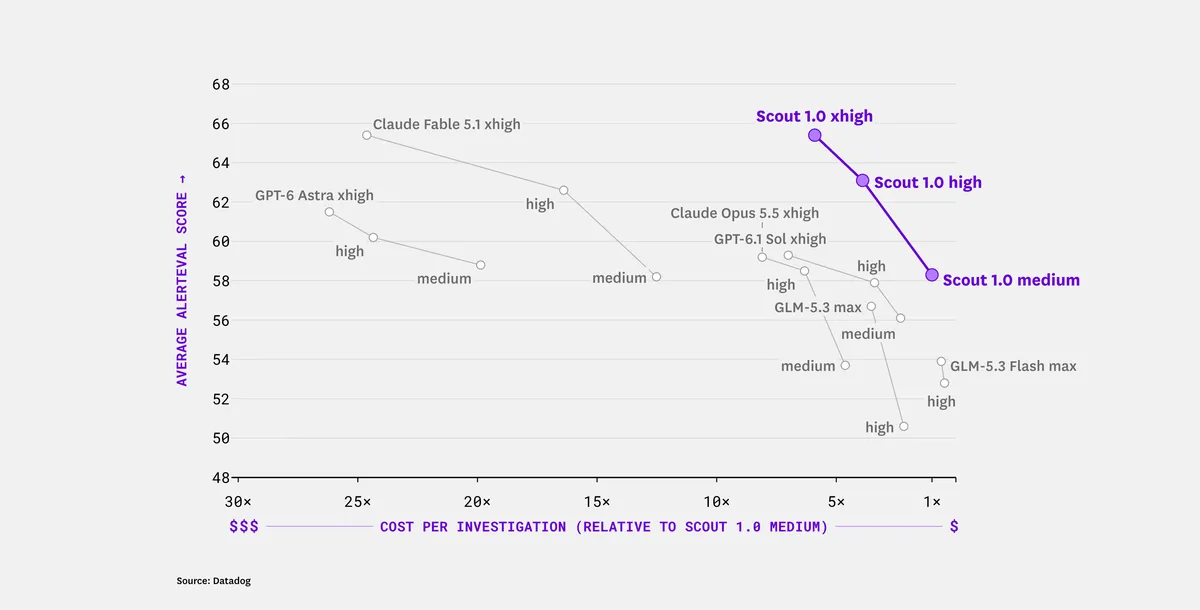
- Scout 1.0 medium matches GPT-6.1 Sol high and Claude Opus 5.5 high at 3 to 8 times lower estimated inference cost, per Datadog.
- Scout was built on GLM-5.3 Flash and trained with reinforcement learning in simulations from real historical incidents.
- Results come mainly from AlertEval, Datadog's internal benchmark, plus the third-party SREGym.
- A closed preview is running; general availability has no announced date.
A model built for investigations
Scout powers Bits Investigation, Datadog's AI SRE. Datadog says it trained the model to cut inference cost so that investigations become cheap enough to run "an order of magnitude more often" and earlier in an incident's lifecycle.
The company describes the goal as making Bits an always-on first responder that gathers evidence and identifies likely causes before an engineer steps in. Each investigation involves forming hypotheses, querying telemetry and deciding whether the evidence supports a conclusion. Those steps need repeated model calls, so a lower cost per call leaves room to cover more alerts and dig deeper into complex problems.
Benchmark claims
The comparisons come from AlertEval, an internal benchmark annotated by human experts. Datadog says scores measure agreement with expert reference explanations on a 0 to 100 scale, and are not percentages of incidents solved. Costs are estimated inference costs per investigation.
- Scout 1.0 medium matches GPT-6.1 Sol high and Claude Opus 5.5 high at 3 to 8 times lower estimated cost.
- It performs comparably to Fable medium and Astra medium at 12 times and 19 times lower cost, respectively.
- With test-time scaling, Scout 1.0 xhigh matches Fable xhigh at 4 times lower cost.
In the figure caption, Datadog also says the xhigh mode outperforms GPT-6 Astra and matches Claude Fable 5.1 xhigh while keeping costs in the same range as Sol and Opus.
Datadog also tested Scout on SREGym, a third-party benchmark. There, it says Scout 1.0 medium significantly improves on its base model, GLM-5.3-Flash, and surpasses GLM-5.3 at a more than 4 times cost reduction. Scout 1.0 high is described as competitive with the best models on that benchmark while keeping at least 2 times cost savings against all competitors, and 10 times against Astra and Fable-class models.
How Scout was trained
Datadog built Scout 1.0 on GLM-5.3 Flash and post-trained it with reinforcement learning in investigation simulations. The simulations are built from historical incidents and telemetry from real alerts, with known causes. According to the company, they do not contain any customer data. In training, Scout uses tools modeled on Bits Investigation to gather evidence and test competing explanations, and it is rewarded for finding the cause and backing its conclusions with evidence.
The company says it built its own distributed reinforcement learning infrastructure on top of open source tools, covering simulation, evaluation and model training. AlertEval combines real alerts, archived telemetry and root cause explanations written by Datadog engineers. Datadog says it is developing Scout and Bits Investigation together, training the model for the tools Bits uses and improving those tools based on what it learns.
Availability and what comes next
Datadog engineering teams and a small group of customers in a closed preview already use Scout to investigate production alerts. Interested teams can sign up for the preview to try it in their own environment and give feedback before general availability. The source gives no date for general availability or any pricing.
Datadog says it plans to simulate a wider range of failures and keep improving investigation quality while lowering cost. It also wants to extend the approach beyond investigation to help teams autonomously remediate issues. In the company's words, this would move Bits toward "becoming the only responder during an incident".
For engineering teams, the practical point is cost. If the company's figures hold in customer environments, cheaper investigations could allow AI analysis on more alerts, not only the most severe ones. The benchmarks are largely Datadog's own, so results in production may differ.