Daytona: NVIDIA Vera Starts 1,000 Agent Sandboxes in 10.8 Seconds
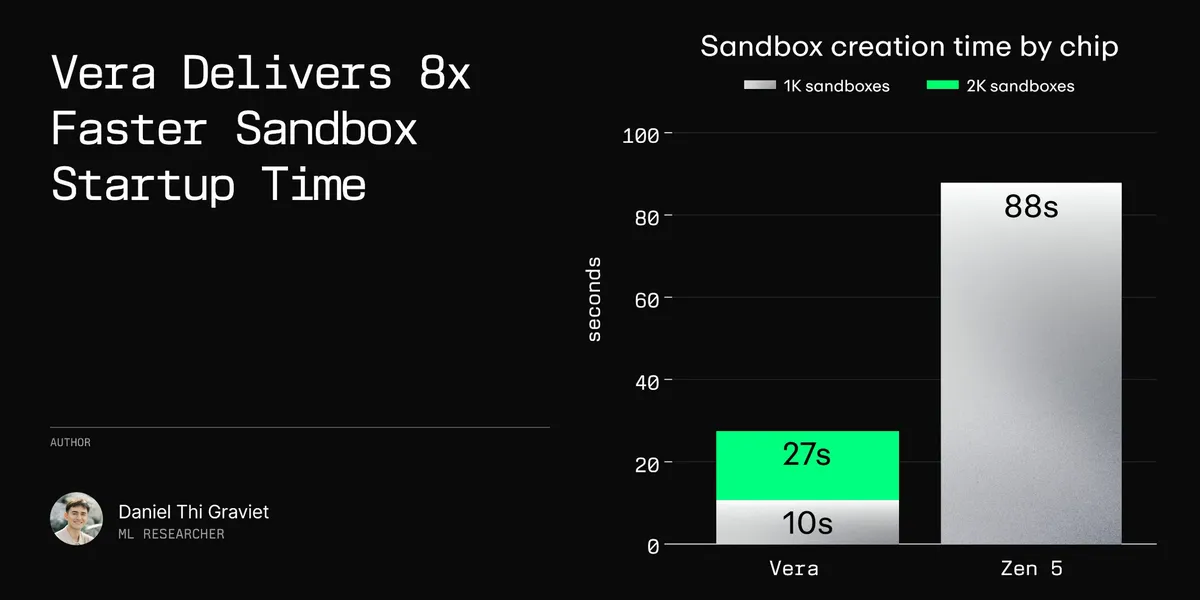
In Daytona's own benchmark, NVIDIA Vera brought 1,000 agent sandboxes online in 10.8 seconds, against 32.3 seconds for the AMD EPYC 9575F and 88.4 seconds for the EPYC 9755. According to Daytona, Vera also held close to 13 completed agent jobs per second as concurrency rose to 2,000 sandboxes.
- Daytona says NVIDIA Vera brought 1,000 sandboxes online in 10.8 seconds, versus 32.3 seconds for the EPYC 9575F and 88.4 seconds for the EPYC 9755.
- Vera started 2,000 sandboxes in 27.4 seconds, according to Daytona.
- Peak throughput was 13.3 agent jobs per second for Vera, and 12.7 at 2,000 concurrent sandboxes versus 10.9 (9755) and 8.1 (9575F).
- In an illustrative 1,000 jobs per second workload, Vera needs about 15% fewer machines than the 9755 and about 38% fewer than the 9575F.
Two tests: startup speed and sustained load
Daytona, which provides infrastructure for running AI-generated code, compared NVIDIA Vera with AMD EPYC Zen 5 processors. The company ran the same coding-agent task across large fleets of its sandboxes and also measured how quickly each system could start them.
The first test covered startup. Each of 1,000 sandboxes booted the same agent image and ran the same commands, and Daytona timed how long it took to provision all of them and make each ready to accept work. According to Daytona, Vera needed 10.8 seconds, the EPYC 9575F needed 32.3 seconds and the EPYC 9755 needed 88.4 seconds.
Daytona then doubled the fleet to 2,000 sandboxes. Vera brought all of them online in 27.4 seconds. The company notes that this is faster than the 9575F needed to bring up 1,000.
Startup speed matters because, according to Daytona, it spins up millions of sandboxes on a typical day, and the median sandbox lives for less than five minutes. Environments are constantly replaced as agents finish tasks and rollouts reset, so startup happens all day rather than once.
Throughput as concurrency climbs
The second test measured sustained throughput. Daytona raised concurrency from 44 to 2,000 sandboxes, each running the same workload: build a small broken Python package, search through it, apply a patch and run tests.
As load increased, the three chips separated, according to the company:
- EPYC 9575F: levels off around 8 agent jobs per second.
- EPYC 9755: levels off around 11 agent jobs per second.
- NVIDIA Vera: reaches a peak of 13.3 agent jobs per second and stays close to 13 through 2,000 sandboxes.
At 2,000 concurrent sandboxes, Vera still completed 12.7 agent jobs per second, compared with 10.9 on the 9755 and 8.1 on the 9575F. Daytona's point is that total useful work does not collapse once the socket is full, so more isolated environments can be added without throughput falling apart. CTO Vedran Jukić said Vera "slows down a little but stays stable instead of falling apart."
Why density drives cost
Daytona argues that agents change how infrastructure is built. A company with 1,000 engineers might have 1,000 laptops, but it had no reason to pack all those development environments onto one CPU. An organization running agents may eventually have more agents in parallel than engineers, each needing its own filesystem, processes, dependencies and tools.
The company translated throughput into hardware needs with an illustrative workload of 1,000 completed agent jobs per second. Under that model, Vera needs about 15% fewer machines than the 9755 and about 38% fewer than the 9575F. Daytona says fewer machines also means less rack space, fewer network connections, less power and cooling, and fewer servers to operate.
What it means for customers
Daytona says customers get these gains without managing the hardware themselves. It cites Handshake, which builds reinforcement learning environments where AI models learn by attempting tasks. According to Daytona, a project can jump from zero to thousands of concurrent sandboxes within hours, with daily sandbox runs reaching six figures. Because each attempt needs its own isolated environment, the number of experiments a team can run depends partly on how much work each machine can sustain.
The results come from Daytona's own tests on a single coding-agent workload and an illustrative cost model, so they describe that setup rather than every agent workload. Daytona's conclusion is that agent infrastructure is becoming a density problem: systems must create more environments, pack them efficiently and keep them productive under heavy load.
Daytona: When 2,000 Agents Share One CPU