Deepgram to Acquire Daily and Set Up Independent Pipecat Foundation
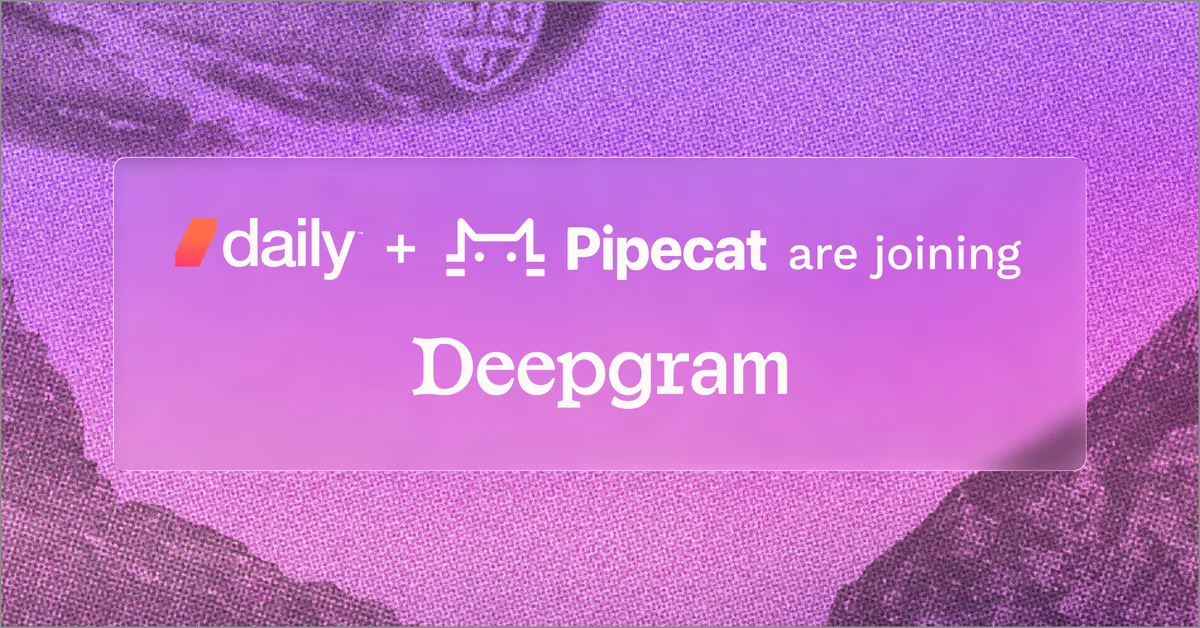
Deepgram is acquiring Daily, the realtime audio and video infrastructure company, and the two sides plan to set up an independent Pipecat Foundation to govern the open source voice AI framework. Daily co-founder Kwindla Hultman Kramer announced the deal in a blog post dated October 29, 2026.
- Deepgram is acquiring Daily, and the Daily team is joining Deepgram, according to co-founder Kwindla Hultman Kramer.
- An independent Pipecat Foundation will be set up, run by a steering committee representing the realtime AI ecosystem, including Deepgram competitors.
- Pipecat stays open source and vendor neutral, while Deepgram adopts it as the core of its new voice AI products.
- Deepgram will sell, support and develop all of Daily's current products and services.
- Pipecat has more than 200 integrations and almost 400 contributors, per Daily.
What the deal means for Daily and its customers
According to Kramer, the Daily team is joining Deepgram and will keep working on the Pipecat open source framework and on the global network infrastructure that powers realtime audio, video and AI applications. He framed the move as a shared bet: both companies believe every developer and enterprise will need models, realtime infrastructure and open source orchestration in every product.
Kramer says continuity is the priority. "For Daily's customers and the Pipecat ecosystem, nothing will change," he wrote. Deepgram will sell, support and develop all of Daily's current products and services. The post does not state financial terms or a closing timeline.
Kramer also says Daily's commercial products, including WebRTC, telephony and cross-platform libraries, will benefit from the participation of Deepgram's large, world-wide team of engineers.
An independent foundation for Pipecat
The central governance change is the planned Pipecat Foundation. According to Kramer, Pipecat will remain open source and vendor neutral, and the foundation will be run by a steering committee that represents the entire realtime AI ecosystem. That includes companies that compete with Deepgram.
At the same time, Deepgram is adopting Pipecat as the core of its new voice AI products and services. The foundation structure is meant to address the obvious question this raises: whether a framework used by many vendors can stay neutral once a single company builds its products on it.
Pipecat's scale and where it came from
Kramer describes Pipecat as the most widely used voice agents and multimodal AI framework. He says it handles problems such as switching between models, low-latency network transport, streaming data between models, turn detection, interruption handling, flexible context management and async tool calling.
Daily open sourced all of Pipecat in 2024. The release covered:
- the core orchestration framework
- client-side SDKs for every platform and language
- the RTVI messaging and events standard
- the Pipecat Smart Turn native-audio turn detection model
- SmallWebRTC transport
- the Pipecat Flows context engineering library
According to Kramer, Pipecat now has more than 200 integrations and almost 400 contributors, and it was built by eighteen engineers at Daily. He says it is used in projects ranging from voice agents for customer support to aerial drones and toys for kids, and that it can run on-device or in local and cloud hybrid setups on desktop, iOS and Android. He cites a partner who describes Pipecat as on its way to becoming "Linux for realtime AI."
A long relationship between the two companies
Daily and Deepgram went through Y Combinator together in 2016, Kramer writes. They began partnering a few years later, and since 2019 Deepgram has powered transcription inside Daily's audio-video APIs. He says Deepgram's focus on ultra low-latency transcription and voice generation helped enable conversational voice agents, and that its customers now deploy AI agents at production scale for customer support, reservations and scheduling, industrial embedded devices, education and robotics.
Daily began building realtime voice agents in 2023, after concluding that infrastructure created for human-to-human communication could also serve human-to-AI communication. Kramer predicts that in the future most people, most of the time, will interact with most software via voice. He adds that eighteen months ago most enterprise customer conversations were about building a first voice proof of concept, while today leaders in every industry understand how crucial voice AI customer touch points are.
What it means for developers and the market
For developers building on Pipecat, the stated message is stability: the code stays open source, governance moves to a foundation with broad representation, and the engineers behind the project continue to work on it. For Daily's commercial customers, the products continue under Deepgram.
For the voice AI market, the deal pairs a speech model provider with a realtime network and orchestration layer. Kramer says the combined effort spans models, inference infrastructure, network infrastructure, agent hosting infrastructure, orchestration and tooling, and applications. He describes the goal as creating the standards and the standard toolkit for all software that has a human in the loop. How much independence the foundation has in practice will depend on details such as its committee membership, which the post does not yet spell out.