deepset adds Services to Haystack Enterprise Platform for stable agent endpoints
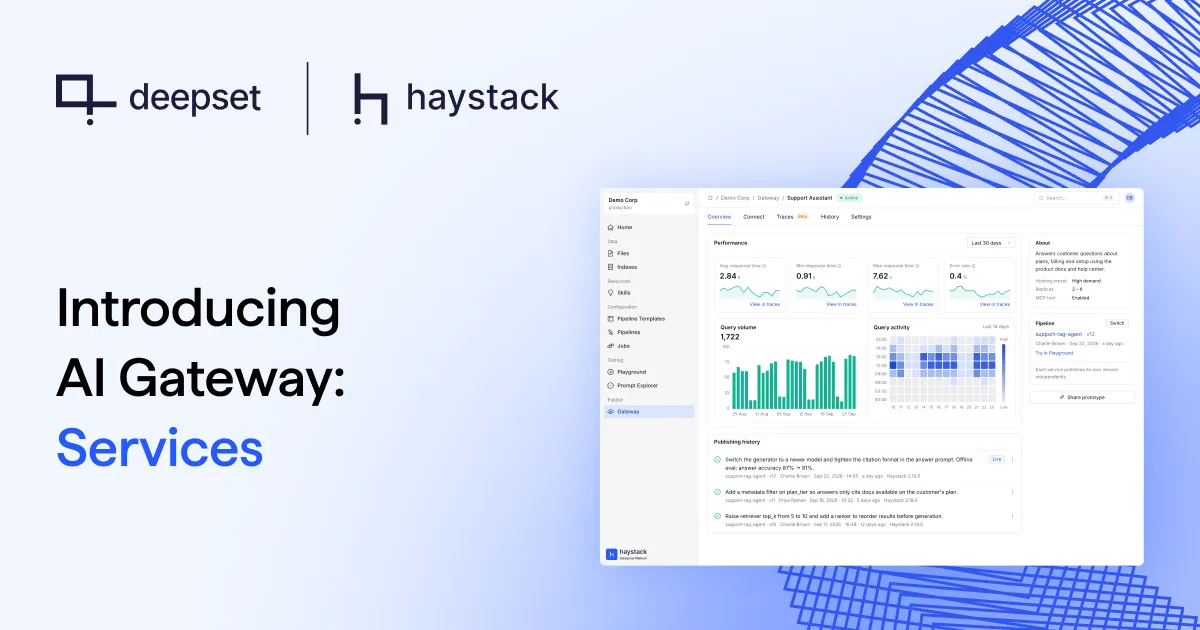
deepset has introduced Services in Haystack Enterprise Platform, a stable, managed endpoint tied to a chosen pipeline version that powers an agent. According to the company, teams can publish new pipeline versions without changing the endpoint that apps and other agents use.
- deepset introduced Services in Haystack Enterprise Platform: stable, managed endpoints tied to a chosen pipeline version.
- Apps and agents connect to the Service, so new pipeline versions can be published without changing the endpoint.
- If a new deployment fails, the last successful version keeps serving, according to deepset.
- Teams can create separate Services for testing, staging, production or individual applications, and set replicas and idle timeouts.
- Services are the first capability in Gateway, the product area deepset is building toward a broader AI Gateway.
The problem: agents change, consumers need stability
In a blog post published on October 1, 2026, deepset describes agent development as a constantly changing, iterative process. Teams update prompts, switch models or data sources, refine retrieval strategies and change business logic as they learn from testing and real-world usage.
The applications and workflows that depend on those agents, however, need stability. deepset frames the question as how to let AI engineering teams work fast and test flexibly without the fear of breaking things. Services are its answer.
How Services work
In Haystack Enterprise Platform, a Service is a stable, managed endpoint connected to a chosen pipeline version. Apps and other agents connect to the Service rather than directly to the underlying pipeline. When a new pipeline version is ready, teams can publish it without altering the endpoint its consumers use.
According to deepset, teams can do the following with Services:
- Publish versions safely: choose exactly which pipeline version is live, record what changed, and keep the last successful version serving if a new deployment fails.
- Separate environments and consumers: create independent Services for testing, staging, production, or individual applications and integrations.
- Configure each runtime: set replicas and idle timeouts for every Service, or use recommended system defaults.
- Operate with visibility: review traces, performance, connection details and publishing history at the Service level.
The company says Services create a reliable interface between an organization's AI capabilities and everything that consumes them.
A foundation for a broader AI Gateway
deepset also positions Services as the first step toward an AI Gateway. The company notes that AI gateways are often associated with a single endpoint for accessing multiple models, supported by routing, fallbacks and spend tracking. That remains an important part of the category, it says, but enterprise requirements are expanding.
AI applications increasingly depend on more than models. They use tools, pipelines, data, MCP servers and other agents. In deepset's view, before an organization can control access, cost, security or routing, it needs a stable object those controls can apply to, and Services provide that.
Within Haystack Enterprise Platform, Gateway is the product area where teams expose and operate the AI capabilities they build. According to deepset, Services are the first foundational capability inside it.
What it means for teams running pipelines
deepset recommends Services as the way to publish pipelines for teams that already run them in production. Services are created and managed in Gateway, and existing deployed pipelines can be moved over when a team is ready. The company points to its documentation pages on Gateway and on creating a Service for first steps.
The release follows other recent additions to the platform that deepset has announced, including Traces for agent observability in July 2026 and managed MCP tools for Haystack pipelines in June 2026. The source does not give details on pricing or availability beyond Haystack Enterprise Platform.