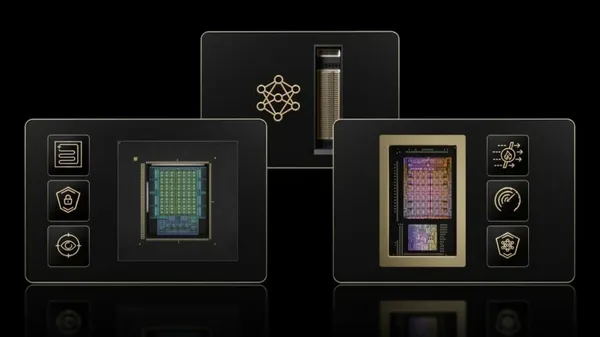
Dell and NVIDIA Pair Runtime and Silicon Controls to Rein In AI Agents

Dell Technologies says enterprises can run the NVIDIA Open Agent Safety Platform on its Dell AI Factory with NVIDIA infrastructure to keep autonomous AI agents inside their intended boundaries. The platform combines OpenShell runtime governance with Sentry threat detection running on NVIDIA BlueField-4 DPUs.
- Dell says AI agent risks such as lateral movement and unauthorized data access cannot be solved by prompting or model-level controls alone.
- The NVIDIA Open Agent Safety Platform combines OpenShell runtime governance with Sentry, which runs on NVIDIA BlueField-4 DPUs.
- According to Dell, Sentry can quarantine agents that exceed authorized boundaries in milliseconds.
- The platform runs on Dell AI Factory with NVIDIA, including PowerEdge servers with Blackwell Ultra, Rubin GPUs and Vera CPUs.
- Dell gives no pricing or availability and points customers to their account team for configuration guidance.
Why Dell says prompts and models are not enough
In a blog post by Ihab Tarazi, Chief Technology Officer and Senior Vice President at Dell Technologies, Infrastructure Solutions Group Core, the company argues that AI systems are moving from single-turn assistants to autonomous agents. These agents can plan, execute code and access enterprise resources across extended workflows, which raises the risk of unintended actions.
According to Dell, without both hardware and software enforced guardrails, such agents can move laterally across networks, access data beyond their authorized scope and trigger privileged workflows that exceed their purpose. Dell states that this "is not a model problem that can be solved through prompting alone" and describes it as an infrastructure challenge.
The post frames governance as the ability to define, observe and enforce what an agent can and cannot do. Dell says control is not the same as safety, but is a prerequisite for it.
How the NVIDIA Open Agent Safety Platform works
The platform is built from two main parts. NVIDIA OpenShell is open-source software described as an open, secure runtime for autonomous agents. It governs how an agent executes, what it can see and do, and where inference goes. It also creates a boundary between the agent's work and how it interacts with its environment.
The second part is NVIDIA Sentry, a reference system design that runs on NVIDIA BlueField-4 DPUs and uses NVIDIA DOCA for out-of-band monitoring and security-policy enforcement. According to the post, Sentry adds continuous in-silicon threat detection, identity governance and multi-tenant isolation.
- OpenShell traces agent actions and enforces runtime policies.
- Sentry verifies agent identity and enforces zero-trust access to data, tools, APIs and services.
- Sentry monitors agent activity for threats and behavioral deviations and provides attested telemetry for detection, investigation and policy enforcement.
- When agents try to exceed their authorized boundaries, Sentry can quarantine them in milliseconds, according to Dell.
Dell adds that Vera CPUs execute agent workloads, while Sentry runs on BlueField-4 DPUs in a hardware-isolated security domain independent of the host software.
The Dell AI Factory hardware behind it
Dell positions the Dell AI Factory with NVIDIA as a validated, end-to-end path rather than a do-it-yourself integration project. The post describes it as a turnkey secure infrastructure platform for deploying models, harnesses and autonomous agentic workloads at enterprise scale.
For GPU-based reasoning, Dell offers systems built around NVIDIA Blackwell and NVIDIA Rubin architectures. For NVIDIA HGX Rubin NVL8 deployments, Dell is engineering the liquid-cooled PowerEdge XE9880L and PowerEdge XE9885L. These complement the NVIDIA HGX B300 air-cooled and liquid-cooled PowerEdge XE9780/L and XE9785/L.
For the CPU needs of large multi-agent systems, Dell is engineering an 18th Generation PowerEdge portfolio powered by the NVIDIA Vera CPU. It includes the liquid-cooled, busbar-powered PowerEdge M9822, with dual-socket Vera CPUs, SOCAMM LPDDR5x memory delivering 1.2 TB/s of bandwidth and a 1.8 TB/s NVLink C2C interconnect. Dell says these systems accelerate Python runtimes, JSON tool calling and multi-agent coordination between model inferences. PowerEdge R-Series servers (R770 and R760) host the orchestration, Kubernetes control plane, API routing and proxy functions needed to run OpenShell control planes and enterprise model registries.
On the data side, the Dell AI Data Platform with NVIDIA unifies four engines: DDAE (Starburst/Trino), DDPE (Apache Spark), DDSE (Elasticsearch) and DDOE (Dataloop). Backed by Dell Lightning File System, Dell PowerScale and ObjectScale, Dell says it enables zero-ETL querying across petabyte-scale data.
PowerEdge also includes an immutable silicon root of trust, signed firmware, continuous drift detection, automated BIOS recovery and dynamic system lockdown. Secured Component Verification is meant to guarantee the authenticity and integrity of the supply chain from Dell manufacturing.
What it means for enterprise buyers
Dell says that as agents take on more responsibility with less continuous human oversight, platforms must answer a basic question: "What can this agent never do, no matter what it is instructed or prompted to try?" The company says the combined offering lets enterprises protect data, contain unauthorized agent activity and govern autonomous workflows from testing through deployment.
The post gives no pricing or availability dates. It notes that specific configuration guidance for deploying the platform's components on Dell hardware should be confirmed with a Dell account team.
Dell Technologies: A New Era of AI Agents Demands a New Security Model