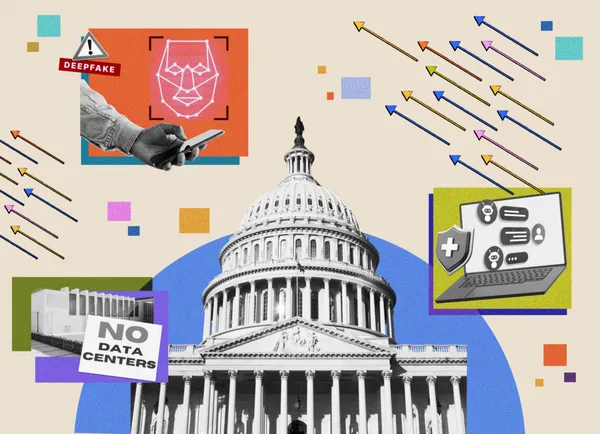
Democratic Congress could reshape US tax, AI and financial rules

Democrats are set to regain majority control of both houses of Congress after the midterm elections, creating potential changes for businesses across taxes, AI regulation, financial services and tariffs. Wipfli says President Trump's veto power will likely limit the party's priorities to measures with bipartisan or broader support.
- Democrats will regain control of both houses of Congress.
- The current Congress has four weeks of scheduled work before year-end.
- Wipfli expects AI legislation to focus on privacy, bias, transparency and liability.
- Financial institutions and digital asset firms could face stronger oversight.
- President Trump's veto power may favor measures with broad agreement.
A short window for the current Congress
The current Congress returns on November 9 for a lame-duck session, giving the Republican majority one final opportunity to advance its legislative agenda before the new Congress is sworn in early next year. Wipfli expects spending bills to be the main focus.
None of the 12 regular 2027 appropriation bills has been enacted. Lawmakers may also consider the 2027 National Defense Authorization Act, which sets military spending and policy priorities but does not itself appropriate funds.
Republicans could try to use budget reconciliation, a process covering federal spending, revenue or the debt limit that can pass the Senate with 51 votes instead of the normal 60 votes required by the “Byrd Rule.” However, only the House has passed a budget resolution so far, and Congress has just four weeks of scheduled work remaining this year. Reconciliation bills have passed in as few as 28 days, but usually take closer to 150.
Tax priorities may center on areas of agreement
Democratic control will flip leadership of Congress's tax-writing committees in the new year. Wipfli also points to a substantial loss of tax-writing experience: at least 35% of Republican tax writers lost reelection or retired, compared with 22% of Democrats.
Traditional Democratic priorities, including clean energy and higher taxes on high earners, could face resistance from the President's veto power and from voters in several states who rejected or capped tax increases. Wipfli therefore expects any successful tax legislation to focus more likely on areas of broad agreement, including improved IRS services, housing, healthcare affordability, digital assets, retirement and domestic investment.
Several issues could still be considered during the lame-duck session. Popular tax provisions such as the Work Opportunity Tax Credit have expired. The Senate unanimously approved the Taxpayer Assistance and Service Act in September, but the House would need to act. A digital asset tax bill cleared the House Ways and Means Committee but has not passed the full House. A U.S.-Taiwan tax relief bill remains in the Senate, while enhanced ACA premium tax credits expired at the end of 2025.
AI and financial services face closer scrutiny
Wipfli expects the change in congressional control to bring renewed momentum for federal AI legislation. Democratic lawmakers have pushed for consumer protections, algorithmic accountability and transparency requirements, including possible rules covering bias in automated decision-making, data privacy and liability for AI-generated harm.
The Senate Commerce Committee and House Energy and Commerce Committee could hold high-profile hearings and advance requirements for AI developers and deployers in financial services, healthcare, hiring and housing. Large-scale data centers are another focus because of concerns about energy consumption, water usage and environmental impact. Thirteen states had ballot measures addressing data centers in 2026, and voters in many cases chose to limit or prohibit them in their city or region.
Financial institutions may also face more investigations into bank mergers, fair lending compliance and the conduct of large financial institutions during economic stress. Democrats could seek to strengthen parts of Dodd-Frank and increase scrutiny of the CFPB. Digital asset companies may face stronger disclosure, anti-money laundering and exchange oversight requirements.
For businesses, Wipfli advises watching tax, AI, financial services, tariffs and healthcare together because changes in one area can create operational and financial effects beyond the tax function. “Technology companies and AI developers should engage with policymakers now and prepare for disclosure and compliance obligations that haven't existed at the federal level before,” said Brian Coddington, Wipfli's senior manager.