Deutsche Bank and Ant Digital Set Safeguards for Agentic Payments
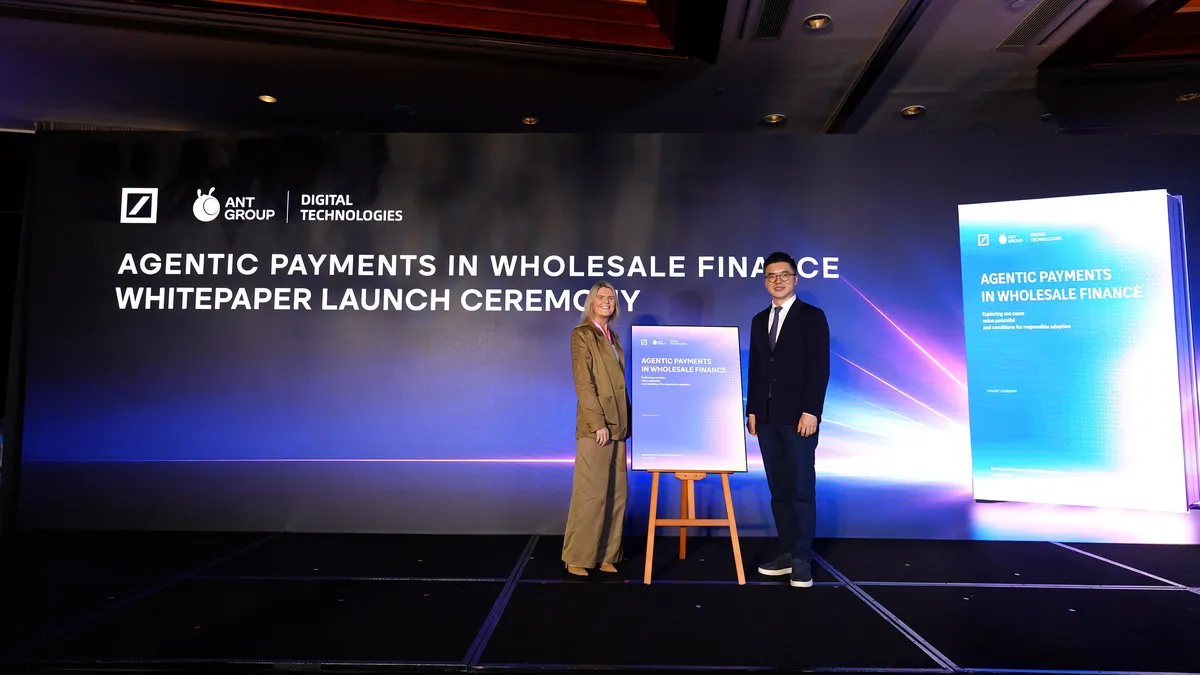
Deutsche Bank and Ant Digital Technologies have released a joint white paper examining how AI agents could execute tasks in treasury, cross-border payments and trade finance. The report proposes “bounded agentic execution” and governance controls designed to keep financial actions secure, authorised and auditable.
- Deutsche Bank and Ant Digital Technologies released a joint white paper on agentic payments.
- The report covers treasury, cross-border payments and trade finance.
- It recommends bounded agentic execution instead of unrestricted autonomy.
- Key safeguards include revocable authority, identity binding and KYA verification.
- Anvita Flow is featured as an implementation case study.
A roadmap for institutional finance
Entitled Agentic Payments in Wholesale Finance, the white paper examines the potential of AI agents to interpret objectives, evaluate alternatives and execute actions in institutional financial operations. It also addresses a central question for wholesale financial institutions: how much authority should be delegated to an agent, and how can its decisions remain secure, controlled and fully auditable?
Sabih Behzad, Head of Digital Assets and Currencies Transformation at Deutsche Bank, said in the report's foreword: “The potential value lies not simply in executing payments automatically, but in improving how those decisions are made, coordinated, and controlled.” Zhuoqun Bian, President of Ant Digital Technologies, called for a security-first approach built on verifiable identity, explicit authority and a separation between decision-making, control and execution.
Three areas for agentic payment workflows
The paper identifies treasury and liquidity management, cross-border payment orchestration, and trade finance as areas where agentic payments could create operational efficiencies and strategic value.
- Treasury and liquidity management: Agents could forecast liquidity shortfalls and surpluses, assess responses and execute compliant actions involving internal fund transfers, investments, external financing and foreign exchange operations.
- Cross-border payment orchestration: Agents could evaluate foreign exchange rates, payment rails and execution timing to balance transaction costs, speed, availability, regulatory compliance and settlement risk.
- Trade finance: Agents could interpret trade documents, identify discrepancies, coordinate exception handling and generate financing or payment instructions after relevant conditions and approvals are in place.
These applications would give agents roles in complex financial processes, but the report also highlights the governance, accountability and risk management challenges created by greater autonomy.
Separating reasoning from transaction settlement
Rather than recommending unrestricted autonomy, the white paper advocates “bounded agentic execution.” It draws on a three-layer reference architecture proposed by the International Monetary Fund: an Intent and Orchestration layer for adaptive reasoning and workflow coordination, a Control and Authorisation layer for deterministic rules and predefined limits, and a Settlement layer for final transaction execution.
The architecture deliberately separates AI-driven reasoning from the execution of financial transactions. The safeguards described by the report include explicit, bounded and revocable authorisation limits, robust identity binding for agents, and comprehensive Know Your Agent, or KYA, verification protocols.
Ant Digital Technologies' Anvita Flow is presented as an implementation case study. The platform illustrates how financial institutions can orchestrate complex payment workflows in real-world operating environments while maintaining controls over agent authority and execution. The full white paper is available from the official websites of Deutsche Bank and Ant Digital Technologies, giving institutions a framework for evaluating agentic payment adoption without handing agents unrestricted control.