Rude prompts don't make AI more accurate, Arize tests find, but they can change token costs
Being rude to a language model does not reliably improve its answers, according to an Arize AI engineer who tested polite, neutral and hostile prompts across six models. Much of the apparent token saving from rude prompts disappeared once tone was separated from instructions to keep answers short.
- Arize tested polite, neutral and hostile prompts on six models, including Claude Opus 5.5 and GPT-6.1 Sol.
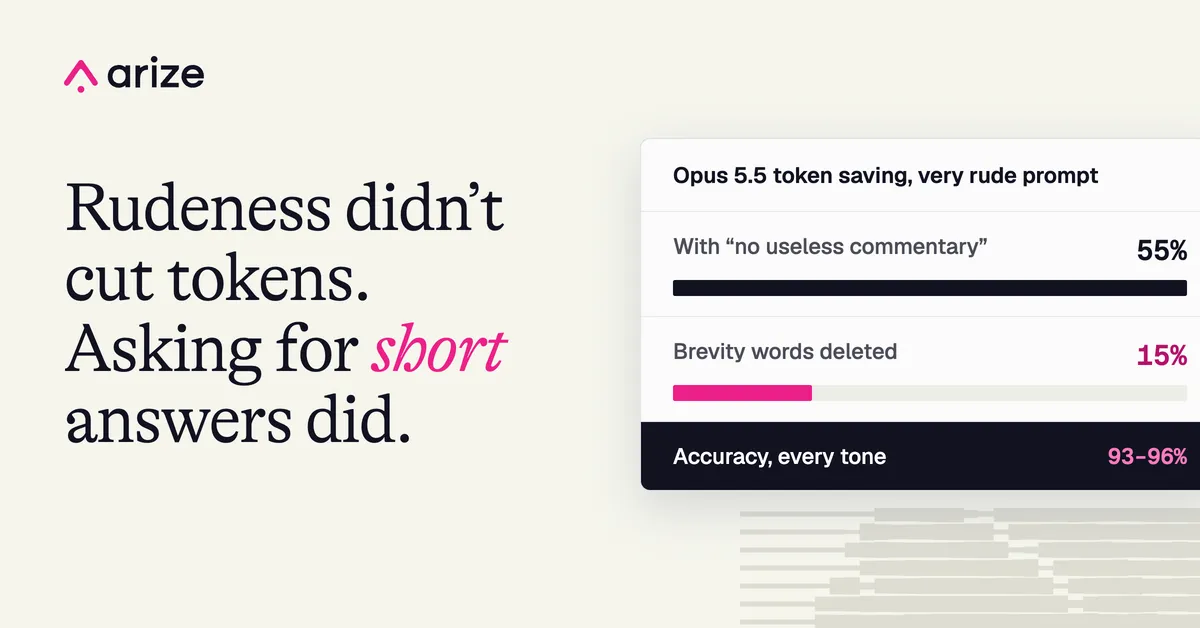
- Accuracy stayed at 93 to 96% for the current models whatever the tone.
- Much of the token saving from rude prompts came from embedded brevity instructions, not tone.
- Asking for no extra text cut tokens by 13 to 74%, but Opus and GPT-6.1 nearly doubled hidden thinking.
- Anthropic's new usage policy rule against sustained, needless cruelty to its models takes effect on November 12.
Why the question came up
The test was prompted by Anthropic's 2026 Usage Policy update, which takes effect on November 12. It adds "a prohibition on sustained and needless abusive or cruel behavior toward our models." Anthropic says the rule applies "where users repeatedly act cruelly toward our models, with no discernible purpose. It does not apply to common versions of user frustration, pushback, dark creative themes, or model testing and research."
Enforcement means Claude ending the conversation, which only happens in Anthropic's apps. According to the Arize post, developers building on the API still decide how their own product handles an abusive user.
Not everyone agrees with the concept. The Verge's coverage quotes a draft code of conduct from Microsoft AI: "The idea of model welfare is wrong. AI's should not have rights or legal personhood." The author does not try to settle whether a model can suffer, and instead tests what can be measured: accuracy, token usage and response behavior.
What earlier research found on accuracy
A Penn State paper called "Mind Your Tone" claimed that rude prompts gave better answers. It used 50 multiple-choice questions rewritten in five tones. On GPT-4o, very polite prompts got 80.8% right and very rude ones 84.8%. The author notes this covered one model and a small test.
The 2026 follow-up used 570 questions from MMLU, four models and seven tones. On GPT-4o, neutral did best and threatening was the only tone that was significantly worse. GPT-5-nano showed an 11-point spread, with neutral beating everything, while Gemini 2.5 Flash did best when threatened. The researchers concluded: "Across models, tonal effects are systematic but highly model-dependent."
Wharton Generative AI Labs tested threats and tips on five models. Its result: "Threatening or tipping a model generally has no significant effect on benchmark performance." One threat cut Gemini 2.0 Flash's score by 27.5 points because the model engaged with the threatening email instead of the question.
Tone and token usage
Penn State's follow-up on inference cost found accuracy varied by less than 3% across tones, while output tokens varied by up to 44.3% on Gemini 2.5 Flash Lite and 23.2% on GPT-4o.
Arize rebuilt the experiment in Arize AX using Claude Opus 5.5, Claude Haiku 5.5, GPT-6.1 Sol and Gemini 3.8 Flash, plus GPT-4o and Gemini 2.5 Flash Lite as a sanity check. The author used the paper's question sample, random seed, exact prompts and answer parsing. Each answer was scored for correctness, output tokens, hidden thinking tokens and latency.
In the first run, current models got 93 to 96% right whatever the tone, and no tone was significantly better or worse than neutral on any model. Tokens moved a lot: on Opus 5.5, rude prompts looked like a 65% saving over neutral, and on GPT-6.1 polite prompts cost up to 52% more.
Brevity instructions explained much of the effect
The author found that the rude prompts contained length instructions, such as "Do not waste my time or give any extra text." Even the neutral prompt asked for "the single letter," while the polite prompts said nothing about length. The experiment was therefore testing tone and brevity at once, which the author calls "not great science."
In a second run with only the brevity words removed, compared against a baseline with no prefix, most of the rudeness discount vanished. Opus's very rude saving fell from 55% to 15%, and GPT-4o's threatening saving went from 22% to nothing. Plain polite prompts were within 4% of no prefix on five of the six models.
Simply asking for a short answer worked: "Answer without any extra text or commentary," with no tone, cut tokens by 13 to 74% with no change in accuracy. There was a catch, though. Opus and GPT-6.1 nearly doubled their hidden thinking to compensate, and thinking tokens are billed too.
A third run held the task instruction constant, ending every prompt with "Answer the following multiple choice question." and changing only the tone before it. The source text provided is cut off before the results of that run.
What it means for developers
Based on the studies cited, hostile prompts offer no consistent accuracy advantage, and effects vary by model and task. For teams watching costs, the Arize results suggest that an explicit request for brevity, not rudeness, drives shorter output, while politeness itself is nearly free. Anyone who relies on length instructions should also check thinking token use, since it can rise when answers are shortened.
Arize AI: Does being rude to AI work? What 6 models revealed