Dyania and NVIDIA Bring Clinical Reasoning AI Inside Hospital Networks
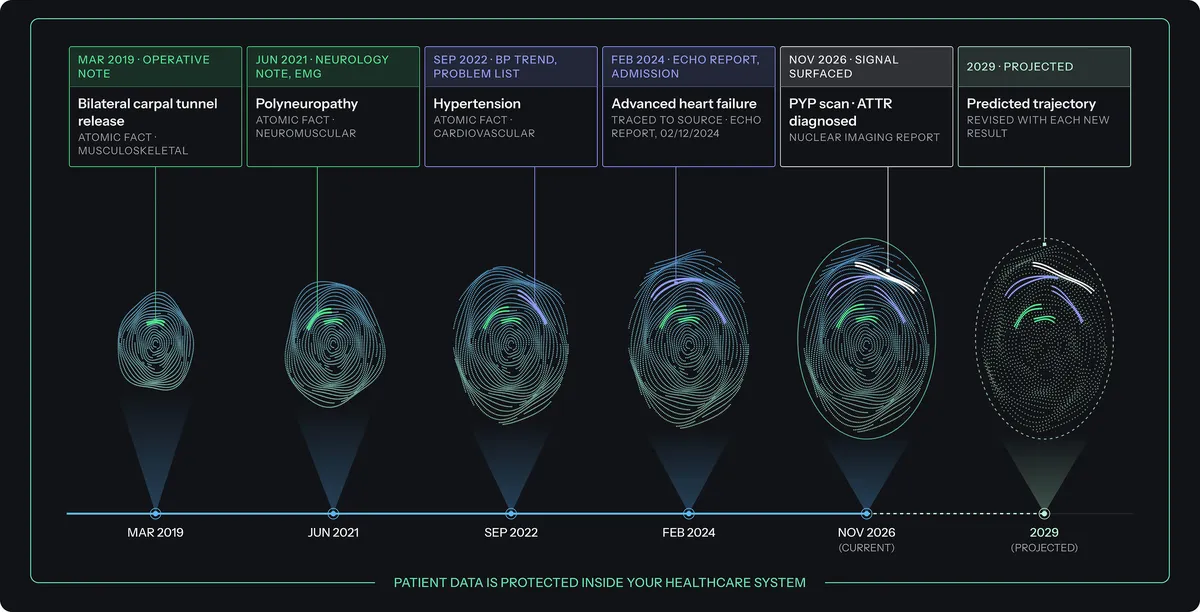
Dyania Health is collaborating with NVIDIA to run its Synapsis AI clinical reasoning system inside health systems, allowing hospitals to analyze complete patient histories without transferring records outside their networks. The companies say the technology could help identify care needs earlier and support treatment decisions with evidence from a patient’s chart.
- Synapsis AI analyzes complete patient histories inside a hospital’s private network.
- The system uses NVIDIA AI Enterprise, NeMo, TensorRT and TensorRT-LLM.
- A Cleveland Clinic study covered 7,812 aortic valve replacement patients.
- The study answered 88 clinical questions for each patient.
- The predictive tool estimates risk at three, five and 10 years and requires clinician validation.
Clinical reasoning across the full medical record
Synapsis AI reads a patient’s medical record across years of notes, operative reports, imaging reports and lab results. It answers clinical questions with evidence from the chart, working longitudinally to establish what a patient had, when it occurred and what evidence supports the conclusion.
Dyania said much of the information needed for registries, outcomes studies and predictive models is contained in narrative text rather than structured fields. Manual review can limit how many charts teams are able to analyze. Synapsis AI is designed to perform that reasoning across an entire health system rather than one chart at a time.
With NVIDIA accelerated computing, the system can process large patient populations inside a hospital’s own environment. According to Dyania, inference stays inside the hospital’s private network, so patient records remain within the health system.
NVIDIA infrastructure supports on premises deployment
Dyania brings its clinical reasoning engine and implementation experience to the collaboration, while NVIDIA provides the accelerated computing platform and software intended to run it securely and efficiently on premises. Synapsis AI is built on the NVIDIA AI Enterprise software stack end to end.
Dyania trains its proprietary clinical models with the NVIDIA NeMo framework for model training and reinforcement learning. Within a health system, Synapsis AI runs on NVIDIA TensorRT and TensorRT-LLM infrastructure. The companies will work to bring the system to health systems in the U.S. and internationally, publish joint case studies and integrate Synapsis AI with NVIDIA’s healthcare software stack.
Areas under evaluation include NVIDIA Confidential Computing for training and inference, NVIDIA Dynamo for distributed inference serving, Multi Instance GPU for dividing GPUs across concurrent clinical workloads, and scaling to many NVIDIA Blackwell Ultra GPUs as deployments move from batch processing toward near real time clinical insight at the point of care.
Cleveland Clinic study examined replacement heart valves
The first work from the collaboration is a Cleveland Clinic study involving 7,812 patients who received an aortic valve replacement between 2005 and 2021. Researchers reviewed up to 16 years of care, including narrative notes and echocardiogram reports, to examine how long replacement valves might last and whether another procedure could be needed.
Running on NVIDIA accelerated computing inside Cleveland Clinic’s environment, Synapsis AI identified the patient population and answered 88 clinical questions for each patient. The questions covered valve characteristics, co existing conditions, laboratory trends, medications, follow up ultrasound measurements and later clinical events.
The resulting dataset was produced in less time than manual review would take, according to Dyania. Researchers also trained a predictive machine learning model capable of estimating valve failure and reintervention risk timelines. The type of valve implanted was the strongest determinant of how quickly it deteriorated, while age and other medical conditions influenced whether and when a second procedure occurred.
The model estimates individual risk at three, five and 10 years and updates the outlook with each new ultrasound. Dyania said the tool is used to help inform care, but requires external validation from clinicians.
What the collaboration means for health systems
The companies present the heart valve project as an example of how hospitals could use their own records to study which patients may benefit from particular therapies, how treatments perform over time and why outcomes differ between patients who appear similar on paper.
Dyania said Synapsis AI agents will eventually continuously train predictive models of this kind, with the aim of improving recommendations for the next action in a patient’s care as precision medicine advances. The company describes current uses for Synapsis AI as finding patients who need care they have not yet received, strengthening registries and quality programs, and turning a health system’s clinical experience into better outcomes for future patients.
NVIDIA’s Chelsea Sumner said the opportunity is to give care teams more time and insight to focus on patients. Dyania founder and CEO Eirini Schlosser said the Cleveland Clinic work showed that a health system can learn from patients it has already treated to give the next patient the right care sooner. These are company statements about the collaboration and its potential, while the valve tool still requires clinical validation.