Vigil wins Elastic's Forge the Future Hackathon 2026 in India
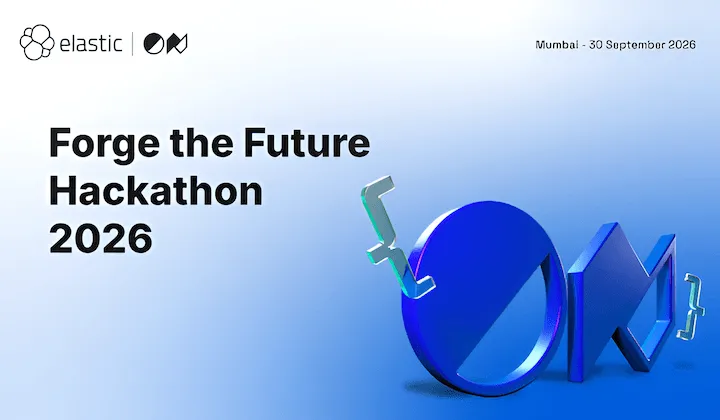
Vigil, a compliance auditing system for sales calls built by Team Frustrated Engineers, won the Forge the Future Hackathon 2026, according to Elastic. The winners were announced on stage at Elastic{ON} Mumbai after a live finale in Bengaluru.
- Vigil by Team Frustrated Engineers won the Forge the Future Hackathon 2026, announced at Elastic{ON} Mumbai.
- The contest drew 8,000 registrations and 300 idea submissions, with 20 teams reaching the Bengaluru finale.
- Eyewitness (Team Sandboxed) was first runner-up and MediAudit-X (Team defcon1) second runner-up.
- Elastic says traditional audits cover fewer than 30% of sales calls, the gap Vigil targets.
- AWS, Sarvam AI, Nasscom AI and HackCulture supported the event.
From 8,000 registrations to three winners
Elastic says the hackathon drew 8,000 registrations and 300 initial idea submissions across India. From these, 20 shortlisted teams gathered at Elastic's Bengaluru office for a two-day finale, where they turned design concepts into working, production-grade applications.
The top three finalist teams were then invited to Mumbai. There they were recognised on stage and demonstrated their applications in the Elastic{ON} Creator Zone.
The judging panel included Ravindra Ramnani of Elastic, who wrote the announcement, along with Sehaj Virk, Head of Strategy & GTM at Sarvam AI, and Chokalingam M, Director of Frontier Technology at Nasscom. Ruchikka Chaudhary, Solutions Architect at AWS, and Manasvi Jain, Partner Solutions Architect at AWS, completed the panel. According to Elastic, the focus was on robust, scalable systems built for complex enterprise workloads, and teams had to show their applications could handle live data flows, complex query logic and unexpected edge cases without failing.
The three winning builds
Grand Winner: Vigil (Team Frustrated Engineers). Elastic describes the problem as follows: Indian asset managers and mutual fund distributors handle tens of thousands of sales and customer calls daily, while regulators such as SEBI and AMFI impose strict rules against unverified return promises and mis-selling. Because manual review is slow, traditional audits still cover fewer than 30% of total calls, according to Elastic.
Vigil transcribes multilingual Indian speech, indexes the text and runs hybrid search across official SEBI and AMFI guidelines. When a representative makes an unverified claim, it flags the exact audio timestamp and matches it to the specific regulation clause. Compliance teams can verify violations in seconds rather than spending hours listening to call tapes.
First Runner-Up: Eyewitness (Team Sandboxed). Eyewitness targets silent frontend failures, such as a broken checkout button, that can leave backend dashboards looking green while customers abandon a purchase. Elastic watches session signals including dead clicks, rage clicks and abandoned checkouts. When a session looks troubled, the system replays what the customer saw, confirms a real failure and files a case with the moment it broke, a short clip and the matching backend trail. AWS reviews the recordings, and Sarvam can turn the summary into Hindi or Tamil for on-call teams.
Second Runner-Up: MediAudit-X (Team defcon1). This tool addresses medical insurance claims, where reviewers manually cross-reference hospital paperwork, discharge summaries and lab reports against policies. Hospitals upload documents and receive a structured claim. Reviewers get a recommendation with cited policy rules, treatment history and drug-safety checks. Elastic holds the claim, searches the policy and keeps the trail, while AWS reads the paperwork and runs the review steps. Approved claims are recorded onto a secure, tamper-proof audit log.
Partners and wider themes
Elastic says Elasticsearch powered hybrid search, context engineering and real-time log monitoring across the solutions. Among other projects, the judges saw automated SOC platforms meeting strict statutory incident reporting timelines and deterministic guardrails using ES|QL that prevent AI models from taking unauthorized actions. Elastic also pointed to localized multilingual voice capabilities and low-latency search.
AWS provided cloud computing and AI inference through Amazon Bedrock, SageMaker and AgentCore. Sarvam AI enabled sovereign Indian-language speech and text integration, and Nasscom AI and HackCulture supported nationwide developer engagement.
What it means
The winning entries all focus on regulated or high-stakes workflows: financial compliance, frontend incident response and healthcare claims. Elastic argues that as enterprises move beyond basic generative pilots toward autonomous operational agents, India's engineering community is well placed to build scalable, auditable AI applications. The source gives no information on whether any of the winning projects will be developed into commercial products.
Elastic: Building production-ready AI in India