Envision Deploys First Commercial 800V DC Power System in AI Data Center
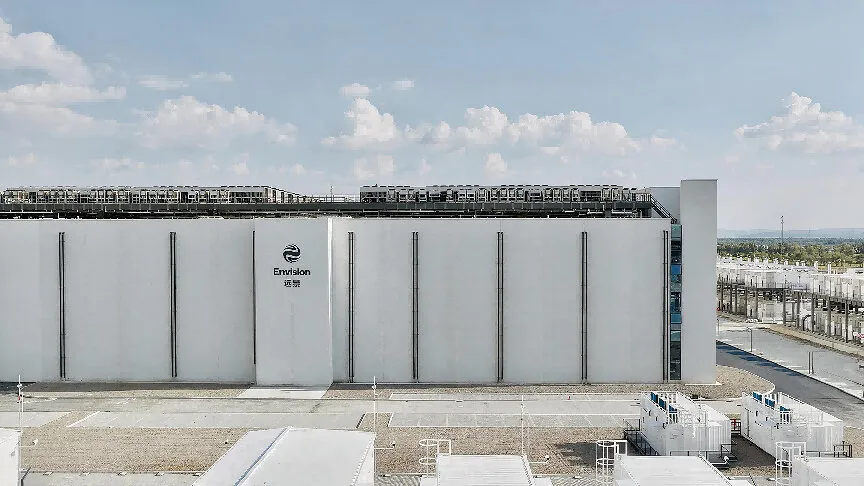
Envision says it has made the world's first commercial deployment of an integrated 800V DC power system in a large-scale AI data center. The system now powers live computing workloads at the company's Galaxy AI data center campus in Ulanqab, China.
- Envision announced the world's first commercial deployment of an integrated 800V DC power system in a large-scale AI data center.
- The system runs live workloads at the Galaxy campus in Ulanqab, China, converting 10 kV medium voltage directly to an 800V DC bus.
- It combines solid-state transformers, battery storage and the Dubhe Controller for millisecond-level coordination of GPU load swings.
- The Galaxy campus began operations in August 2026 with a planned capacity of 3GW.
- Mission Gobi targets 5GW of green AI data center capacity in desert regions by 2030.
End-to-end power from grid to rack
According to Envision, the system delivers power end to end, from medium-voltage AC input at the grid to the server rack. It combines solid-state transformers (SST), battery energy storage (BESS) and equipment that adjusts direct-current voltage for computing hardware.
The company describes three core capabilities:
- stable SST conversion directly from 10 kV medium voltage to an 800V DC bus across operating conditions;
- battery storage that provides both second-scale power support and minute-scale backup;
- millisecond-level coordination between SST and storage to absorb GPU load fluctuations locally.
Envision's Dubhe Controller, supported by its Dubhe Energy Foundation Model, coordinates the transformers and batteries in real time. Its job is to match power supply with computing demand and manage sudden load swings.
Why 800V DC matters for AI computing
Envision argues that operators must deliver more power to each rack within constrained space, while keeping supply stable as computing loads swing sharply from moment to moment. In the company's view, an 800V DC architecture significantly simplifies AI data center power systems.
The claimed benefits include higher power conversion and watt-to-bit efficiency, a more compact equipment footprint, and reduced cabling and copper requirements. According to Envision, these advantages can lower infrastructure costs and support higher computing density in the same space, meaning more computing power within the same footprint.
The announcement comes as the industry advances its transition to 800V DC infrastructure for next-generation AI data centers. Envision says its system is already operating commercially ahead of wider industry adoption and can serve as a reference for that shift.
Kevin Huang, Senior Vice President of Envision Energy and President of Energy Storage and AIDC Power Systems, said the system is "now powering live computing workloads, demonstrating an end-to-end architecture that connects renewable energy supply with computing demand." He called it "a critical step in turning power-compute coordination from a strategic vision into an operational reality."
The Galaxy campus and Mission Gobi
The Galaxy campus in Ulanqab, Inner Mongolia, began operations in August 2026. Its planned capacity is 3GW, and at full build-out it is designed to support up to one million AI accelerators operating in parallel. More than 80% of its power is planned to come from direct renewable electricity connections.
Envision aims to scale this approach through its Mission Gobi initiative, which targets 5GW of green AI data center capacity in desert regions worldwide by 2030.
What it means for data center operators
For operators planning high-density AI facilities, the deployment offers a live commercial example of an 800V DC design that links renewable supply, storage and the grid to computing demand. The source gives no cost, efficiency or performance figures for the installation, so the benefits remain Envision's own claims. The system's operation under real GPU workloads at Ulanqab will be a reference point as the industry moves toward 800V DC.