ETSI's new TC NET committee begins work on AI-native network standards
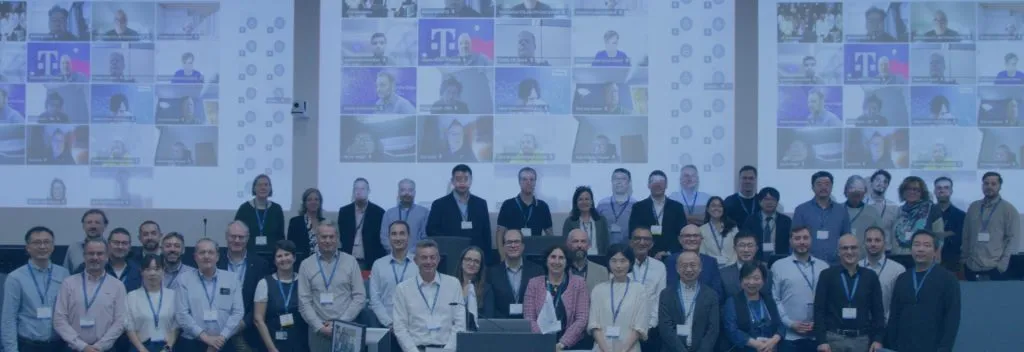
ETSI's new Technical Committee on Federated Network, Edge, Cloud and AI Technologies (TC NET) has held its kick-off meeting, creating four working groups and electing its leadership. The committee will develop global standards for a digital infrastructure that combines computing and AI resources with connectivity.
- ETSI's TC NET held its kick-off meeting from 7 to 9 October 2026 in Sophia Antipolis, France, with more than a hundred delegates.
- The committee, launched in June 2026, develops standards for a federated cloud-network-edge-device continuum that integrates computing and AI resources with connectivity.
- Four working groups were created, including one on Agentic, Intelligent and Autonomous Networks.
- Relevant work from the ETSI ISGs ENI, MEC, NFV and ZSM is to be migrated into TC NET.
- Ricard Vilalta (CTTC) was elected Chair; the next meeting is on 9-11 December 2026.
A first meeting with more than a hundred delegates
TC NET met from 7 to 9 October 2026 at ETSI headquarters in Sophia Antipolis, France. According to ETSI, the meeting brought together more than a hundred delegates from industry, including network operators and vendors, as well as research institutes and academia.
The committee was launched in June 2026. ETSI says it develops globally applicable standards for a digital infrastructure that integrates computing and AI resources with connectivity technologies. The aim is a highly programmable, intelligent and federated cloud-network-edge-device continuum.
"TC NET will define how computing, connectivity and AI resources are federated across cloud, network, edge and devices, so that intelligent services can run wherever they are needed," said Dr. Ricard Vilalta, Chair of ETSI TC NET.
Structure, migration of existing work and four working groups
At the meeting, TC NET agreed on its decision-making processes and discussed its structure. It also looked at its relationship with other relevant stakeholders and open source communities, including ETSI's Software Development Groups.
The committee also agreed on a strategy to migrate relevant activities from several ETSI Industry Specification Groups (ISGs) into TC NET. These are:
- Experiential Networked Intelligence (ENI)
- Multi-access Edge Computing (MEC)
- Network Functions Virtualisation (NFV)
- Zero-touch network and Service Management (ZSM)
Technical experts started discussions on the first set of activities. Four working groups were created:
- Continuum Infrastructure and Control
- Continuum Exposure and Services
- Agentic, Intelligent and Autonomous Networks
- Ecosystem Harmonisation and Validation
During the meeting, representatives of EURO-3C presented their interest in federating existing capabilities and infrastructure resources from telecom operators and cloud providers. They discussed a possible relationship with TC NET's standardisation activities.
Leadership and next steps
Members elected a global leadership group. Dr. Ricard Vilalta of CTTC is Chair of TC NET. The four Vice-Chairs are Lucía Cabanillas Rodríguez (Telefónica), Yu Zeng (China Telecom), Yuya Kuno (DOCOMO Communications Laboratories) and Walter Featherstone (Apple).
The committee's second meeting is scheduled for 9-11 December 2026 at ETSI headquarters.
ETSI is one of only three bodies officially recognised by the European Union as a European Standards Organisation. According to the organisation, it has over 900 member organisations from more than 60 countries across five continents.
What it means for the industry
The migration strategy suggests that work now spread across the ENI, MEC, NFV and ZSM groups is to be brought together under one committee. The working group on Agentic, Intelligent and Autonomous Networks shows that AI-driven network operation is part of the committee's remit from the start.
The leadership group includes representatives from operators and technology companies in Europe, Asia and the United States. The source does not give timelines for the first standards, so the output of the four working groups will become clearer after further meetings.