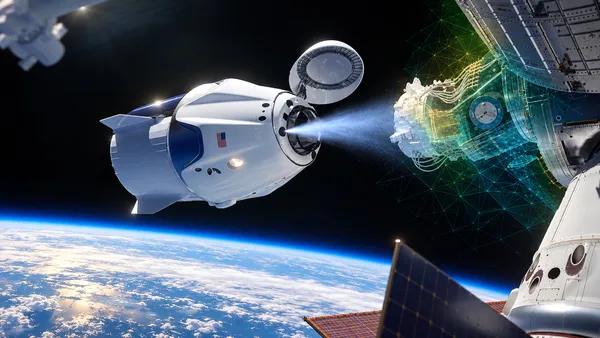
Flexcompute Simulates Starlab Space Station Cabin Airflow on GPUs

Flexcompute is collaborating with Starlab Space and Voyager Technologies to simulate airflow inside Starlab, the commercial space station designed to succeed the International Space Station. According to the company, its GPU-native Flow360 platform produced results that closely matched Starlab's existing models in a fraction of the time traditional CFD tools take.
- Flexcompute is working with Starlab Space and Voyager Technologies to simulate cabin airflow in the planned ISS successor.
- The work uses Flow360, a GPU-native CFD platform, and GeometryAI, an automated geometry preparation engine.
- According to Flexcompute, the first study closely matched Starlab's existing models in a fraction of the time of traditional CFD tools.
- The teams are now modeling how exhaled carbon dioxide moves through the cabin and how the life support system removes it.
- Starlab is designed to launch in a single flight, so its life support design must be right before launch.
Why cabin airflow is a design problem in orbit
Air behaves differently on a space station. According to the announcement, in microgravity warm air does not rise, and the carbon dioxide that crew members exhale can linger around them unless the ventilation system keeps it moving.
That puts weight on Starlab's Environmental Control and Life Support System (ECLSS), which has to circulate fresh air through every part of the station and keep the crew comfortable. Starlab is designed to launch in a single flight, so the design has to be right before it leaves the ground.
The tools and the first results
Flexcompute used two of its products for the work: Flow360, its GPU-native computational fluid dynamics (CFD) platform, and GeometryAI, its automated geometry preparation engine. Together they were used to model airflow across the full station interior.
Flexcompute says the first study closely matched Starlab's existing models while taking a fraction of the time that traditional CFD tools require. The press release gives no specific timings or accuracy figures.
The teams are now extending the work to model how the carbon dioxide exhaled by crew members moves through the cabin and how the life support system removes it.
What the partners say
Jonathan O'Neill, Atmosphere Management System Lead at Starlab Space, said: "Building a commercial space station takes partners who move at our pace." He added that "Flexcompute's engineers paved new ground in cabin ventilation CFD" and that the support "gives us more confidence as Starlab moves from design into production."
Vera Yang, Co-founder and President of Flexcompute, pointed to the limits of ground testing: "Life support airflow can't be fully tested on the ground, so simulation carries much of the design work." She said the collaboration shows what GPU-native physics makes possible for commercial space: "faster answers, earlier in design."
The companies involved
Starlab Space is a U.S.-led, global joint venture among Voyager Technologies (NYSE: VOYG), Airbus, Mitsubishi Corporation, MDA Space, Palantir Technologies, and Space Applications Services. Its strategic partners include Hilton, Journey, Northrop Grumman, and The Ohio State University. The company describes Starlab as a next-generation, AI-enabled commercial space station meant to ensure continued human presence in low Earth orbit as the ISS is retired.
Flexcompute describes itself as a frontier AI lab building a Physics World Model that bridges data-driven AI and the laws of physics. It was founded by researchers from Stanford and MIT and has a team of more than 70 PhDs. According to the company, engineering teams at more than 250 companies across aerospace, automotive, semiconductors, photonics and advanced manufacturing use its software.
What it means
For Starlab, the collaboration is aimed at getting life support design right earlier, since airflow cannot be fully tested on the ground. If the faster turnaround Flexcompute describes holds up as the work expands to carbon dioxide transport and removal, engineers could evaluate more ventilation options before the station moves into production. The release does not say when Starlab is scheduled to launch.