Forethought: A First Mover Could Make Rivals' Space Entry Costlier, Maybe Block It
A new Forethought research piece asks whether a first mover in space could cement its lead by denying rivals access, either by capturing scarce assets or by destroying rockets as they launch. The authors estimate a ~5% chance that such a lock-out leads to a decisive strategic advantage.
- Forethought separates soft lock-out (raising rivals' costs) from hard lock-out (using force, such as space-based interceptors against launches).
- Soft lock-out could add about $49, 73B, roughly 5, 7% on a ~$1 trillion build, according to the authors.
- An interceptor system is estimated at ~$150, 390B, or ~$0.6, 1.6T over 20 years, within reach of the US.
- The authors put ~10% on a baseline case, ~85% on a serious but recoverable lead, and ~5% on a decisive strategic advantage.
Two kinds of lock-out
The piece, written by Jordan Stone, Avi Parrack and Fin Moorhouse and dated 30 October 2026, defines lock-out as a first mover securing access to space while denying it to rivals. It separates the idea into two categories.
Soft lock-out means raising the cost for competitors to enter the space industry without force or the threat of force. The main route is capturing scarce, non-substitutable assets such as orbits, spectrum and lunar sites before rivals can. Hard lock-out means using force to stop others from expanding into space. The authors focus on space-based interceptors that destroy rockets as they launch from Earth.
The authors say launch from Earth is the chokepoint. A leader that held it would, in their words, have exclusive access to practically unlimited resources. They also stress that in practice lock-out means selective denial: the leader exempts itself and its allies and shuts out rivals.
What soft lock-out could cost rivals
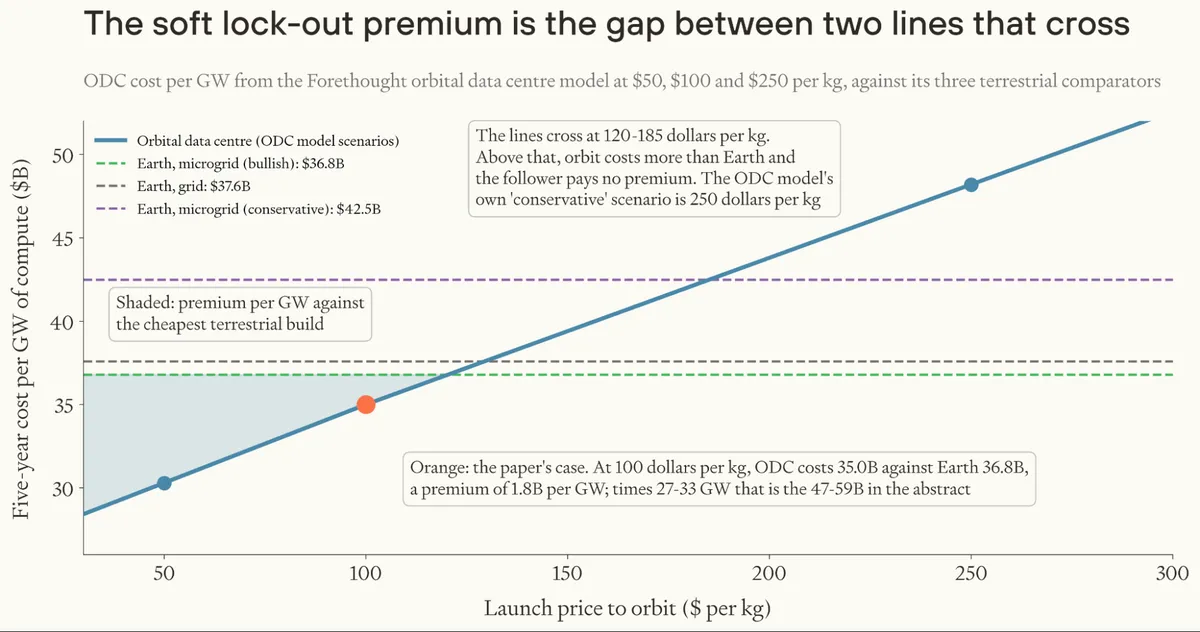
For soft lock-out, the authors consider excluding rivals from orbital bands by occupying them with data centres, or claiming the best sites on the Moon. They estimate a first mover could plausibly make a comparable presence in space about $49, 73B more expensive, a premium of roughly 5, 7% on a ~$1 trillion build. They call that small given the stakes.
The piece is clear about the limits. Soft lock-out falls far short of completely excluding later entrants, and on its own it is very unlikely to be decisive. Later entrants could pay tens of billions of dollars in workaround costs. The authors do describe a tail case: if orbital data centres become the marginal source of compute during an intelligence explosion, a first mover holding the best orbits, most plausibly SpaceX, could turn that position into a lasting lead in compute and AI capabilities. A soft grab could also supply revenue and an infrastructure base from which a first mover could move toward hard lock-out.
Interceptors and the cost of hard lock-out
For hard lock-out, the authors use existing launch and hardware costs to estimate that a first mover could set up an interceptor system for about $150, 390B, or about $0.6, 1.6T on a 20-year horizon, sized against today's fixed launch sites. They note these costs are accessible to the US, which is already pursuing a similarly capable system for missile defence, estimated at about $1.2T over 20 years.
Rivals have options. According to the piece, they could overwhelm the interceptors with rapid launches, destroy them with anti-satellite weapons, or threaten war on Earth. If a leader did maintain lock-out while supporting a space industry through an industrial explosion, it could eventually outgrow the world and achieve a decisive strategic advantage, defined as an advantage sufficient for complete domination without facing effective opposition.
Why the authors think the odds are low but real
The authors argue that space industry will eventually outgrow industry on Earth, since Earth industries will hit growth ceilings, for example from waste heat. They also note there is about 5, 7 times more usable solar energy per square metre in certain Earth orbits than on Earth's surface. They previously examined deliberately dispersing debris through Earth orbit to block access and found that strategy ineffective.
The analysis assumes broadly present-day space governance, including licensing under the ITU and FCC, no auctions of orbital slots and no new international enforcement mechanisms. That shows how far a first mover could get if nothing changes.
The authors split their probability across three cases: about 10% for a baseline in which existing terrestrial power asymmetries dominate space, about 85% for a serious case in which space-side growth compounds into a big but recoverable lead with lock-out adding at the margin, and about 5% for a decisive case in which hard lock-out confers a decisive strategic advantage. The piece closes by returning to rules that could be changed to keep the future open.
Forethought: Could a first mover lock everyone out of outer space?