Forrester study models 466% three-year ROI from Dynatrace observability
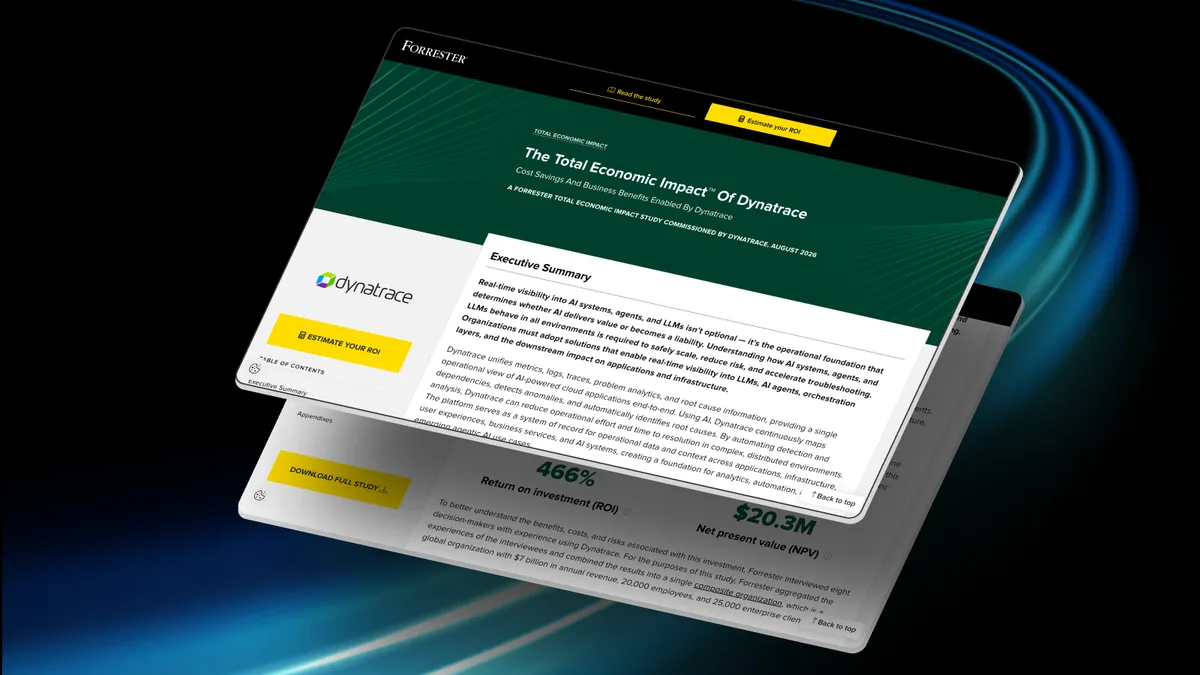
A Forrester Consulting study commissioned by Dynatrace models a 466% three-year return on investment from unified observability. According to the Total Economic Impact™ study, a composite enterprise would see $20.3 million in net present value and payback in less than six months.
- Forrester's commissioned Total Economic Impact™ study models a 466% three-year ROI for a composite enterprise using Dynatrace.
- The model shows $20.3 million in net present value and payback in less than six months.
- The largest benefit is $14.4 million from AI-powered incident detection and resolution efficiency.
- Other modeled benefits: $3.1M profit, $2.0M developer productivity, $1.3M cost containment, $3.0M tool consolidation, $765,000 regulatory reporting.
- Dynatrace commissioned the study, and the figures describe a composite organization.
Where the modeled value comes from
Dynatrace commissioned Forrester Consulting to evaluate the potential business value of unified observability, as AI adds new operational demands to already complex technology environments. The study is built around a composite organization, not a single real customer, and draws on interviews with customers.
The largest single benefit category is $14.4 million attributed to AI-powered incident detection and resolution efficiency. The composite organization starts with 450,000 monitoring alerts a year across all severity levels. For its lowest-severity P4 incidents, the model assumes 98% are auto-remediated. For critical incidents, war room time is cut by 50%, with problems identified in about two hours instead of four. With 20 people involved in a critical-incident war room, the shorter investigations free up significant capacity. Interviewees also reported reductions in mean time to resolution of up to 90%.
Forrester also modeled $3.1 million in increased profit from improved business performance, including a reduction in severe incidents of more than 50%.
Developer productivity and cost control
Forrester modeled $2.0 million in three-year, risk-adjusted present-value benefits from developer productivity. The analysis assumes efficiency gains of 30% in years one and two, and 35% in year three, across the portion of developer work influenced by observability.
A principal site reliability engineer in telecommunications reported that diagnosing a production issue dropped from 45 minutes to five minutes. Gathering logs and metrics went from 15 to 20 minutes to about one minute. A second interviewee at the same organization said major releases that once took 10 to 15 weeks now complete in two to four weeks, and minor fixes that took a week are often delivered the same day. One interviewee estimated that setting up and validating observability previously required 10 to 20 hours of coordination per project.
Operating cost containment and consumption visibility account for $1.3 million in three-year, risk-adjusted present-value benefits. The model combines three areas:
- Infrastructure: the composite's mainframe costs had been rising 8% annually, and spending is held flat despite growing workloads.
- Log management: annual log storage costs fall by 50% through more efficient data handling and less duplication.
- AI token consumption: token spending is reduced by 20% against a baseline that assumes annual AI spending growth of 30%.
One interviewee used Dynatrace to see the cost of individual prompts and identify the ten most expensive queries, which led to caching opportunities and changes in which models handled different tasks.
Tool consolidation and regulatory reporting
Tool consolidation is modeled at $3.0 million in three-year, risk-adjusted present-value benefits. The composite retires all duplicated application performance monitoring and log management tools by year three. Separately, one interviewee reported replacing two legacy APM products and saving roughly $1.7 million in annual licensing costs, while decommissioning a standalone log analytics platform removed another $800,000 a year.
Interviewees said that before consolidating, logging and performance data were kept apart, forcing teams to switch between systems to find root causes. Major incidents could bring together 20 or more people, sometimes including external vendors, each investigating a different part of the environment.
Regulatory reporting adds $765,000 in three-year, risk-adjusted present-value benefits. The composite cuts report preparation time by 50%. One financial services interviewee said Dynatrace is used to populate four of the seven sections in its DORA incident reports.
Toward autonomous operations
A staff technical program manager in telecommunications said they run AI-driven remediation today on a single contained infrastructure use case, with control policies in place to keep human oversight before any wider rollout. In the workflow described, a Kubernetes cluster is detected with pods saturating at 90% CPU, and a problem card is created and passed to ServiceNow, which opens an incident.
Dynatrace argues that as AI systems become part of the application stack, extending observability to LLM calls, agent orchestration and inference pipelines gives teams the context to resolve problems faster. The company also says many organizations scaling LLM usage cannot tell which models, calls or agents drive spending. Because the figures come from a commissioned study of a modeled composite, results for individual organizations will differ.