Picsart compares Gemini Omni 1.2 Flash with 1.1 Flash
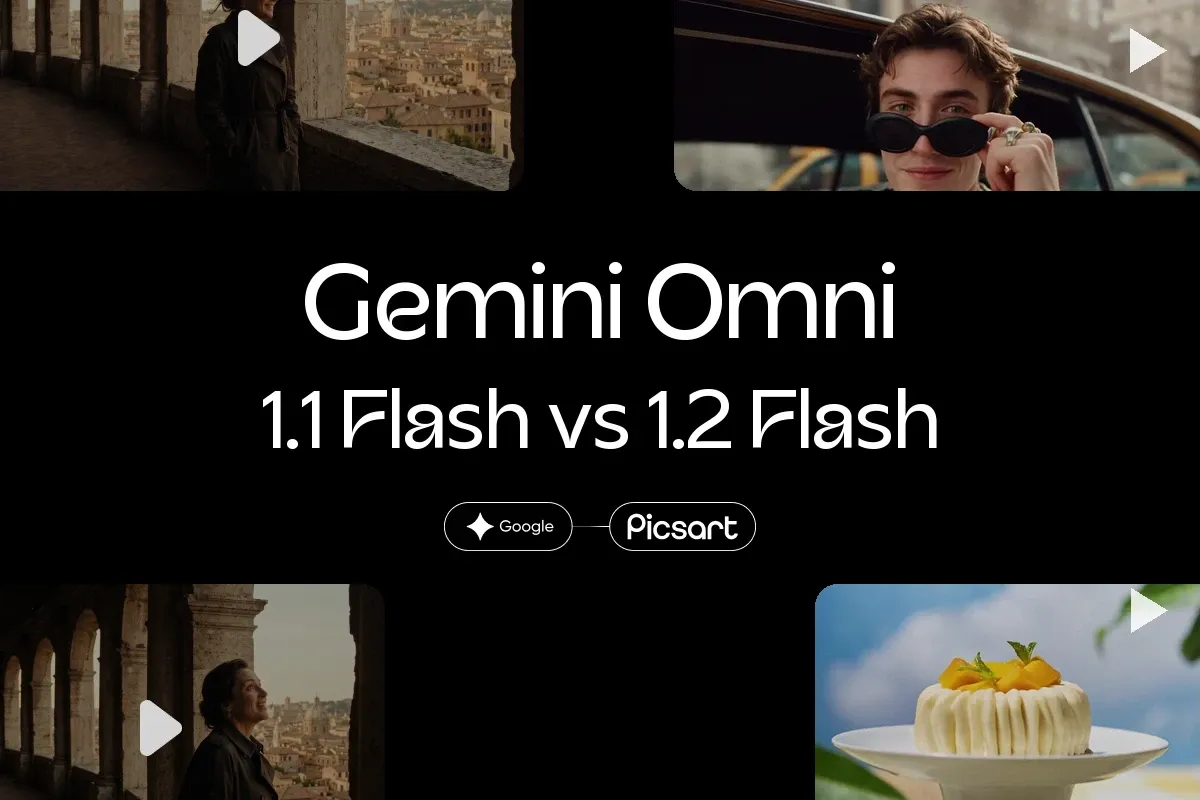
Gemini Omni 1.2 Flash brings longer clips, closer reference matching and turn-by-turn editing to Picsart, while keeping the same core controls as Gemini Omni 1.1 Flash. Both models remain available side by side in Picsart, allowing users to compare them on identical projects.
- Gemini Omni 1.2 Flash supports clips up to 15 seconds, versus 10 seconds for 1.1 Flash.
- Picsart says 1.2 holds references more consistently across camera angles.
- The newer model adds conversational editing through Picsart's Edit and Extend mode.
- Both models support the same formats, resolutions and inputs in Picsart.
- Google has deprecated 1.1 Flash on its cloud platform, but Picsart keeps both models available.
Longer clips and closer reference matching
Google released Gemini Omni 1.2 Flash in November 2026, about two months after 1.1 Flash. The newer model can generate clips from 3 to 15 seconds, compared with 1.1 Flash's 3 to 10 second range. Picsart says the additional duration can accommodate projects such as a product reveal with a closing shot, a short explainer or a social ad with room for a hook and payoff.
Clips created from a first and last frame remain limited to 3 to 10 seconds on 1.2 Flash. The model is also designed to preserve attached references more faithfully. According to Picsart, faces, garments, packaging typography and brand colors stay more consistent across camera angles, with less drift and morphing during a shot.
Gemini Omni 1.2 Flash also supports turn-by-turn refinement of the same clip. In Picsart, an Edit and Extend mode lets users change a product, background, lighting, weather or aspect ratio without starting over. Extensions can use up to the last 30 seconds of footage, while 1.1 Flash looked back at up to 10 seconds.
Speech and camera movement improvements
Picsart says dialogue is more fluid in 1.2 Flash, with clearer lip-sync and distinct voices for scenes featuring several speakers. That positions the model for short dramas, talking-character videos and explainers with multiple people on screen.
The company also says 1.2 handles long, continuous camera movements more smoothly, including sweeping fly-throughs, slow zoom-outs and orbits. The model is intended to reduce unwanted jump cuts, allowing a 15-second clip to contain one unbroken camera move instead of several shorter segments.
The two models otherwise share the same Picsart toolkit. Both support 16:9 and 9:16 clips, resolutions of 360p, 720p, 1080p and 4K, and the same inputs: a start frame, an end frame, up to five reference images, up to three reference videos and a source video of up to 30 seconds. Both start at 720p unless users change the setting and use Picsart credits per second of video within the same range.
Which model fits different projects
Picsart describes 1.2 Flash as the stronger default for projects requiring more than 10 seconds, multiple speakers, several product angles or changes to a finished clip. Its longer limit suits a 15-second ad or explainer, while its reference consistency is intended to reduce changes to packaging text and brand colors.
Gemini Omni 1.1 Flash can still make sense for a series already started with that model, since continuing with it can preserve a consistent look across episodes. For clips that only need a few seconds, either version can cover the required length.
Both models are available in Picsart AI Playground. Users can select either model, reuse the same inputs and compare results at identical settings. Picsart recommends starting with a 10-second clip, checking faces, logos, packaging text and dialogue, then testing 1.2 Flash at 15 seconds or using Edit mode to make a follow-up change.