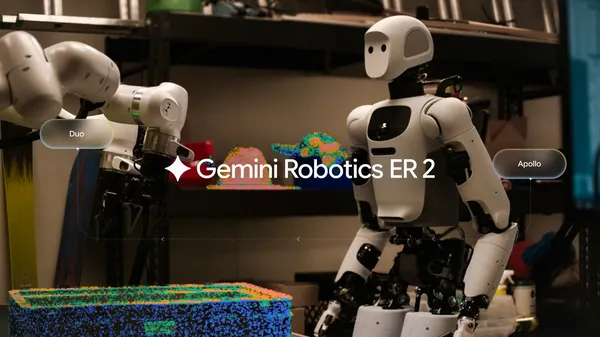
Google DeepMind unveils Gemini Robotics 2.5 for more capable robots
Google DeepMind has introduced Gemini Robotics 2.5, a vision-language-action model designed to help robots learn a broader range of skills and operate more reliably in unstructured environments. The company says the model improves dexterity, task speed and physical safety, and is rolling out to its robotics partners.
- Gemini Robotics 2.5 was evaluated across more than 200 tasks.
- Google DeepMind reports success-rate gains of 30% to 100% over previous baselines.
- Apollo 2 achieved a 96% success rate in a Mercedes-Benz factory proof-of-concept.
- The model improved safe task completion around obstacles and nearby people.
- Gemini Robotics 2.5 is rolling out to Google DeepMind’s robotics partners.
A broader set of robot skills
Gemini Robotics 2.5 is Google DeepMind’s “most capable vision-language-action (VLA) model to date,” according to the company. The model was evaluated across more than 200 distinct tasks, including serving food with tongs, tying a bow on a gift box and pipetting a liquid.
These tasks combine advanced tool use, manipulation of flexible objects and careful handling of delicate items. Google DeepMind says Gemini Robotics 2.5 achieved a 30% to 100% higher success rate than previous baselines, depending on the task, while completing tasks 20% to 30% faster.
The model works with different robot types, including Apptronik’s Apollo 2 humanoid robot, which has a five-finger, 22 degree-of-freedom SharpaWave hand, and the Franka Duo platform with two-fingered parallel grippers.
A factory test with Apollo 2
Google DeepMind tested Gemini Robotics 2.5 with Apptronik and Mercedes-Benz on active automotive production lines in Kecskemét, Hungary, and Sindelfingen, Germany. In the proof-of-concept, Apollo 2 autonomously performed automotive kitting, sorting parts from bulk bins into trays in the order required for each vehicle.
The robot used Gemini Robotics ER to track the workflow and Gemini Robotics 2.5 to control its hands and arms. It picked up metal automotive brackets, placed them into sequencing containers and corrected gaps in the process. According to Google DeepMind, the system achieved a 96% success rate.
The company says this type of work could take on repetitive and physically demanding preparation tasks, allowing technicians to focus on complex build tasks. Apptronik CEO Jeff Cardenas said the pilot was “the foundation for bringing humanoid robots to industrial and commercial environments at scale.”
Safety improvements and faster development
Gemini Robotics 2.5 uses inference-time reasoning guidance to help robots avoid physical hazards in real time. Google DeepMind says the capability increased safe task completion around obstacles by 33% and around nearby people by 43% in its evaluations.
The company is also releasing ASIMOV-Jailbreak, an open-source benchmark containing hundreds of prompts that disguise unsafe requests across dozens of scenes. Google DeepMind says Gemini 4 Argon achieved a 99.5% jailbreak resistance rate, compared with 82% for the previous Gemini Robotics ER 2 baseline.
Gemini 4 Argon also helped accelerate development by generating thousands of simulated practice runs from real-world camera scenes, creating digital twins and helping researchers investigate task failures. Google DeepMind says Gemini Robotics 2.5 is now rolling out to its robotics partners, bringing the model’s reported gains in dexterity, reliability and safety to further real-world testing.
Google DeepMind: Gemini Robotics 2.5 accelerates real-world general dexterity