Global Cruise Market Forecast to Nearly Double to USD 38.48 Billion by 2034
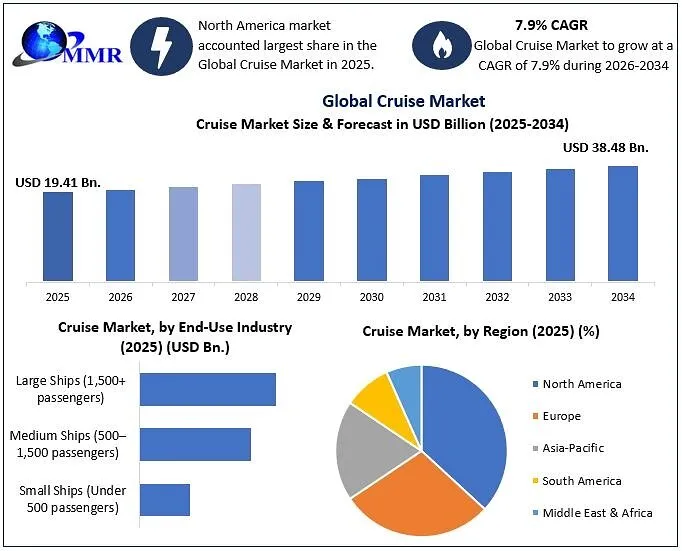
The global cruise market is set to grow from USD 19.41 Billion in 2025 to USD 38.48 Billion by 2034, according to a new analysis by Maximize Market Research. The firm projects a CAGR of 7.9% from 2026 to 2034.
- Maximize Market Research values the global cruise market at USD 19.41 Billion in 2025 and projects USD 38.48 Billion by 2034.
- The forecast CAGR for 2026 to 2034 is 7.9%.
- Global ocean cruise passengers reached approximately 37.2 million in 2025, up 7.5% from 2024.
- The industry operated 310 ocean-going ships in 2025, with nearly 80 new ships in the pipeline through 2036.
- Mainstream ships held about 50-55% of the market in 2025, and North America remains the leading region.
Passenger numbers and fleet pipeline
Maximize Market Research says global ocean cruise passenger volume reached approximately 37.2 million in 2025, which represents 7.5% growth from 2024. North America remained the leading source region with more than 22 million cruise passengers, while the Caribbean stayed the most visited destination with more than 16 million passengers.
The industry had 310 ocean-going ships in operation in 2025. According to the analysis, nearly 80 new ocean, expedition and river cruise ships were in the pipeline through 2036, which the firm reads as a sign of continued investment in capacity and next-generation vessels.
The report also puts the global economic output generated by cruise tourism in 2024 at USD 198.8 Billion, with 1.8 million jobs supported worldwide. About 35% of global ocean cruise travelers were below the age of 40 in 2025.
What is driving demand
The analysis points to experiential tourism, multi-destination holidays, luxury cruises, family vacations, expedition travel and tourism recovery as the main demand drivers. First-time cruisers, new itineraries, digital booking, younger travelers and multigenerational tourism are also cited as supports for growth.
Operators are investing in technology and cleaner propulsion. The report lists:
- LNG-capable and fuel-flexible vessels
- shore-power readiness and biofuel testing
- advanced wastewater treatment and energy-efficiency technologies
- smart cabins, mobile applications and AI-supported personalization
In Singapore, Disney Cruise Line launched Disney Adventure in March 2026. The 208,000-tonne ship is the first Disney Cruise Line vessel to be homeported in Asia, and the report says it expands premium and family capacity in Southeast Asia.
Segments, regions and competition
By type, Mainstream Cruise Ships led in 2025 with approximately 50-55% of the market. Premium Cruise Ships accounted for nearly 30-32%, and Luxury Cruise Ships for around 15%. Large ships carrying more than 1,500 passengers remain important, while small and medium vessels serve luxury, expedition, river and destination-focused trips.
North America is the leading region, backed by established infrastructure, major homeports and destinations such as the Caribbean, Alaska and Mexico. Europe stays important through Mediterranean and Northern European routes. Asia Pacific is gaining momentum across China, Japan and Australia, the Middle East is developing through hubs such as Dubai, and South America offers opportunities in Brazil, Argentina and the Amazon region.
The report names Carnival Corporation & plc, Royal Caribbean Group, MSC Cruises, Norwegian Cruise Line Holdings, Disney Cruise Line, Viking, Princess Cruises, Celebrity Cruises, Costa Cruises and TUI Cruises among the important players. Luxury names include Regent Seven Seas Cruises, Silversea Cruises, Seabourn, Crystal and Oceania Cruises.
Recent moves cited include Royal Caribbean Group's announced expansion of its Celebrity river fleet, Norwegian Cruise Line adding Norwegian Luna, and Viking expanding its luxury ocean offering with Viking Mira. Regent Seven Seas Cruises prepared the Seven Seas Prestige for its maiden transatlantic voyage.
What it means for the market
Maximize Market Research argues that competition is increasingly shifting toward fleet modernization, regional expansion and differentiated experiences. In its view, companies that expand capacity, improve the passenger experience, adopt cleaner propulsion and strengthen their regional presence are likely to shape the market through 2034. These are the firm's own projections and assessments, not company guidance.