GMIF2026 in Shenzhen: AI inference pushes memory and storage to center stage
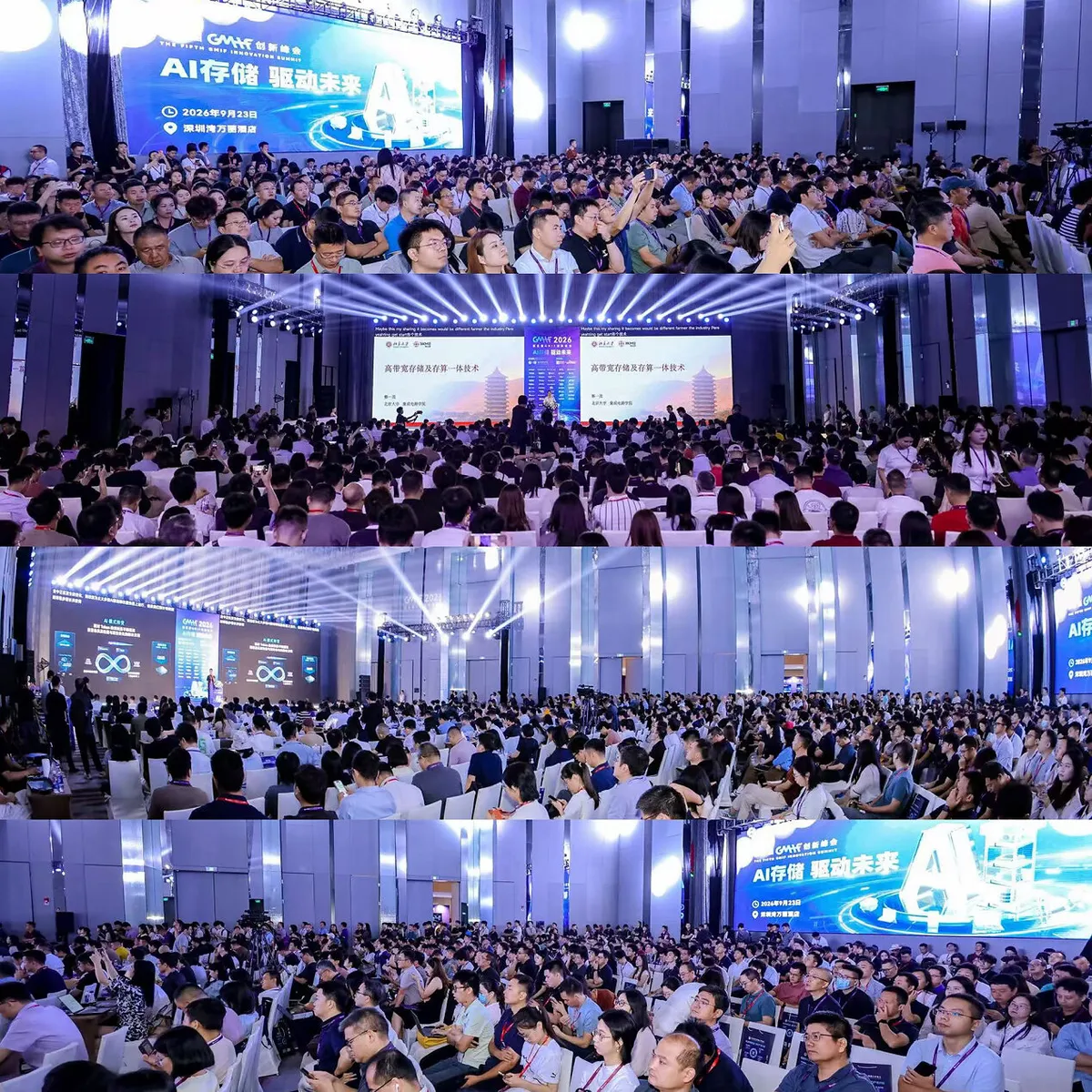
The 5th Global Memory Innovation Forum (GMIF2026) in Shenzhen, themed "The Future Built on AI Memory and Storage", focused on how large-scale AI inference is changing the role of memory and storage. Speakers from Samsung, Sandisk, Solidigm, Arm, Lenovo and others described the "token factory" as an emerging model for enterprise AI.
- The 5th GMIF Innovation Summit (GMIF2026) took place in Shenzhen under the theme "The Future Built on AI Memory and Storage".
- Morgan Stanley's Daniel Yen projected more than half of cloud data center capex to go to memory and storage (excluding HBM) by 2027.
- Speakers from Samsung, Sandisk and Solidigm pointed to KV cache demand, tiered storage and memory offloading as core inference topics.
- Lenovo's Tao Zhou said 80% of enterprises have deployed at least one agent, but fewer than 40% of projects scale with positive ROI.
- The exhibition featured 40 companies, from controllers and SSDs to token factory servers and software.
From training to inference: memory moves to the center
The summit was co-hosted by the Shenzhen Memory Industry Association (SMIA) and the School of Integrated Circuits at Peking University. According to the organizers, GMIF has grown from a regional gathering into a benchmark for the global semiconductor memory ecosystem. This year's edition included keynotes, an investment forum, product exhibitions and a global livestream.
Rixin Sun, President of SMIA, said that as AI evolves from generative to agentic, inference efficiency, data scheduling and system coordination have become shared priorities. He described cooperation across the value chain as a deeper partnership built around workload requirements, joint product definition and scenario validation.
The organizers framed the token as a new unit of value as AI shifts from model training to large-scale commercial inference. Inference demands low latency, high concurrency and sustained throughput, which makes memory and storage bandwidth, capacity and energy efficiency key factors in system efficiency and cost.
Daniel Yen of Morgan Stanley projected that global data center capital expenditure will stay strong in the coming years, with more than half of cloud data center capex expected to go to memory and storage (excluding HBM) by 2027. He named six paths to overcome the "memory wall": process migration, design changes, advanced packaging, memory peripherals, PIM/CIM, and new materials.
HBM, NAND and the rise of tiered storage
Prof. Yimao Cai, Dean of the School of Integrated Circuits at Peking University, said HBM remains central to high-end AI compute, but yield, cost and thermal constraints limit broader adoption. NAND-based high-bandwidth technologies such as HBF have become a major research focus because of their cost advantage, he said, and hybrid multi-media architectures could balance performance, capacity and cost for models with hundreds of billions of parameters.
Kevin Yoon of Samsung Electronics said agents are generating massive KV cache demand and driving rapid iteration of tiered storage, citing Samsung's work on Z-NAND, PCIe Gen6 SSDs and ultra-high-capacity data center SSDs.
Maya Zhang of Sandisk called this the first year of the "inference boom". She said AI data centers are shifting from cost centers to value and capacity centers, with the evaluation framework moving from TCO to TVO, and described the SSD as a "token battery" that improves economics through token reuse.
Benny Ni of Solidigm said high-capacity QLC SSDs are being adopted faster, memory offloading has moved from an alternative to a core design paradigm, and liquid cooling has become a prerequisite for unlocking high-end storage performance. John Xavier Lionel of Arm said competition is shifting from chasing higher TOPS to balancing compute, memory, storage and data movement, so that "the right AI workload runs in the right place."
At the edge, Stanley Huang of Silicon Motion said intelligent storage directly determines real-world device performance, pointing to its PerformaShape technology. Sam Sun of BIWIN said inference is extending memory demand to endpoints, pushing storage toward matching specific scenarios and platforms.
Token factories and the exhibition floor
Tao Zhou of Lenovo ISG China said 80% of enterprises have deployed at least one type of agent, yet fewer than 40% of projects can scale and deliver positive ROI. Lenovo says it has built a full-stack "token factory" paradigm spanning data governance, compute optimization and security management to address this.
Other firms contributed pieces of the stack. Numbers Law presented its PMD (Parallel Magnetic Drive) technology, and NEXWISE its "KuberCloud" token factory solution. Infplane, Maxio and Genstoraige focused on lowering the deployment threshold for large on-device models through AI SSD tiered offloading and memory expansion.
The concurrent exhibition brought together 40 companies. SanDisk showed its iNAND AT EU752 automotive UFS 4.1, SN861 enterprise NVMe SSD and BiCS8 QLC NAND. Silicon Motion introduced the SM8466 PCIe Gen6 16-channel controller and the SM2524XT controller for edge SSDs. Lenovo exhibited its WenTian series of AI training-and-inference integrated servers, while NEXWISE presented token factory hardware and software with token-based billing.
What it means for the market
The message from the summit is that inference at commercial scale is making memory and storage a design question for the whole system, not only a component choice. Vendors across HBM, NAND, controllers and modules are positioning products around KV cache offload, tiered storage and scenario-specific design. According to the organizers, GMIF plans a more specialized and differentiated format in the future, connecting memory companies with AI compute and end-application players worldwide.