GMIF2026 Awards Honor Samsung, Sandisk, Lenovo, Arm and Others for AI Memory Work
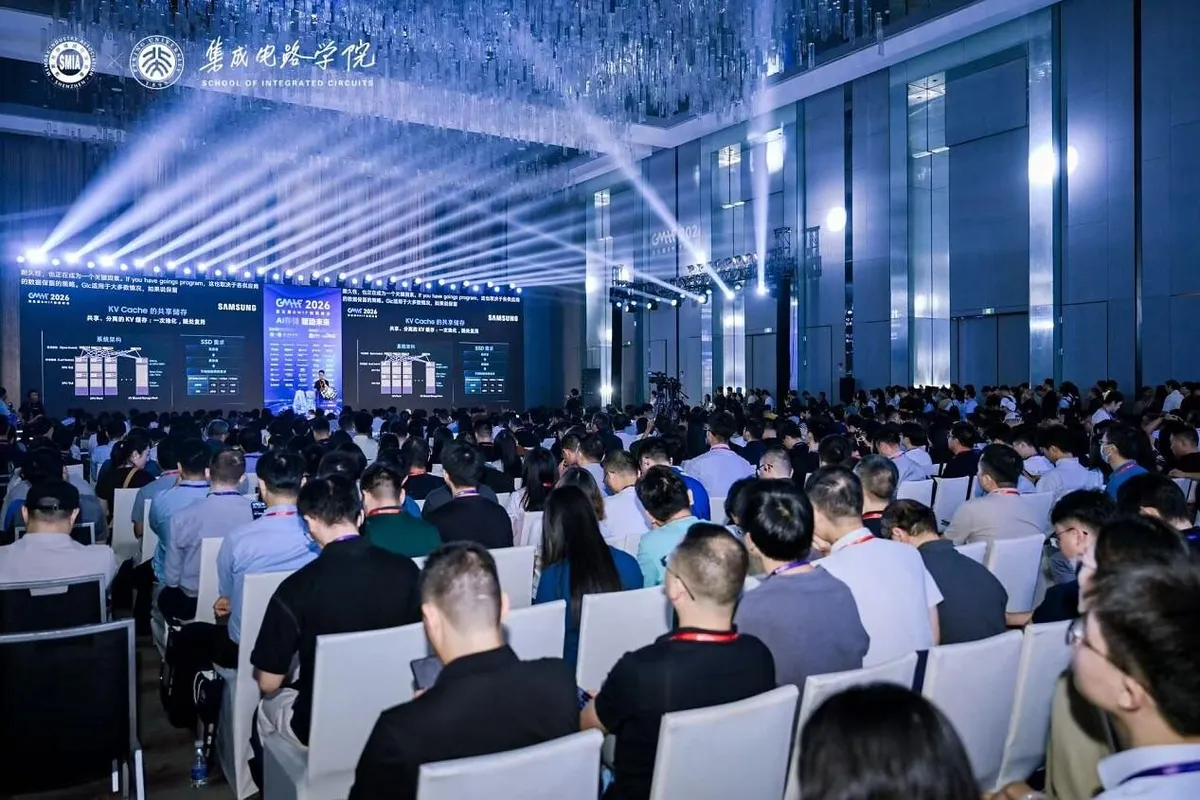
The 5th Global Memory Innovation Forum (GMIF2026) in Shenzhen has launched its Annual Awards, naming Samsung Semiconductor, Sandisk, Solidigm, CXMT, Arm, Lenovo and others among the honorees for work on AI memory and storage. According to the organizers, winners were judged on technology innovation, industry contribution, market service and application results.
- The 5th GMIF Innovation Summit in Shenzhen introduced the GMIF2026 Annual Awards, co-hosted by SMIA and Peking University's School of Integrated Circuits.
- Winners were judged on technology innovation, industry contribution, market service and application results.
- Honorees include Samsung Semiconductor, Sandisk, Solidigm, CXMT, Arm, Lenovo, Silicon Motion, BIWIN and Dify.
- Categories span memory and storage, compute, packaging and testing equipment, test systems and end applications.
A summit built around AI memory and the token economy
The 5th GMIF Innovation Summit recently concluded at the Renaissance Shenzhen Bay Hotel. It was co-hosted by the Shenzhen Memory Industry Association (SMIA) and the School of Integrated Circuits at Peking University. The theme was "The Future Built on AI Memory and Storage".
According to the organizers, the event gathered companies, technical experts and industry leaders from across the global memory and semiconductor value chain. They examined new trends, demands and partnerships in the AI era, with the token economy as a key perspective.
To recognize contributions along that chain, the summit established the GMIF2026 Annual Awards. The categories span memory and storage, compute, packaging and testing equipment, test systems, and end applications.
Memory makers, compute and infrastructure leaders
Several of the awards went to large names in memory and compute. The organizers' descriptions of the winners include the following:
- Samsung Semiconductor received the Outstanding AI Memory & Storage Industry Leadership Award. The organizers cite its zNAND-O 3D architecture, V10 NAND with more than 400 layers, and CXL memory.
- Sandisk won the Outstanding NAND Technology Breakthrough Award. The organizers point to its CBA scaling strategy, aimed at improving storage density and energy efficiency, and its role in the development and strategy of high-bandwidth flash (HBF).
- Solidigm was honored with the Outstanding AI SSD Technology Innovation Award for its end-to-end enterprise storage portfolio, from the core data center to the edge.
- CXMT took the Outstanding DRAM Technology Innovation Award. According to the organizers, it achieved the first full-platform launch of LPDDR6.
- Arm received the Outstanding AI Computing Ecosystem Contribution Award. The organizers say its platform spans cloud, edge and physical AI and has brought together more than 22 million developers worldwide.
- Lenovo won the Outstanding AI Infrastructure Leadership Award for its hybrid AI strategy and full-stack infrastructure across devices, edge, cloud and network.
Dify, the open-source LLM application development platform, received the Outstanding AI Open-Source Platform Contribution Award. The organizers credit its visual workflow orchestration and RAG engine with lowering the barrier to building AI applications.
Controllers, HDDs, compute services and vehicles
The list also covers controller makers and service providers. Silicon Motion won the Outstanding Controller Technology Pioneer Award for a controller portfolio spanning data centers, AI PCs, automotive embedded systems and consumer devices. Maxio Technology received the Outstanding AI Storage Ecosystem Contribution Award. The organizers describe it as ranking second worldwide in shipments of independent third-party SSD controllers and first in China, serving more than 100 leading customers.
Numbers Law won the Outstanding HDD Technology Breakthrough Award. The organizers say its new PMD technology delivers 30x bandwidth and more than 1,000x random IOPS.
Paratera received the Outstanding AI Computing Service Award. According to the organizers, its cross-cluster scheduling system orchestrates heterogeneous compute across millions of CPU cores and tens of thousands of GPUs, lifting utilization above 85%. NEXWISE won the Outstanding AI Infrastructure Pioneer Award, with compute clusters of roughly 50,000P across East, South and North China, according to the organizers. Both companies use a "token factory" business model.
On the application side, SYNCORE, a company jointly established by GAC Group and iFLYTEK, received the Outstanding Intelligent Cockpit Technology Innovation Award. The organizers say it was first to bring integrated device-cloud large models to mass production in vehicles.
Solution providers target specialized markets
A second group of awards went to memory and storage solution providers working on scenario-specific products across cloud, edge and device.
- BIWIN won the Outstanding Enterprise Memory & Storage Innovation Award. Its portfolio covers PCIe 5.0 SSDs, CXL memory and RDIMMs, according to the organizers.
- Infplane received the Outstanding Intelligent Storage Achievement Award. Its AI SSD uses dedicated acceleration partitions and custom scheduling algorithms for KV cache persistence, hot/cold expert prefetching for MoE models, and intelligent model data tiering.
- Genstoraige won the Outstanding Emerging Enterprise in AI Storage Innovation Award. Its edge AI 90 token factory uses an FaaS for KV Cache Offload architecture that moves KV cache from GPU memory to AI SSDs and schedules data across HBM, DRAM and SCM tiers.
What the awards signal
The awards reflect how the memory and storage industry is framing its role in AI. Recognition went not only to DRAM and NAND makers but also to controller designers, compute service providers, open-source platforms and vehicle software firms. The organizers say the list traces the technology roadmap of the memory and storage industry in the era of large models. The honorees are chosen and described by the organizers, so the performance claims above are theirs and the source does not provide independent verification.