Google's third AI Quest, Polar Peaks, has students map the human brain
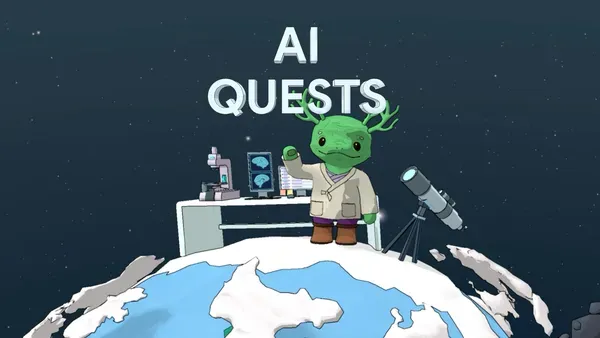
Google Research and the Stanford Accelerator for Learning have launched "Polar Peaks," the third quest in the AI Quests series, in which students ages 11 to 14 map neurons to learn how AI works and how to use it responsibly. Google is also releasing training modules to help teachers bring the quests into classrooms.
- Google Research and the Stanford Accelerator for Learning launched "Polar Peaks," the third AI Quest, for students ages 11 to 14.
- Students map neurons to explore a game character's memory loss, practicing data cleaning and model testing.
- The quest is inspired by over a decade of Google research in connectomics, including the complete fruit fly brain map.
- Teacher training modules for Quests #1 and #2 are available in the Google AI Educator Series; the Quest #3 module follows next month.
- According to Google, more than 400,000 quests have been completed in 10 languages.
A quest built around brain mapping
According to Google, AI Quests invites students ages 11 to 14 to step into the shoes of Google researchers and tackle some of humanity's biggest challenges. The first two quests focused on flood forecasting and eye disease detection, inspired by Google Research's Flood Forecasting initiative and its AI model for diabetic retinopathy screening.
The newest quest, "Polar Peaks," moves to neuroscience. Students travel to the frontiers of the field and see how AI can speed up scientific research. With guidance from in-game mentors, they scan and map the neurons in the brain to better understand the game character's memory loss.
Practicing data cleaning and model testing
Along the way, students complete tasks such as data cleaning and model testing. Google says the aim is for them to learn firsthand that AI requires careful human oversight and critical thinking.
The quest draws on more than a decade of Google research in connectomics, the science of mapping neural networks in the brain. When students finish, they hear from two researchers behind real-world breakthroughs. These include the recent mapping of the complete fruit fly brain, which Google describes as the largest brain map by number of neurons to date.
Teacher training and reach so far
Google says teachers play a critical role in bringing the quests to life and fitting them into existing curricula. To support them, it is rolling out dedicated training modules that help educators reinforce key AI literacy concepts and use AI Quests for learning and discussion. The modules are part of the Google AI Educator Series.
- Modules for Quest #1 and #2 are available now.
- The module for Quest #3 will follow next month.
According to Google, more than 400,000 quests have been completed to date, and the series is localized to 10 languages. Earlier this year, AI Quests won a 2026 Webby Award for AI Education, Learning & Training, and Best Global K, 12 Learning Solution at the ETIH Innovation Awards.
What it means for classrooms
For schools, the release adds a third activity to an existing set of free-standing lessons on AI literacy, paired with materials for teachers. The emphasis on data cleaning, model testing and human oversight reflects Google's stated goal of teaching students not only what AI can do but how to use it responsibly. Google says it will keep working with educators and partners to bring more quests to more classrooms this school year.
Google: Our newest AI Quest: Mapping the human brain