Google DeepMind unveils Gemini 4 Argon, first for trusted cyber defenders
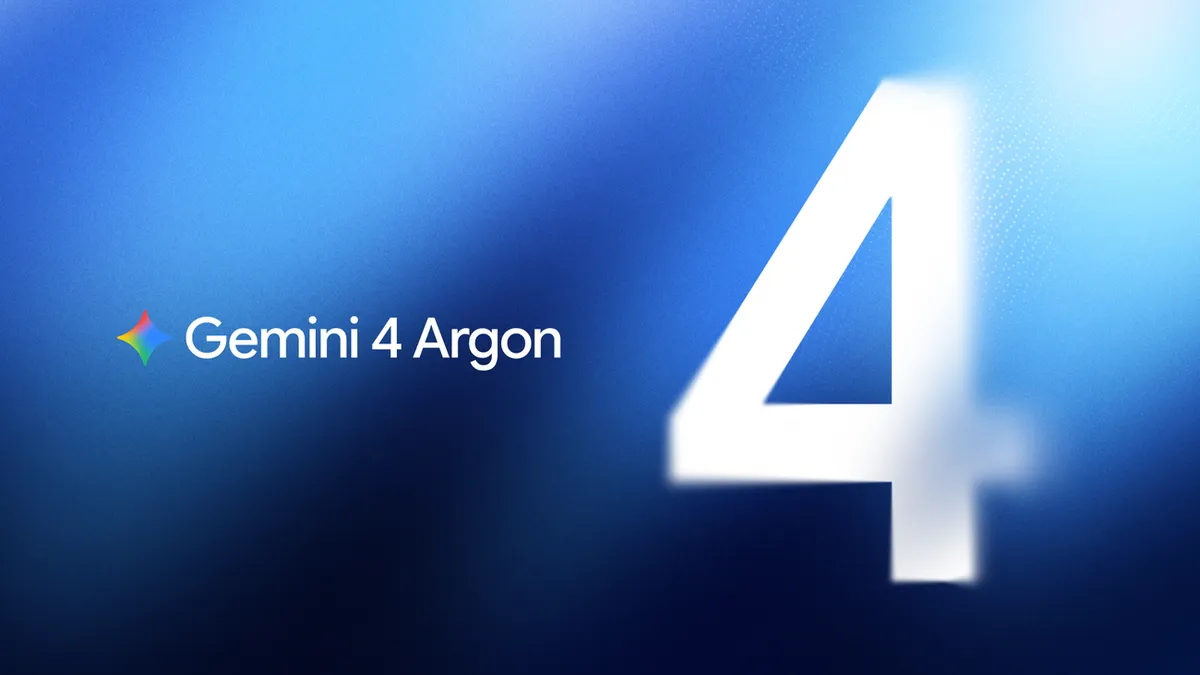
Google DeepMind has introduced Gemini 4 Argon, a frontier model aimed at long, multi-step professional work such as software engineering, legal and finance tasks, and cybersecurity defense. Access starts with a small group of trusted cyber defenders through the Fairwind Program, with a wider release to follow after further safety work.
- Gemini 4 Argon is rolling out first to trusted cyber defenders through Google's Fairwind Program, with wider access to follow after further safeguard work.
- Output token limit rises to 1M tokens from 64K, according to Google.
- Google reports 77.9% on DeepSWE v1.1, 51.3% on AutomationBench, 91.7% on LVBench and 68% on CWE-bench v1.
- Introductory pricing is $2 per million input tokens and $10 per million output tokens, with cached input at 95% off.
- Google says Argon agents are already used internally for memory optimization and C/C++ to Rust migrations.
A phased rollout with safety checks first
According to Google DeepMind, Argon is rolling out to a set of trusted cyber defenders through the Fairwind Program. The company says that releasing capabilities at this level safely requires a phased approach. It is taking part in the U.S. government's voluntary process for pre-release model access while it gradually expands availability.
Google says it will keep gathering feedback from early testers and iterate on guardrails before making Argon available to developers, enterprises and consumers "as soon as possible". No date for general availability is given in the announcement.
Pricing has been set for the eventual launch. Argon will launch at an introductory price of $2 per million input tokens and $10 per million output tokens, according to Google, with cached input tokens priced at 95% off the input token price.
Already at work inside Google
Google says Argon is already powering its internal workflows, with thousands of Googlers pointing to its strengths in specialized coding, deeper research and writing quality. The company highlights several examples:
- Quantum algorithms: Argon helped quantum computing researchers optimize the spacetime resources (qubits × gates) of subroutines that bottleneck important applications. In one example it beat the published baseline by 40% in a matter of minutes.
- Memory efficiency: A team of Argon agents analyzed fleet-wide profiling telemetry and applied memory optimizations across Google's data centers. Google says this will free up over 300 TiB of memory once rolled out, with estimated total savings of 500 TiB to 1 PiB.
- Codebase migrations: Argon agents are migrating C/C++ codebases to Rust, from tens of thousands of lines in libraries such as re2 and libgav1 up to 800K+ lines for the Fuchsia Zircon kernel. Google says these rewrites are undergoing automated and manual auditing, emulation testing and review before reaching production.
In the libgav1 video decoder, agents took an existing Rust port and replaced 32K lines of SIMD code through many rounds of profile-guided experiments. The result, according to Google, is a memory-safe decoder that runs 2.7x faster than the Rust port with identical video output.
One million output tokens and benchmark results
Google is raising Argon's output token limit to an "industry-leading 1M tokens", up from the previous 64K. The company argues that a model with room to generate hundreds of thousands of tokens in a single trajectory can reason more deeply and solve hard problems in one go.
Google reports the following results, which are its own claims:
- A new state of the art on DeepSWE v1.1 at 77.9%, a measure of long-horizon, real-world software engineering.
- The leading position on the Vals Index, which gauges economic impact across finance, coding, legal and tax work, weighted by each sector's contribution to U.S. GDP.
- Similarly leading performance on Vals Finance Agent v2 and Harvey's Legal Agent Benchmark.
- First place on Zapier's AutomationBench with 51.3%.
- A state-of-the-art 91.7% on LVBench, which measures long video understanding.
Google says the model can also handle professional chart analysis, pick out details from long videos and act on a series of documents.
Cybersecurity defense and the Wiz example
Google says it trained Argon to be highly capable at cybersecurity defense, and that it can autonomously find, validate and patch critical software vulnerabilities. For trusted defenders and Google's internal teams, the company will release Argon without cyber guardrails so they can use its full capabilities.
Wiz is already using the model through its Scan for Good initiative, which protects critical public infrastructure for free by finding and fixing high-risk exposures. In an early demonstration, Argon uncovered a critical vulnerability exposing sensitive personal information in healthcare software used by hospitals worldwide. Google says previous frontier models had missed this risk.
On CWE-bench v1, which evaluates vulnerability remediation, Argon ties for first place with 68%. Google also says it improves on 3.8 Flash Cyber in vulnerability discovery. On Google's internal benchmark it found exposures in codebases spanning 20 programming languages. On Wiz's internal black-box penetration testing benchmark, it did better than 3.8 Flash Cyber at discovering the attack surface, identifying vulnerabilities and producing proof-of-concept evidence.
Safeguards before broad availability
Google says it is strengthening safeguards across four main areas before a broad rollout. Three are described in the announcement text available here.
- Misuse: The model is designed to refuse harmful requests, including cyber and chemical, biological, radiological and nuclear (CBRN) attacks, while preserving legitimate dual-use research. Google says it is improving techniques to monitor the model's internal activations, and that internal and external red teams tested the safeguards.
- Prompt injection: Google calls Argon its most resilient model yet against indirect prompt injections and says it leads on Gray Swan's Indirect Prompt Injection benchmark.
- Misalignment: Mitigations monitor Argon's chain-of-thought and actions and stop execution when necessary, so the model does not go beyond the user's intentions.
What it means
For now, Argon is available only to a narrow group, and the benchmark figures come from Google and its partners rather than independent tests. The announcement signals where Google is directing the model: long-running agentic work in engineering, finance, legal and security. Developers and enterprises will have to wait for the wider release, which Google ties to continued testing and feedback. The stated introductory prices give an early indication of what that access will cost.
Google DeepMind: Gemini 4 Argon: our next era of frontier intelligence