Google launches EmbeddingGemma 2, a multimodal embedding model for on-device search
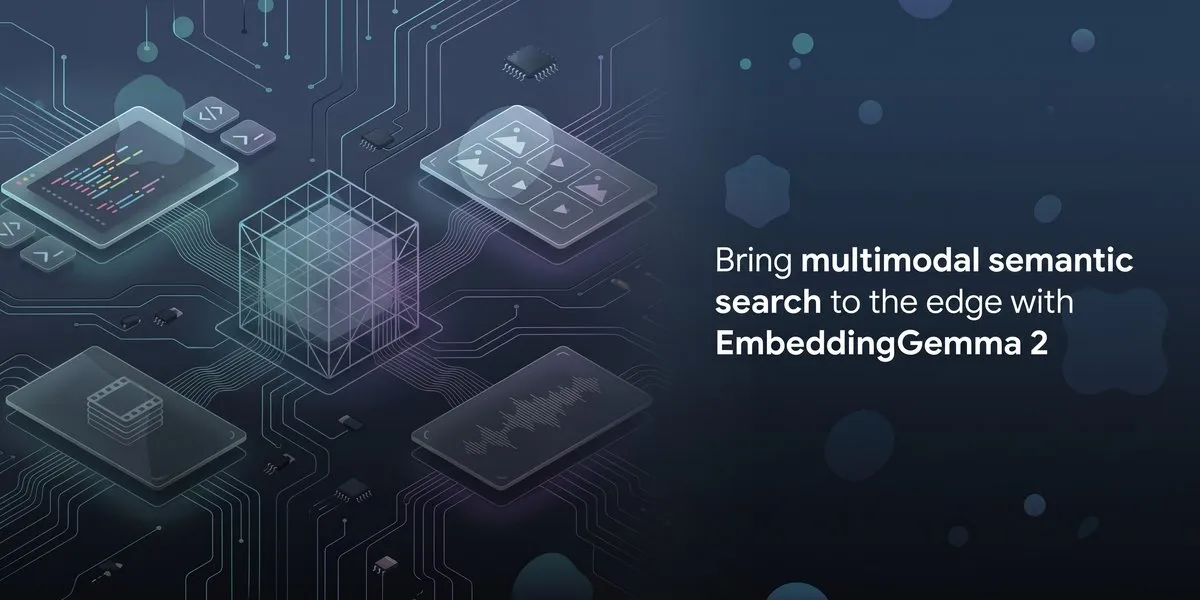
Google DeepMind has launched EmbeddingGemma 2, an open-weight multimodal embedding model that maps text, images, video frames and audio into a single vector space. According to Google, the 740M-parameter model is built for local, privacy-first apps and is the best in its class for its size.
- Google DeepMind launched EmbeddingGemma 2, an open-weight multimodal embedding model with 740M parameters.
- It maps text, images, video frames and audio into one vector space and, per Google, runs in ~567MB of active RAM for the full model on a Pixel 11 Pro.
- Google AI Edge Gallery gains Instant Media Search and Video Moments Finder; Foresight launches as an experimental Mac app.
- MediaPipe Tasks adds support now, while ML Kit availability on Android is planned for the coming weeks.
One vector space instead of chained models
Google says EmbeddingGemma 2 is meant for developers building local search and media retrieval. Because it handles text, vision and audio natively, it removes the need to chain separate image captioning, speech-to-text and text-embedding models. According to the company, that cuts latency and memory overhead.
The model uses modular encoders. Google states that it can run on as little as ~191MB of active RAM for text-only weights and ~567MB for the full multimodal model on a Google Pixel 11 Pro.
Google also describes the model as an on-device decision engine. Without training data or fine-tuning, it matches user inputs against classification labels and descriptions, which the company says delivers zero-shot intent routing in milliseconds.
New demos: Gallery and Foresight
Two new showcases have been added to the Google AI Edge Gallery app, which lets users and developers try on-device AI models. Instant Media Search finds images or videos in local media using natural language or example images. Queries and media are converted to on-device embeddings, with the media vectors stored in a local SQLite database, and results are ranked by cosine similarity. Results update with every keystroke and no internet connection is needed. Google's example is typing "Katze" (German for cat) to see cat photos, then refining to "Katze schläft auf Tastatur" to bring one specific photo to the top. Users can also pick an image or use the live camera stream to find related photos.
Video Moments Finder locates specific moments in local videos without transcribing audio or generating text captions. After a user selects a video, the engine indexes vision with audio chunks and creates embeddings. Queries such as "kids laughing" or "dog catching a frisbee" return the matching timestamps. The Gallery app is available on Google Play and the Apple App Store, and a GitHub repo shows the implementation.
Google also launched Google AI Edge Foresight for Mac, an experimental meeting companion. It is powered by EmbeddingGemma 2 and Gemma 4 models and runs fully locally. It helps with note-taking, indexing and recalling transcripts and private files, and works with any meeting platform through system audio and the microphone, even offline. According to Google, it enriches shorthand notes with details from the live conversation, finds images, documents, transcripts and notes using natural language, keeps sensitive data on the device and carries no cloud subscription costs.
Tools for developers: ML Kit and MediaPipe Tasks
For Android, Google plans to make the model available through ML Kit in the coming weeks. The company says this will offer production-grade quality without developers managing the model or worrying about APK bloat, with NPU acceleration when available and automatic model updates.
For cross-platform work, MediaPipe Tasks is adding EmbeddingGemma 2 support to the existing Embedder and Semantic Retriever. Google says this covers iOS, macOS, Windows, Linux and Web, with one developer experience across platforms.
- MediaPipe Universal Embedder Task: handles image resizing, tensor normalization and multimodal tokenization, and returns 768-dimensional normalized vectors, or truncated 128d to 512d vectors.
- MediaPipe Semantic Retriever Task: an edge-optimized vector search engine that indexes embeddings on-device and runs Approximate Nearest Neighbour searches, returning ranked matches in single-digit milliseconds, according to Google.
- MediaPipe Decision Task: lets developers classify image, text or audio inputs without fine-tuning, for uses such as routing or action prediction.
What it means for developers and users
For developers, the release offers a single open-weight model and ready-made tooling for private, offline search across text, images, video and audio. For users, the demos show media search and meeting recall that, per Google, keep data on the device. The Android ML Kit service is still to come, so production Android integration depends on that rollout in the coming weeks.
Google for Developers: Bring multimodal semantic search to the edge with EmbeddingGemma 2- Google Developers Blog