Google Research uses smartwatch sensors to detect signs of hypertension
Google Research has presented an AI system that uses standard consumer smartwatch sensors to passively detect signs of high blood pressure without calibration from an arm cuff. The system was evaluated against 24-hour ambulatory blood pressure monitoring in a prospective clinical study.
- AI-PPG-ACC-HTN uses smartwatch PPG and accelerometer sensors without cuff calibration.
- The system aggregates physiological signals collected over multiple days.
- The study involved 196 participants across five US sites.
- Results were benchmarked against 24-hour ambulatory blood pressure monitoring.
- Google says the approach is exploratory and not a standalone medical diagnosis.
A smartwatch approach to hypertension screening
Hypertension affects over one billion people globally, according to Google Research, while more than half of adults with the condition are unaware they have it. The condition often has no obvious symptoms, meaning it is commonly found through incidental screening.
The research focuses on a potential way to complement episodic office care, particularly because existing commercial cuffless wearable solutions usually need regular calibration with a traditional arm cuff. Those devices generally track changes from a baseline reading rather than identifying an absolute hypertensive state.
Published in Nature, the study describes a multimodal AI system called AI-PPG-ACC-HTN. Google Research says the system can identify a person’s persistent hypertensive state by combining passive measurements collected over multiple days, rather than trying to estimate exact blood pressure values at a single moment.
How the AI system uses smartwatch data
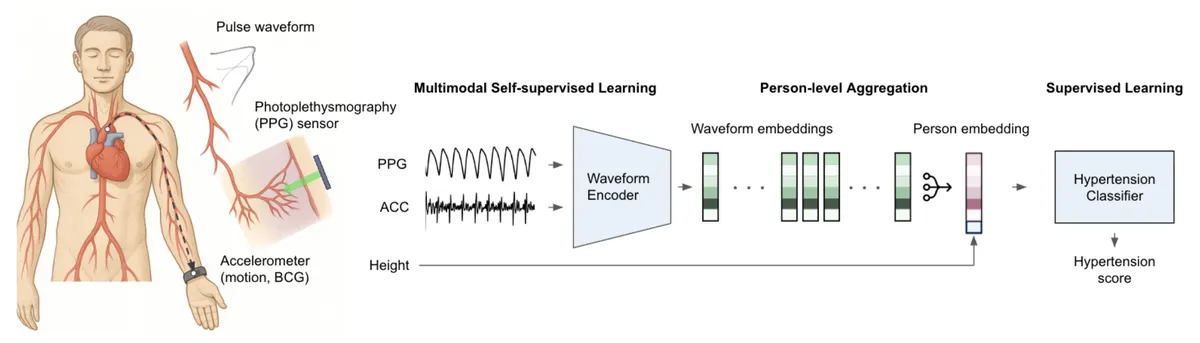
AI-PPG-ACC-HTN uses two sensors already active on modern smartwatches. Photoplethysmography, or PPG, measures changes in blood volume at the wrist through reflected light and captures pulse wave contours. Accelerometry, or ACC, detects periods of stillness and records the ballistocardiogram, subtle wrist vibrations caused by blood being ejected from the heart into the aorta.
The system turns overlapping 15-second PPG and ACC recordings into waveform embeddings. These are aggregated across multiple days of wear to reduce the influence of temporary factors such as sudden movement or temperature changes. The resulting person-level embedding is combined with the user’s height and passed to a regularized logistic regression classifier, which produces a continuous hypertension probability score.
For its waveform encoder, Google Research used self-supervised contrastive learning on 492,347 hours of sensor data from 2,109 consenting participants. The model learned physiological features from unlabeled data, without manual feature engineering or medical labels.
Performance in a clinical study
The researchers conducted a prospective, multi-center clinical study at five US sites with 196 consenting participants. The participants were free from known cardiovascular disease and were not taking blood pressure medications. The smartwatch results were benchmarked against 24-hour ambulatory blood pressure monitoring, described by Google Research as the clinical gold standard for hypertension diagnosis.
For initial screening, the smartwatch recorded 65.8% sensitivity, 90.0% specificity and an 80.6% positive predictive value. Initial office-based screening recorded 55.3% sensitivity and a 77.8% positive predictive value against the same reference.
Among 48 participants with elevated initial office blood pressure, the smartwatch achieved 78.4% sensitivity, 90.9% specificity and a 96.7% positive predictive value for confirmatory testing. Return office measurements recorded 67.6% sensitivity, 63.6% specificity and an 86.2% positive predictive value. Multi-day home monitoring recorded 89.2% sensitivity, 81.8% specificity and a 94.3% positive predictive value.
Research tool, not a standalone diagnosis
Google Research says the findings helped inform the blood pressure trends Health Guardian feature in the Google Health app. However, the company says smartwatch-based hypertension screening is not intended to replace standard clinical arm cuffs or provide a definitive standalone medical diagnosis.
The researchers describe the work as early feasibility research and say the methods are exploratory. They also state that the results are not indicative of any existing or upcoming commercial product feature or device capability.
The proposed role is an opportunistic screening tool that could passively identify people who may benefit from formal clinical assessment. The research was a collaboration between Google Research, Beth Israel Deaconess Medical Center and Harvard Medical School.
Google Research: Detecting signs of hypertension using wearable sensors