GPT-6.1 Terra tops Ultralytics auto-annotation leaderboard, beating pricier OpenAI models
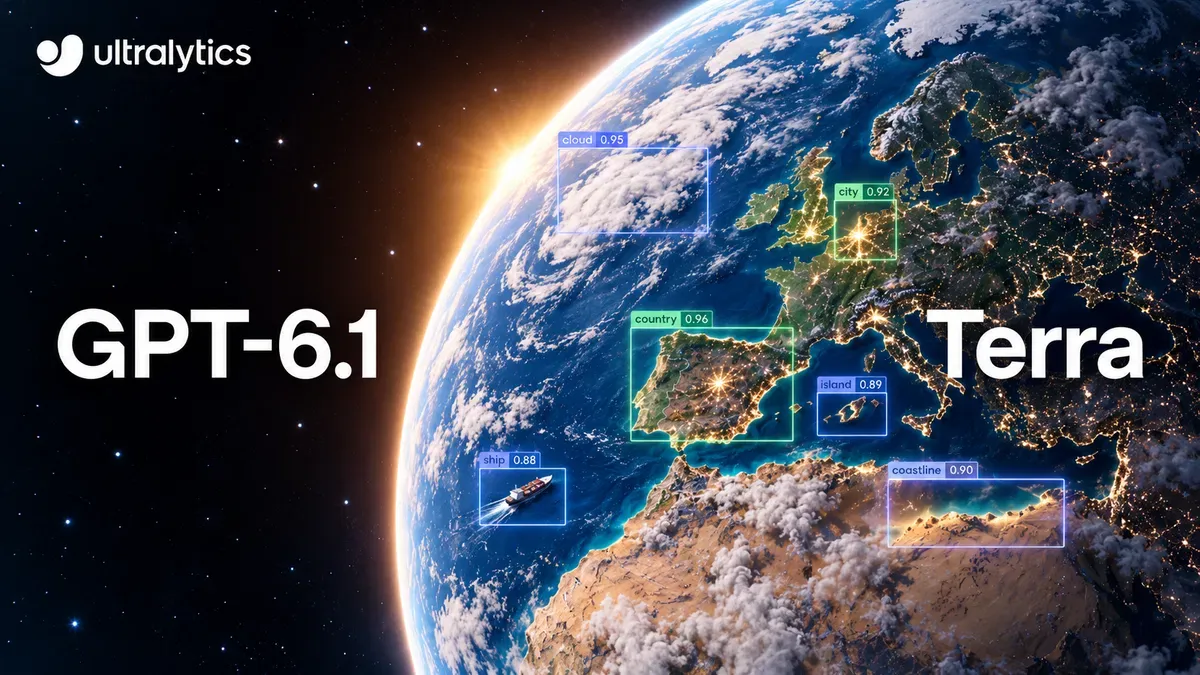
OpenAI's mid-priced GPT-6.1 Terra took first place among 39 models on the Ultralytics VLM Leaderboard for auto-annotation, scoring 0.560 mAP50 on the company's UL37 detection benchmark. According to Ultralytics, it beat GPT-6.1 Sol, the flagship GPT-6 Astra and Gemini 4 Argon, which had held the top spot until this week.
- GPT-6.1 Terra scored 0.560 mAP50 on Ultralytics' UL37 benchmark, first among 39 models.
- Cost was $4.36 per 1,000 images at a median of 5.1 seconds per image, with no failed requests.
- It beat GPT-6.1 Sol (0.514), GPT-6 Astra (0.525) and Gemini 4 Argon, which had led until this week.
- Terra averages 0.505 mAP50 on eight medical datasets but scores poorly on X-ray and PCB data.
- Without the thyroid ultrasound dataset, Terra and Gemini 4 Argon are nearly level at 0.549 and 0.544.
Best score at the lowest cost among the top six
Ultralytics ran GPT-6.1 Terra through UL37 on October 26, 2026, the day OpenAI released the model. UL37 is a benchmark of 360 images, 10 from each of 36 real object detection datasets covering medical scans, aerial imagery, retail shelves, sports, documents and circuit boards. Each image passes through the same production pipeline that Ultralytics Platform users get, with SAM 3.1 tightening every box.
Terra's scorecard, as reported by Ultralytics:
- mAP50: 0.560, first of 39 models
- mAP50-95: 0.345, also first
- Precision and recall: 0.646 and 0.613
- Provider cost: $4.36 per 1,000 images
- Median time per image: 5.1 seconds
- Failed requests: none
Six models score above 0.51 on UL37, including Claude Opus 5.5 in third place. Ultralytics says Terra is both the most accurate and the cheapest of the six. It ran at OpenAI's default medium reasoning effort, with no special tuning.
Cheaper and faster than OpenAI's larger models
OpenAI positions GPT-6.1 Terra as the fast, efficient middle of its lineup. Its documentation describes it as "a fast, efficient model for visual reasoning, precise computer use, and clear, natural writing." Pricing is $1 per million input tokens and $5 per million output tokens, which Ultralytics says is half of GPT-6.1 Sol's rate and a tenth of GPT-6 Astra's.
On UL37, the OpenAI models compare as follows:
- GPT-6 Luna: 0.370 mAP50, $0.77 per 1,000 images, 11.9 s per image
- GPT-6.1 Terra: 0.560, $4.36, 5.1 s
- GPT-6.1 Sol: 0.514, $10.30, 10.5 s
- GPT-6 Astra: 0.525, $49.31, 11.6 s
Head to head, Terra beats Sol on 22 of the 36 datasets. The two find a similar share of objects, with recall of 0.613 for Terra and 0.618 for Sol. The difference is precision: 0.646 against 0.551. On the SKU110K supermarket shelf dataset, Terra's precision is 0.79 against 0.49 for Sol, and its 0.62 mAP50 there is the highest any model has posted. Ultralytics notes that false boxes cost reviewers more effort than missed ones, so higher precision gives a cleaner first draft.
Strong in medical imaging, weak on X-rays and circuit boards
Terra's most distinctive result is in medicine. Across the eight medical datasets in UL37 it averages 0.505 mAP50, first of 39 models. The next best are Gemini 3.8 Flash at 0.387 and Gemini 4 Argon at 0.379. Terra scored 0.94 on thyroid ultrasound (TN5000), 0.90 on brain tumor MRI and 0.89 on blood cell microscopy. Ultralytics cautions that each dataset contributes only 10 images, so single scores are signals rather than verdicts, and that the output is not diagnosis. Clinical experts still need to check and approve the boxes.
The weaknesses are clear too. On every X-ray dataset in UL37, another model does better. Terra scored 0.00 on the IEDXray security dataset, where Gemini 4 Argon reaches 0.30. On industrial PCB datasets it averages 0.13, against 0.39 for GPT-6.1 Sol. On DeepPCB it scores 0.03. For circuit board inspection data, Ultralytics calls Sol the better OpenAI choice.
A closer race with Gemini 4 Argon
Terra scores higher than Gemini 4 Argon on 19 datasets, Argon on 16, with one tie. Much of Terra's 0.023 lead comes from the thyroid ultrasound set, where it scores 0.94 to Argon's 0.29. Without that dataset, the averages are 0.549 for Terra and 0.544 for Argon. By domain, Terra leads in five and ranks first of all 39 models in medical and in documents, UI and CAD. Argon leads in six, including aerial, underwater and thermal.
What it means for labeling teams
Ultralytics says GPT-6.1 Terra is available in Ultralytics Platform now. OpenAI offers it in the API as gpt-6.1-terra, and in ChatGPT Work and Codex for Plus, Pro, Enterprise and Edu users. For teams drafting bounding boxes, the results suggest a cheaper and faster option than OpenAI's larger models, particularly for medical ultrasound, MRI and microscopy, and for dense retail scenes. Ultralytics advises checking the model page, which replays Terra's recorded boxes on all 36 benchmark datasets and COCO, before labeling large datasets in domains such as X-ray or PCB inspection.
Ultralytics: GPT-6.1 Terra takes #1 for auto-annotation, beating OpenAI's own flagships