FDA Clears HanchorBio's IND for HCB303, a Trispecific Cancer Immunotherapy
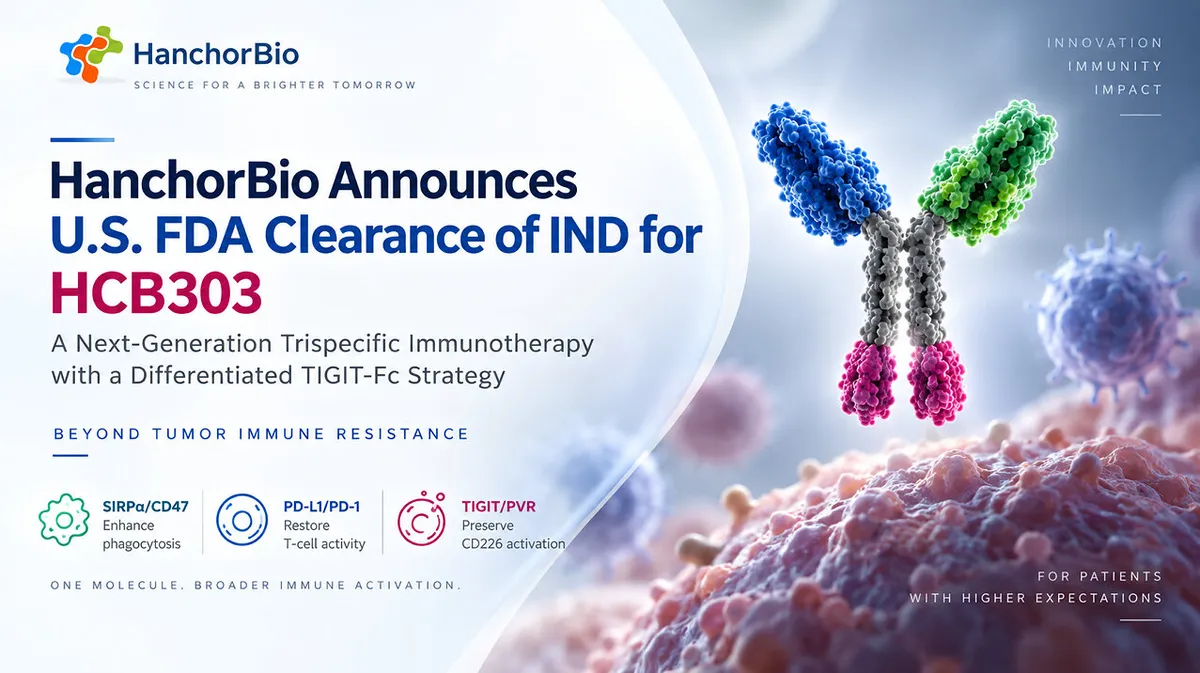
The U.S. Food and Drug Administration has cleared the investigational new drug application for HCB303, a trispecific immunotherapy from HanchorBio (TWSE: 7827), the company said. The clearance allows HanchorBio to start a Phase 1 first-in-human trial in patients with advanced solid tumors.
- The FDA cleared HanchorBio's IND application for HCB303, enabling a Phase 1 first-in-human trial.
- HCB303 is a trispecific fusion protein targeting TIGIT/PVR, PD-L1/PD-1, and SIRPα/CD47, built on the FBDB™ platform.
- Instead of blocking the TIGIT receptor, it is designed to trap TIGIT ligands and potentially preserve CD226 signaling.
- The HCB303-ONC-101 study will enroll patients with advanced, relapsed, or refractory solid tumors with no remaining standard options.
- IND clearance is not an approval and does not assure safety, efficacy, or success, the company states.
What the FDA clearance allows
According to HanchorBio, the FDA clearance enables the company to begin its Phase 1 first-in-human clinical trial of HCB303. The company describes HCB303 as its second trispecific immunotherapy to enter clinical development. The clearance follows pre-IND feedback from the agency in August 2026.
The planned study, named HCB303-ONC-101, is a dose-escalation, multi-regional trial. It will enroll patients with advanced, relapsed, or refractory solid tumors who have no remaining standard treatment options. HanchorBio says the study will evaluate safety, tolerability, pharmacokinetics, pharmacodynamics, immunogenicity, biomarkers, and preliminary antitumor activity.
The company notes that an IND clearance permits clinical investigation to proceed but is not an approval of HCB303 and gives no assurance about the safety, efficacy, timing, or success of its clinical development.
How HCB303 is designed to work
HCB303 is a humanized trispecific fusion protein built on HanchorBio's proprietary FBDB™ platform. In a single molecule, it is designed to target three pathways: TIGIT/PVR, PD-L1/PD-1, and SIRPα/CD47.
The distinguishing element is the TIGIT-Fc strategy. Conventional anti-TIGIT antibodies primarily bind TIGIT and block TIGIT receptor signaling. HCB303 instead is designed to intercept TIGIT ligands, including PVR/CD155 and CD112. By trapping these ligands, the company says, HCB303 is designed to reduce TIGIT-mediated inhibitory signaling while potentially preserving CD226 expression and the associated activating signaling in T cells and NK cells.
Combined with PD-L1 blockade and SIRPα-mediated enhancement of macrophage phagocytosis, HCB303 aims to coordinate complementary innate and adaptive antitumor immunity within the tumor microenvironment, according to HanchorBio.
Company statements and pipeline
Scott Liu, PhD, Founder and Chairman of HanchorBio, said: "We believe TIGIT-Fc offers a biologically superior strategy to conventional anti-TIGIT receptor blockade." He argued that blocking PVR signaling with an anti-TIGIT antibody may release the inhibitory signal but does not address the down-regulation of CD226, which is needed for enhanced activation of T and NK cells.
Alvin Luk, PhD, MBA, President and CMO (Group) and CEO (USA), said the clearance "moves HCB303 from a differentiated biological hypothesis into clinical testing." He added that the priority now is to evaluate whether the TIGIT biology and the coordinated engagement of innate and adaptive immunity translate into meaningful clinical benefit for patients.
HCB303 joins HCB301, a clinical-stage trispecific immunotherapy targeting SIRPα, PD-L1, and TGF-β biology. HanchorBio's pipeline also includes HCB101, its lead SIRPα-based innate immune checkpoint program, along with additional programs in oncology and immune-mediated diseases.
What it means
The clearance moves HCB303 from preclinical work into human testing, but no clinical data have been reported. The Phase 1 study is designed to assess safety and early signals of activity in heavily pretreated patients. Whether the TIGIT ligand-trap approach performs differently from conventional anti-TIGIT antibodies will only become clear as trial results emerge. HanchorBio's forward-looking statements stress that outcomes remain uncertain.