Huawei Launches Next Generation FAN to Help Operators Monetize AI-Era Broadband
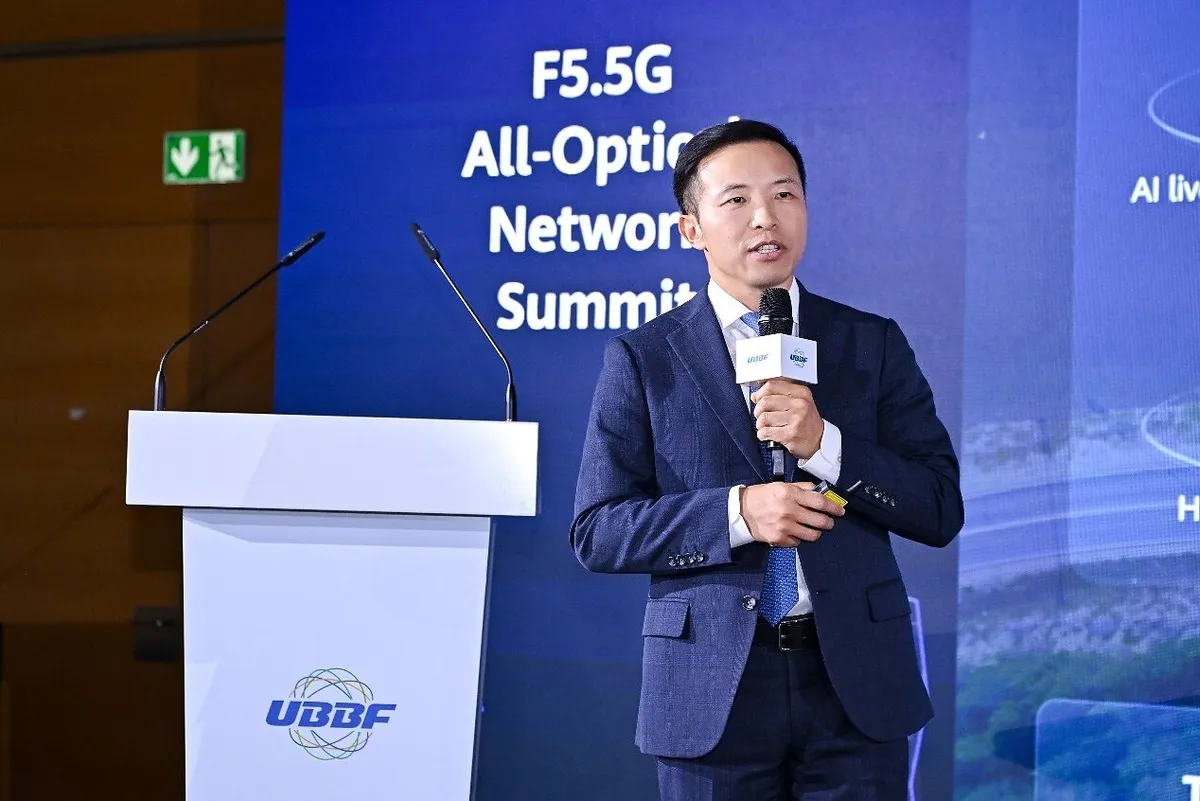
Huawei has launched its Next Generation FAN solution and a set of new optical access products, which it says will help operators earn revenue from AI-era broadband across four areas: coverage, bandwidth, experience and service. Jared Feng, President of Huawei's Optical Access Network Domain, presented the plan in a keynote at the Ultra-Broadband Forum 2026 in Vienna.
- Huawei launched the Next Generation FAN solution at UBBF 2026 in Vienna, built around four monetization waves: coverage, bandwidth, experience and service.
- According to Huawei, 4-core PreConnection cuts investment by 20% and shortens Time to Market by 70%, while the ATB solution reduces deployment time by 75%.
- FlexPON 2.0 Pro enables 10G PON-ready networks with GPON investment, and FlexPON 3.0 enables 50G PON-ready networks with 10G PON investment.
- Wi-Fi 7 products include an ONT with up to 4 Gbps bandwidth and a radar sensing solution with accuracy above 95% and a false positive rate below 1%, per Huawei.
- Gateways become AI service home hubs so operators can sell AI applications alongside bandwidth.
From connectivity to connectivity plus AI services
In his keynote, Feng argued that the spread of AI is changing the business logic of the telecom industry. According to Huawei, home applications such as AI healthcare, cloud gaming and AI live streaming are growing quickly, while enterprise demand for AI computing power scheduling, smart security and smart offices is also rising.
As a result, users' network requirements have shifted from "connectivity" to "connectivity + AI services", Feng said. He described the combination of optical networks and AI as the core direction of the industry.
He also pointed to the ITU-T ION-2030 vision, which sets an evolution framework for the global optical network industry. It names three directions for AI and optical networks to support each other: AI agent services, on-demand quality assurance that uses the bandwidth, low latency and reliability of optical networks, and AI-enabled Level 4 autonomous driving networks (ADNs) meant to improve operations and maintenance efficiency and cut energy use.
Coverage and bandwidth: cheaper, faster rollouts
For coverage, Huawei introduced the 4-core PreConnection solution, which it describes as plug-and-play and free of splicing. According to the company, it cuts investment by 20% and shortens Time to Market by 70%. For indoor scenarios, the integrated Access Terminal Box (ATB) solution uses four-core self-bonding transparent cables and built-in pigtails, and Huawei says it reduces deployment time by 75%.
On bandwidth, FlexPON 2.0 Pro lets operators build 10G PON-ready networks with GPON investment. FlexPON 3.0 allows 50G PON-ready networks with 10G PON investment. Both support Combo SFP ports and work with existing ONTs, which Huawei says allows operators to build once and upgrade several times.
Experience and service: Wi-Fi 7, radar sensing and AI home hubs
For homes, Huawei launched a full lineup of Wi-Fi 7 tri-band Next Generation ONT products, plus Next Generation Mesh and Next Generation FTTR solutions. The ONT provides up to 4 Gbps bandwidth. With Wi-Fi 7 tri-band APs and 8 dBi smart antennas, it delivers 1000 Mbps Wi-Fi mesh networking across a whole house, according to the company. The FTTR solution uses AI anti-interference and intelligent Wi-Fi interface scheduling to provide 2000 Mbps to 4000 Mbps networking.
For small and medium businesses, the Wi-Fi 7 Next Generation FTTO NVR hub solution combines FTTR with enterprise security and offers 2000 Mbps Wi-Fi 7 rates. It supports SuperCoding 3.0, which Huawei says reduces storage space use by 85%, so one disk is equivalent to six. Huawei names restaurants, supermarkets and chain stores as typical targets.
On the service side, a Wi-Fi 7 ONT and FTTR radar solution senses events such as home intrusion or an elderly person remaining motionless. Huawei states that, compared with standard Wi-Fi sensing, it detects objects within 7 meters with accuracy above 95% and a false positive rate below 1%, and filters out interference from pets and fans.
Huawei also turns traditional gateways into AI service home hubs. Using terminal AI computing power and built-in AI agents, they run applications such as smart movie viewing, 3D movie viewing and AI fitness.
What it means for operators
The pitch is aimed at operators that want to move from selling bandwidth only to selling both bandwidth and AI application services. Huawei's products target lower deployment cost and time, upgrade paths that reuse existing equipment, and value-added offerings such as home security and elderly care.
Feng said Huawei will increase investment in the Next Generation FAN solution and keep working with global operators and industry partners to advance optical access networks toward the AI era. All performance and savings figures come from Huawei's own announcement.