Huawei Pitches Next Generation OTN for AI Data Center Networks
Huawei has presented its "LIGHTS" All-Optical Network concept and a Next Generation OTN solution, which it says lets operators build networks centered on AI data centers (AIDC). The company outlined the plan at the Optical Transport Innovation Summit during NetworkX 2026 in Vienna.
- Huawei presented its "LIGHTS" All-Optical Network vision at the Optical Transport Innovation Summit during NetworkX 2026 in Vienna.
- LIGHTS stands for Low Latency, Intelligent Operation, Green Foundation, High Reliability, Tbps-level Capacity and Security Assurance.
- For DCI, Next Generation OTN offers 800G to 2T capacity and an OTN capacity pool, according to Huawei.
- For DCA, Huawei lists E2E OXC, millisecond-level WSON, fgOTN from 10Mbps to 1Gbps, and integrated QKD.
- Huawei says operators can shift from bandwidth-only sales to differentiated, value-added services.
Three waves of AI opportunity for operators
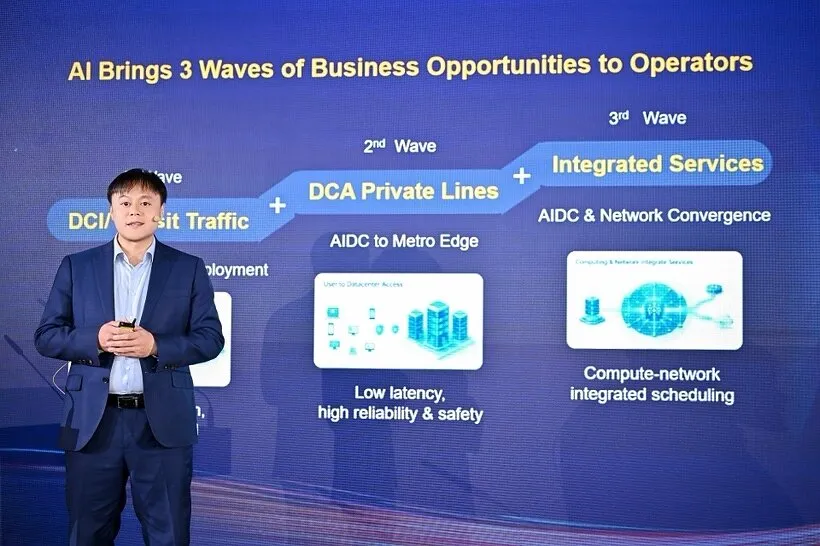
According to Huawei, the rapid evolution of AI opens three waves of opportunities for network operators: data center interconnection for hyperscalers, private lines for enterprise computing power, and integrated computing and network services.
Huawei says this is reshaping optical transport in two ways. The network is moving from a basic service for consumer and home (ToC and ToH) users to a business network serving enterprises (ToB) and AI. Planning is also shifting from administrative divisions to an AIDC-centric approach.
The LIGHTS target network and Next Generation OTN
Huawei proposes the LIGHTS target network as a key priority for operators in the AI era. The name stands for six capabilities:
- Low Latency
- Intelligent Operation
- Green Foundation
- High Reliability
- Tbps-level Capacity
- Security Assurance
Gavin Gu, president of Huawei's Optical Transmission Network Domain, presented the Next Generation OTN solution, which Huawei says responds to the need to build this network by covering both DCI and DCA scenarios.
DCI: Huawei says the solution delivers 800G to 2T ultra-high-speed capacity and an OTN capacity pool, which uses minimal resources to pre-deploy capacity in multiple directions. According to the company, this helps operators achieve fast time-to-market, maximize fiber capacity, and meet the Tbps-level bandwidth and rapid delivery requirements of DCI traffic.
DCA: Huawei offers end-to-end (E2E) OXC for a meshed, one-hop direct architecture, millisecond-level WSON for guaranteed high availability, fgOTN for flexible bandwidth from 10Mbps to 1Gbps, and an integrated QKD solution for quantum encryption.
Huawei also says Next Generation OTN has been upgraded in both hardware and software to deliver an end-to-end "zero-outage network."
From selling bandwidth to selling services
Huawei argues that the LIGHTS network lets operators move away from a bandwidth-only sales model toward delivering core capabilities and value-added services. Computing-power private lines, in its description, are advancing from a single bandwidth dimension to multiple dimensions covering bandwidth, latency, reliability and security. The company says this allows operators to offer differentiated services for different industries and improves pricing power.
The convergence of computing and network services is also accelerating, according to Huawei. As an example, it points to Hubei, China, where operators are combining network and computing advantages to launch integrated services across industries such as education, healthcare and finance.
What it means for operators
Huawei frames the LIGHTS all-optical network as a way for operators to seize AI-driven opportunities, realize network monetization and achieve business growth. The announcement is a statement of strategy and product direction rather than a report of independent results, and the performance claims come from the company itself.
Huawei says it will collaborate with industry partners to advance technological innovation and business growth, and to speed the optical transport industry's evolution into the AI era.