Huawei Says NG WAN Solution Is Now in Large-Scale Commercial Use
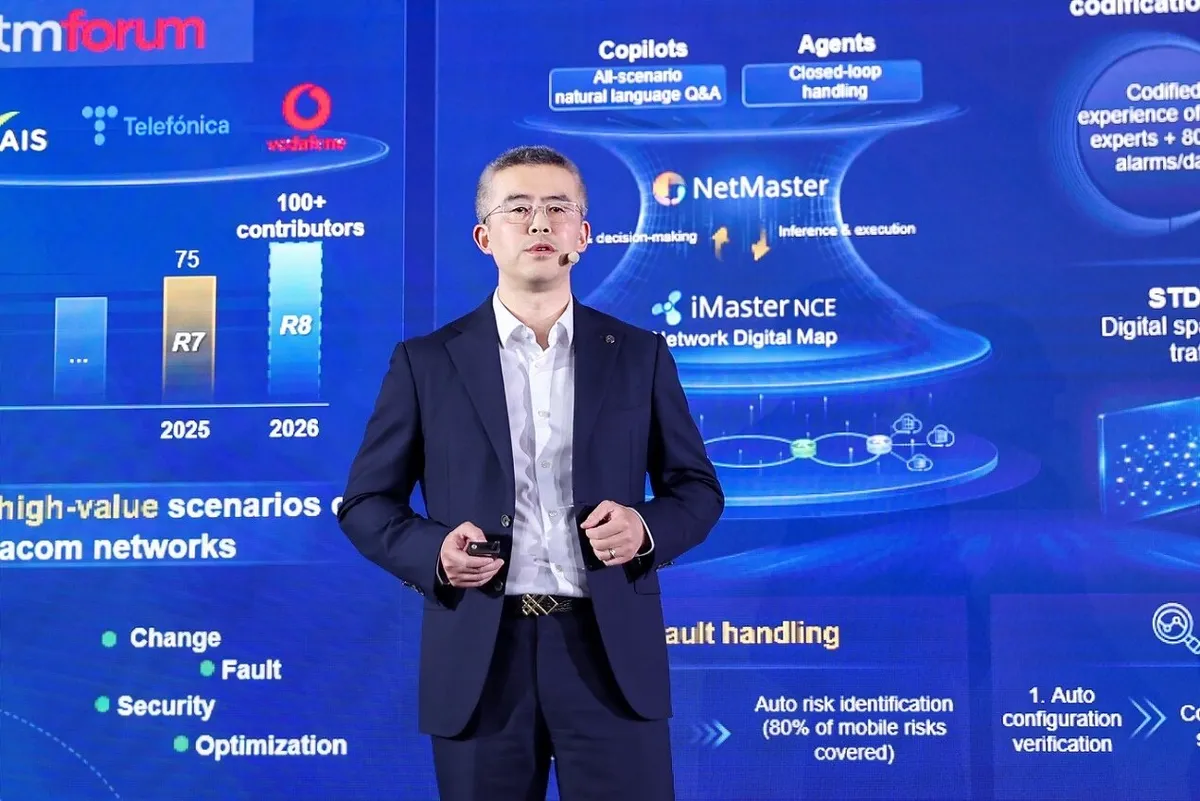
Huawei says its NG WAN Solution has entered full-scale commercialization, with more than 60 carriers worldwide now using it. The claim came from John Cai, Vice President of Huawei's Data Communication Product Line, in a keynote at the Net5.5G Intelligent IP Network Summit during UBBF 2026 in Vienna on October 13.
- Huawei says its NG WAN Solution has entered full-scale commercialization, with over 60 carriers worldwide deploying it.
- The claim was made by John Cai at the Net5.5G Intelligent IP Network Summit during UBBF 2026.
- Huawei claims its Starnet lossless algorithm delivers zero packet loss over 1,000 km with more than 96% remote computing efficiency.
- The company says a South African carrier is the world's first to reach AN L4 autonomy on an IP network.
- All performance figures are Huawei's own claims.
Keynote positions AI as an opportunity for carriers
According to Huawei, Cai described AI as a definitive opportunity in an uncertain future. He said the widespread deployment of the NG WAN Solution marks the full-scale commercialization of NG WAN. Huawei stated it hopes to work with industry stakeholders to strengthen what it calls a secure, resilient foundation and to drive shared growth in the AI era.
The company framed the solution around three areas: multi-layered security, lossless computing efficiency and network autonomy. All figures below are Huawei's own claims, taken from its announcement.
Security across device, link and service layers
Huawei says the solution builds a security system spanning the device, link and service layers.
- Device layer: The RDR solution uses independent Threat Protection Units (TPUs) and a multimodal behavior expert algorithm, running isolated from the router OS. Huawei says it detects over 95% of threats and can trace APTs within minutes. On the data plane, its proprietary NP and intelligent flow identification algorithm are said to achieve 1:1 traffic inspection, detect attacks in seconds and reduce DDoS risks by 90%. In over three months of use with a leading Chinese carrier, the TPUs thwarted 324 attacks from eight countries, according to Huawei.
- Link layer: The PQC algorithm is supported on all Huawei devices in all scenarios, boosting encryption performance by 40%. Huawei calls its built-in QKD solution the industry's first, saying it enables three-channel integration, cuts network construction costs by 60% and breaks the 80 km transmission distance limit. Huawei and a carrier in Macao unveiled what the company calls the world's first quantum-secured target network, which it says drove a 50% surge in private line revenue.
- Service layer: A "1+4" defense-in-depth approach reduces border DDoS attack response from 1 minute to under 5 seconds, according to Huawei. It also claims a 15% improvement in unknown threat detection, a 100% ransomware detection rate, and threat handling shortened to under 30 minutes via the CT-SOC.
Lossless computing for AI workloads
Huawei argues that intelligent computing is highly sensitive to packet loss, saying a loss of just 0.1% can cut computing efficiency by up to 55%. Its answer is AI Fabric, which aims to strengthen compute through network enhancements.
- A simplified two-layer multi-plane architecture expands network scale fourfold while reducing hardware usage by 30%.
- Network-wide NPLB reaches 98% link utilization and lifts training and inference performance by over 7%.
- The Starnet lossless algorithm achieves zero packet loss for transmission over 1,000 km with more than 96% remote computing efficiency.
Huawei says this lets carriers offer a local-like experience and speeds up ToB monetization. As an example, it says a Chinese carrier deployed the solution for a healthcare project, cutting hospital computing costs by 30% and driving a fivefold surge in private line ARPU.
Autonomous networks and what comes next
Huawei's "One Map, One Brain" autonomous network architecture is said to reach AN L4 across fault handling, network changes, network optimization and security protection. For network changes, closed-loop automation covers configuration verification, simulation and comparison. Security protection enables intrusion detection, attack tracing and one-click blocking within minutes. Huawei says multiple carriers have reached AN L4, and that a South African carrier became the world's first to reach this level of autonomy on an IP network.
For carriers, Huawei's pitch is that the solution shifts AI strategies from efficiency optimization to value creation. The company says it will work with industry partners to speed global adoption of the NG WAN Solution and help build secure, resilient, intelligent and efficient next-generation bearer networks. The performance and revenue figures come from Huawei and its customer examples, and the announcement does not include independent verification.