Huawei publishes European white paper on 10 Gbit/s smart campus networks
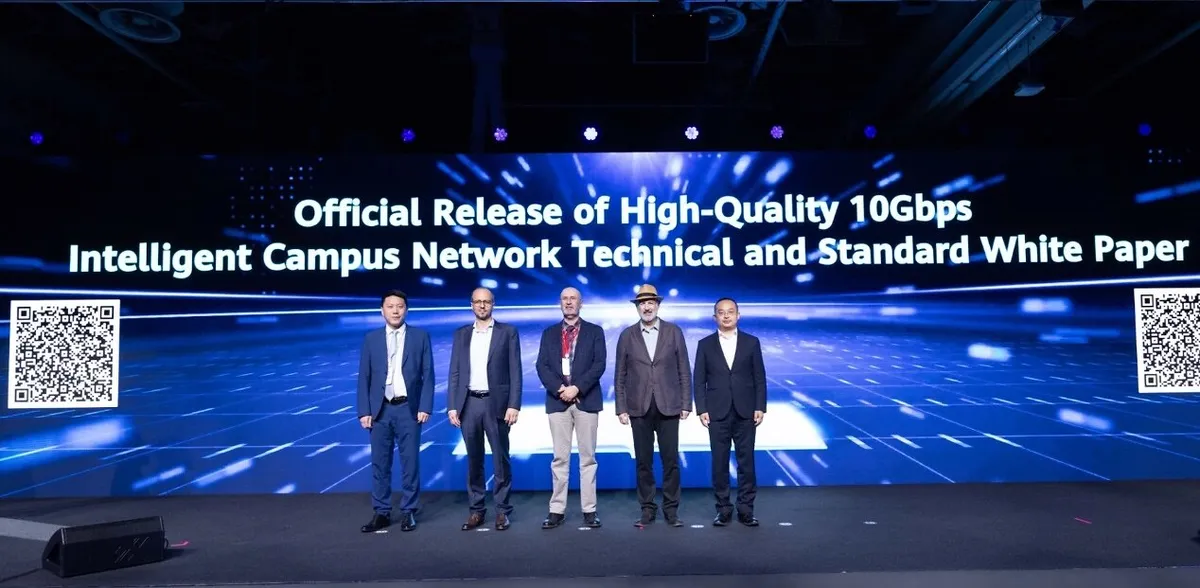
Huawei and industry organizations have published a technical and standards-oriented white paper on 10 Gbit/s smart campus networks at the company's 2026 network summit in Florence, Italy. At the same event, Huawei launched Stellar, an enhanced smart campus network solution.
- Huawei and industry organizations released a white paper on 10 Gbit/s smart campus networks at the 2026 network summit in Florence.
- The paper defines six core capabilities, including autonomous network, 10 Gbit/s ultra-wideband and comprehensive security.
- Huawei launched Stellar, built on Wi-Fi 7 Advanced, with quantum-resistant encrypted channels and the NetMaster large model.
- According to Huawei, automated operations cut mean time to repair by 90%.
What the white paper covers
According to Huawei, the white paper was produced with global industry organizations and pioneers. It targets sectors such as public services, education, healthcare and manufacturing. The document sets out construction goals, capability frameworks and reference solutions for building secure, intelligent campus networks running at 10 Gbit/s, for today and for the future.
The paper defines six core capabilities:
- autonomous network
- 10 Gbit/s ultra-wideband
- generalized connectivity
- deterministic experience
- energy savings
- comprehensive security
It also explains how to build a next-generation smart campus infrastructure using technologies such as multi-access-point coordination, Wi-Fi sensing, connected collaboration within the network and zero-trust security.
Participants in the launch ceremony included David Chen, vice president of Huawei's campus network domain, and Wei Qing, head of Huawei's enterprise solutions department in Italy. Philippe Breuils of Wifirst (managing director for Southern Europe), Rui Aguiar, president of NetworldEurope, and George Polyzos, president of the Datacom Industry Association, also took part.
Stellar: Huawei's enhanced campus solution
During the smart campus innovation session, Huawei introduced Stellar. Gibbs Wang, president of Huawei's global enterprise network marketing and solution sales department, said in his welcome speech that Stellar responds to the need for "une infrastructure de réseau de campus plus performante, plus sécurisée et plus intelligente", intended to support productivity gains at European companies.
Alex Sun, vice president of the campus network domain in Huawei's data communication product line, said campus networks are moving beyond being a pure connection infrastructure and evolving into an intelligent one. According to Huawei, Stellar offers ultrafast wireless connectivity, comprehensive security and network autonomy.
Huawei lists three main strengths:
- Ultrafast wireless: the solution uses Wi-Fi 7 Advanced to coordinate several access points and, according to Huawei, doubles network performance. It also applies a Wi-Fi+X concept so that wireless networks can work as a sensing system for smart spaces.
- Comprehensive security: Huawei says the solution blocks abnormal terminal behavior within seconds and pinpoints the source of anomalies. It also provides end-to-end encrypted, quantum-resistant channels to prevent data leaks.
- Network autonomy: a digital network map and Huawei's NetMaster large model enable automated operations and maintenance around the clock without expert intervention, which Huawei says cuts the mean time to repair by 90%. An energy-efficient network architecture also supports multidimensional optimization of power consumption.
What comes next
Huawei says it will work with European innovators, industry organizations and ecosystem partners to apply the white paper's concepts and technologies in more campus scenarios. The stated aim is to help customers build smart campus networks that are higher quality, more sustainable and easier to maintain.
For organizations in the targeted sectors, the white paper offers a reference framework for planning 10 Gbit/s campus networks, while Stellar is Huawei's product answer to those goals. The performance and repair-time figures come from Huawei itself, and the source gives no pricing or availability details for Stellar.