IEC and ISO push AI standards from principle to practice at AI for Good
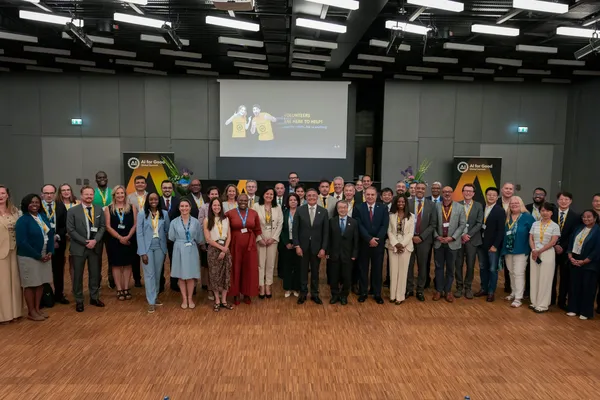
The IEC and ISO used the AI for Good Global Summit in Geneva to argue that international standards can link AI ambition to practice, from data centre energy use to human rights impact assessment. According to the IEC, the workshop showed broad support for a pilot project that would test standards against legal frameworks in a real deployment.
- The IEC and ISO held two sessions at the AI for Good Global Summit in Geneva in July 2026.
- The IEA's Thomas Spencer said data centre electricity consumption rose around 17 percent last year, more than five times faster than total electricity consumption.
- ISO/IEC 42001 covers AI management systems, while ISO/IEC 42005 guides impact assessment of a specific AI system.
- Workshop participants broadly supported an IEC and ISO pilot testing standards against frameworks such as HUDERIA.
Two sessions, two questions
According to the IEC, questions about AI are no longer limited to what models can do. Grid operators ask where electricity for the next wave of data centres will come from. Ministries ask how to buy an AI system without inheriting hidden risks. Human rights bodies ask how algorithms used in welfare, policing or hiring affect the people on the receiving end.
The IEC says what is often missing is the layer that turns ambition into something an engineer can build, an auditor can check and a regulator can rely on. At the summit in July 2026, the IEC and ISO convened two sessions to address this gap with industry, civil society and regulatory authorities.
Data centres and the energy question
The first session, From data centres to climate goals: International standards for a more energy-efficient AI, was moderated by Priyanka Dasgupta of the IEC. Speakers came from the International Energy Agency, the UK Department for Energy Security and Net Zero, Energy Unlocked and Eaton.
Thomas Spencer of the IEA offered one figure: "We estimate that their electricity consumption increased by around 17 percent last year, growing more than five times faster than total electricity consumption," he said of data centres. Speakers stressed planning rather than alarm. They named rising demand, grid capacity limits, access to clean power and the difficulty of measuring energy use as pressing challenges.
Laura Schade of the UK department, who also discussed the work behind a new IEC Strategic Position Paper on Data Centres, said: "We should stop seeing data centres just in terms of energy demand, but we should look at them in terms of systems that can enable decarbonization." The source notes that data centres can offer flexibility and demand response to the grid, and that AI can help optimize networks and integrate renewable energy. Unmanaged growth, however, could put serious pressure on climate commitments.
According to the IEC, international standards and conformity assessment already provide a shared way of measuring efficiency and carbon footprint, and of setting key performance indicators. An upcoming Strategic Position Paper on "Clean green data centres" identifies gaps in standardization on sustainability and safety. Ongoing IEC work covers cleaner cooling, water use, e-waste and lifecycle emissions.
Operationalizing AI impact assessment
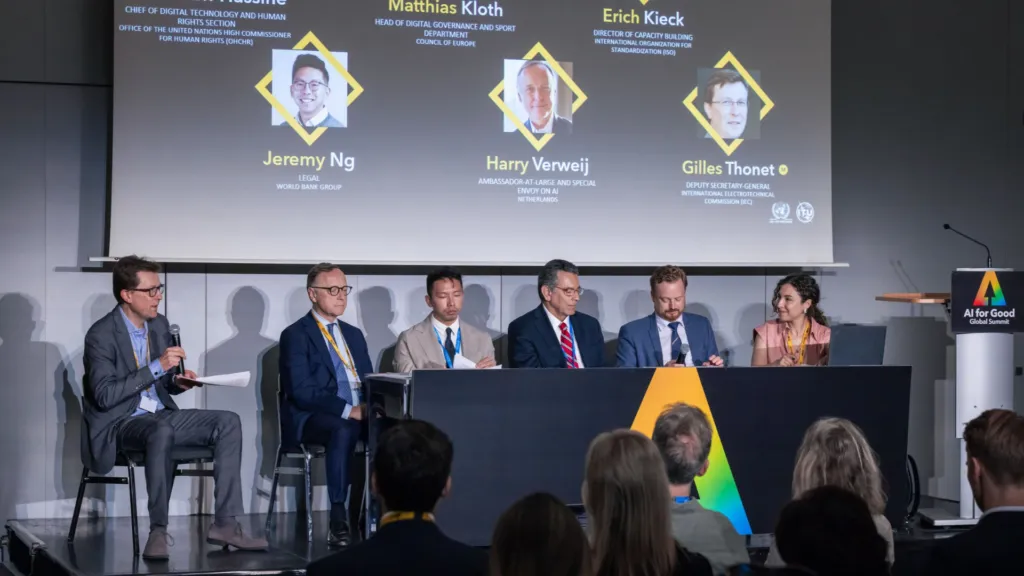
The second session was an IEC/ISO workshop on Operationalizing AI Impact Assessment: The interplay between law-based frameworks and international standards. It was moderated by Gilles Thonet, IEC Deputy Secretary-General. Panellists came from OHCHR, the Council of Europe, ISO, the World Bank Group and the Netherlands, represented by its Ambassador-at-Large and Special Envoy on AI, Harry Verweij.
One message stood out: "AI governance requires collaboration across legal, policy, human rights and technical communities if implementation is to be effective." The Council of Europe presented its Framework Convention on AI and HUDERIA, its methodology for assessing AI impacts on human rights, democracy and the rule of law. Speakers saw standards as a natural partner, offering structured processes and a common vocabulary.
Two ISO/IEC standards from the joint committee JTC 1/SC 42 were central:
- ISO/IEC 42001 sets requirements for an AI management system, covering governance, accountability and risk management inside an organization.
- ISO/IEC 42005 gives guidance for assessing the impacts of a specific AI system in its real deployment context.
ISO also shared results of its Capacity Building Journey on AI Policy and Standards, which brings regulators and national standards bodies together.
From principle to practice, and a proposed pilot
An expert session moved from policy to implementation, with speakers from the Council of Europe, Egypt's Ministry of Communications and Information Technology, the UK Department for Science, Innovation and Technology, the World Bank Group, OHCHR and the German Accreditation Body DAkkS. Key insights included that governments are moving from writing AI policy to implementing it, and that public procurement is a powerful lever for responsible AI deployment.
Participants also distinguished two tools. Certification to ISO/IEC 42001 shows an organization has governance processes in place. Understanding what a system does to people in a given setting needs context-specific assessment, supported by ISO/IEC 42005.
The workshop's most concrete outcome was broad support for a proposed IEC and ISO pilot project. It would apply international standards on AI management, risk and impact assessment to a real-world AI deployment, then map the results against legal frameworks such as HUDERIA to test how well they fit together.
Thonet said: "The real opportunity now is to turn these theoretical concepts into concrete actions: to test these approaches in real-world settings, assess their impact in practice, and learn what works." Participants saw value in evidence on interoperability, better support for public-sector procurement, assessments that can be compared across jurisdictions, and practical learning for institutions building capacity.
ITU AI for Good: Connecting the dots to trustworthy AI: IEC at AI for Good 2026