Illumina launches BioInsight Platform to unify genomic analysis, AI and data
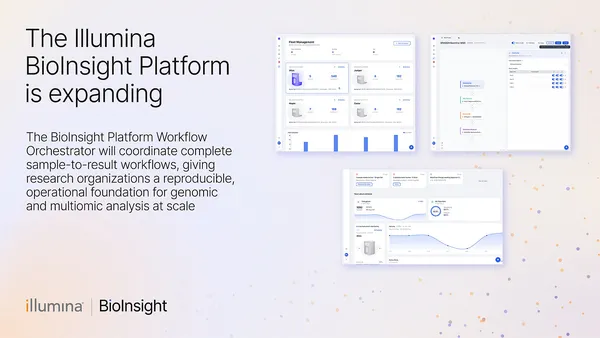
Illumina has debuted the BioInsight Platform, which the company describes as its first unified software environment for turning genomic and multiomic data into biological evidence. The platform combines analysis applications, purpose-built AI and curated datasets, and includes the newly released DRAGEN v4.6.
- Illumina debuted the BioInsight Platform, its first unified software environment combining analysis, AI and curated data.
- DRAGEN v4.6 adds deployment options, including DRAGEN software mode, for supported cloud and standard CPU environments.
- The newly announced SpliceAI2 model targets rare disease research.
- Usage-based BioInsight Credits replace traditional annual subscriptions, according to Illumina.
- A free trial is available, and Illumina will present the platform at ASHG in Montreal, booth #701.
One environment for software, AI and data
According to Illumina, the BioInsight Platform brings its analysis applications, AI innovations and curated data resources together in a single environment. The aim is to reduce the need for researchers to assemble and manage separate informatics tools as their research questions change. The business unit now offers its data, AI and software portfolio through a single sign on.
The platform covers Illumina's informatics applications, including DRAGEN, Emedgene, Connected Multiomics, BioInsight Platform Core, BaseSpace and BioInsight Data. Illumina says it is replacing traditional annual subscriptions with a usage-based model called BioInsight Credits. The company says this lets researchers adopt the capabilities most relevant to their work while keeping the flexibility to evaluate new technologies.
Rami Mehio, senior vice president and general manager of BioInsight at Illumina, said the platform offers customers "one simple place to access the full breadth of our offerings across software, AI, and data." He added that customers will also get access to new capabilities in the future.
Illumina's BioInsight business unit was created one year ago. The company says it was set up to address a gap: next-generation sequencing has made it easy to generate genomic and multiomic data, but the scale and complexity of those datasets make it harder to turn them into insight efficiently.
Genomic AI and curated datasets
The platform gives researchers access to Illumina's genomic AI portfolio, including the newly announced SpliceAI2 model for rare disease research. The BioInsight AI Lab, the research arm of BioInsight, applies multiomic data and AI to variant effect prediction, variant effect prioritization and the training of biological foundation models. According to Illumina, the models are built for genomics and help researchers identify, prioritize and interpret relevant signals across increasingly complex datasets.
On the data side, the platform includes curated datasets for research in oncology, rare disease, population health and multiomics. BioInsight Data converts public and proprietary datasets into what Illumina calls a harmonized, annotated and reusable scientific catalog. The datasets are continuously updated, and Illumina says they let researchers contextualize findings across studies and generate new hypotheses.
The BioInsight business also runs programs such as the Billion Cell Atlas, which connects proprietary data with biopharma partners to support drug discovery and development.
DRAGEN v4.6 widens deployment options
DRAGEN v4.6, included with the platform, expands where researchers can run Illumina's secondary analysis software. Illumina points out that data-residency requirements, infrastructure limitations and operational needs can affect where genomic analyses take place. New deployment options, including DRAGEN software mode, allow organizations to run DRAGEN across supported cloud and standard CPU environments. The company says v4.6 delivers consistent analysis across these supported environments.
One example comes from the Global Parkinson's Genetics Program (GP2), a resource program of Aligning Science Across Parkinson's (ASAP) in partnership with The Michael J. Fox Foundation for Parkinson's Research. According to Illumina, DRAGEN is supporting approximately 170 active research projects on the genetic basis of Parkinson's disease in collaboration with GP2. Andrew Singleton of GP2 said the combination of speed and scalability "allows us to focus more on scientific questions and less on operational bottlenecks."
Availability and what it means for researchers
For research teams, the launch points to a consolidated way to access Illumina's analysis tools, AI models and datasets, paid for by usage rather than an annual subscription. The wider deployment options in DRAGEN v4.6 may matter to organizations with data-residency or infrastructure constraints, since the software can run in supported cloud and standard CPU environments.
Illumina will showcase the BioInsight Platform at the American Society for Human Genetics annual meeting in Montreal, at booth #701. Researchers can sign up for a free trial of the platform. The source does not give pricing for BioInsight Credits.