In-House Legal Teams Report AI Savings and Expect the End of the Billable Hour
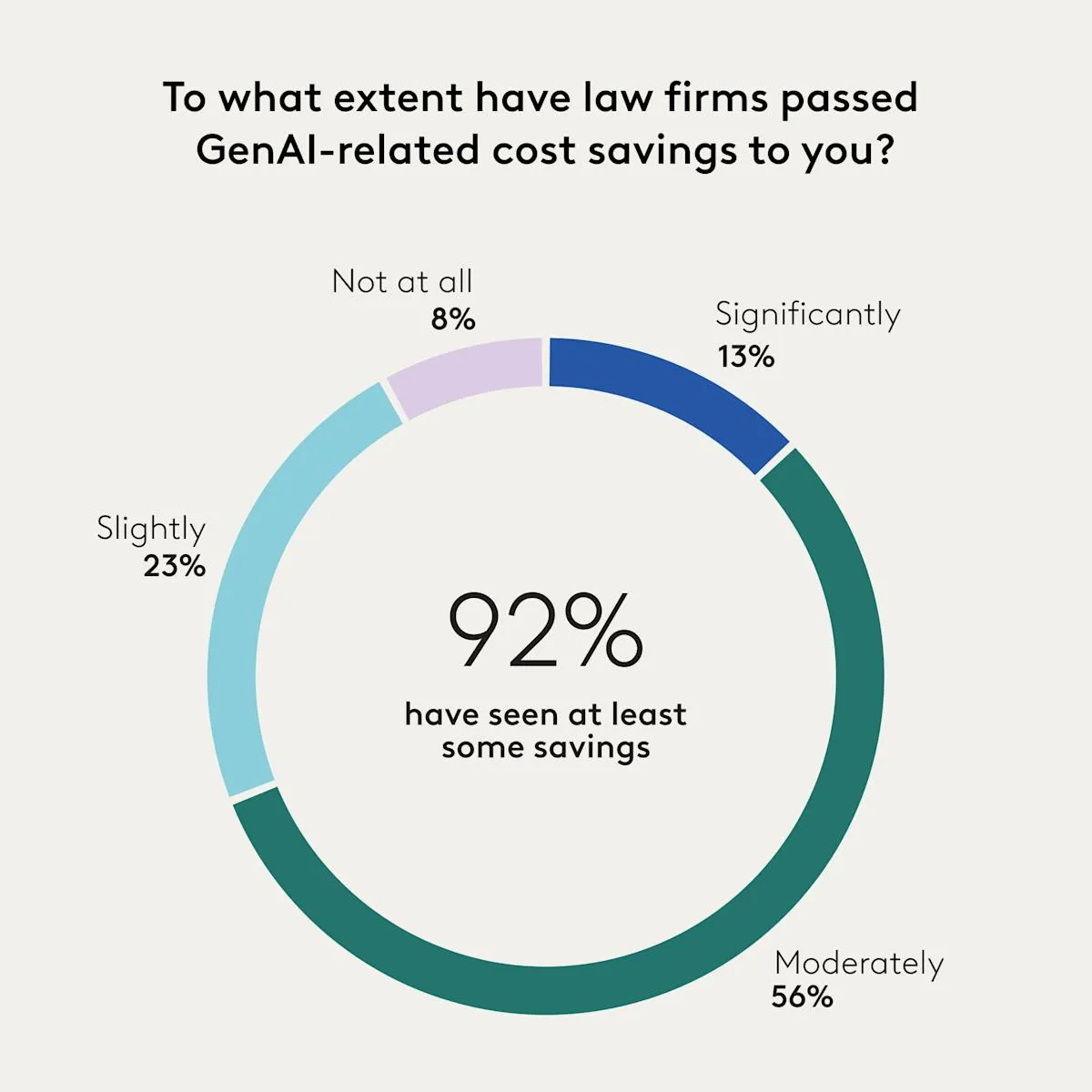
Most corporate legal teams now use generative AI and say it saves money, according to a survey of 300 in-house legal professionals released by Everlaw with Wakefield Research. Respondents also expect outcome-based pricing to replace the billable hour within years, not decades.
- Everlaw and Wakefield Research surveyed 300 in-house legal professionals: 86% use generative AI and 92% see measurable cost savings.
- 54% have already cut the work sent to outside counsel, and 44% plan to start within a year.
- 81% expect most legal work to be priced by outcome within five years, and 47% say within three.
- Accuracy and alignment is the top concern at 80%, and a third have seen fabricated evidence or non-existent case law in litigation.
- 68% prioritize staff training and 53% internal AI governance and policies.
Wide adoption and measurable savings
In the survey, 86% of respondents said they use generative AI tools for legal work, and 92% said they are seeing measurable cost savings. According to Everlaw, part of the savings comes from teams handling more work internally instead of passing it to outside counsel. The survey also notes that 0% of respondents have no plans to test or use generative AI in the next year.
Everlaw Chief Legal Officer Gloria Lee said: "AI tools are making in-house teams more efficient and productive." She added that the tools also help with tasks that were not possible before, such as using AI to harvest inventions for patent disclosures.
Less outsourcing, more strategic roles for law firms
The report finds that 54% of respondents have already reduced the volume of work they send to outside counsel because of AI. Another 44% intend to start cutting back within the next year. Everlaw reads this to mean that nearly everyone will delegate less work to outside firms in 2027.
Lee said the decline will mainly affect the lowest-value tasks, where clients need outside counsel's labor more than its specialized expertise. "AI rebalances the relationship between clients and their law firms," she said.
Awareness of law firms' AI use has also changed. In Everlaw's 2025 research, nearly three-fifths of in-house professionals did not know whether their firms used AI at all. In 2026, only 8% say they have not experienced savings from their firms' use of generative AI. Among respondents, 13% report significant savings, 56% moderate and 23% slight.
Outcome-based pricing expected soon
Respondents widely predict a shift away from time-based billing. Eighty-one percent say that within five years most legal work will be priced by outcome rather than hours worked, and 47% say this will happen in only three years. Only 1% think it will take more than a decade, and 0% chose "Will never happen."
Lee said both clients and firms are still hesitant to act. "Clients have the ability to drive the shift to outcome-based billing," she said, pointing to their motivation of considerable cost savings and their power to reduce dependency on outside firms.
Accuracy and skills remain top concerns
Adoption comes with worries. Accuracy and alignment is the top concern, cited by 80% of respondents. Another 72% worry that non-lawyers will rely on AI for legal advice that may be error-prone. A third of respondents say they have seen fabricated evidence or non-existent case law in litigation. Seventeen percent have seen AI-related errors from opposing counsel, 12% from their own team and 7% from a witness.
Another 63% fear that overreliance on generative AI will erode human skills. In response, 68% of teams say they prioritize staff training, and 53% will focus on internal governance, compliance and policies for AI usage in the year ahead.
What it means for legal teams
Based on the findings, Everlaw argues that the change from generative AI is already here and that relationships between law firms and corporate clients will have to evolve. Teams will also need to decide where automation is most useful and how to keep accuracy and accountability for machine-generated outputs. The full findings are in the In-House Innovation Report: Corporate Teams Gain ROI and Leverage, which Everlaw offers as a free download.